
Most nontraditional applicants reach matriculation several months to multiple years after deciding to apply, and the single biggest variable is how many prerequisites you still need to complete. Work status, MCAT prep time, and clinical hours matter too, but missing chemistry and biology courses is what stretches a plan from “next cycle” to “several years out.” Read the timeline buckets below to find the range that actually matches your starting point.
TL;DR:
- Completing key prerequisites like organic chemistry and biochemistry can extend your timeline to 18 to 36 months if you need to take multiple sequential courses.
- Formal post-baccalaureate or SMP programs are recommended when missing most prerequisites or when aiming to fix an academic record, adding one to four years to the process.
- Taking the MCAT during the same year as your application submission is critical to remain competitive and avoid delays, especially for working applicants.
- Building clinical hours through consistent, longitudinal roles and requesting letters well in advance strengthen your application without needing to quit your job.
- Setting early deadlines for transcripts, recommendations, and application components helps prevent last-minute errors that could delay your medical school admission.
Table of Contents
- What Counts as a Nontraditional Med School Timeline, and Why It Changes Your Plan
- Which Nontraditional Med School Timeline Bucket Matches Your Starting Point?
- The Month-by-Month Plan for a Working Applicant
- Post-Bacc and SMP Options: How They Change Your Nontraditional Med School Timeline
- When Should You Take the MCAT in a Nontraditional Timeline?
- How to Build Clinical Hours, Research, and Letters While Working Full Time
- Application Season Checklist: Deadlines You Set for Yourself
- Interview Season While You’re Still Employed
- What If You Need a Repair Year or a Second Cycle?
- Turning This Plan Into a Tracked Timeline You Actually Follow
- A Real Week From an 18-Month Working Applicant
- Ready to Stop Guessing and Start Tracking Your Timeline?
- Sources
What Counts as a Nontraditional Med School Timeline, and Why It Changes Your Plan
A nontraditional applicant is anyone who doesn’t follow the straight-through path of college, then medical school. That covers a lot of ground, and the label matters because it changes how you plan.
Career changers left another field entirely (finance, teaching, engineering, the military) and often need most or all of their science prerequisites from scratch. Gap-year applicants finished their prerequisites as undergrads but took one or more years off before applying, usually to work, do research, or gain clinical exposure. Reapplicants already went through at least one cycle without an acceptance and need to identify and fix what held them back. Post-bacc students are formally enrolled in a structured program designed to complete missing coursework, often with pre-health advising built in.
Admissions committees don’t penalize any of these paths on principle. What they evaluate is recency of academic performance, coherence of your narrative (why medicine, why now), and whether your experience is substantive rather than performative. A 15-year-old organic chemistry grade carries less weight than a strong post-bacc transcript from last year. A single shadowing weekend carries less weight than 18 months of longitudinal clinical work.
Here’s where the timeline math actually starts: chemistry and biology sequences run sequentially, not in parallel.
- General chemistry must precede organic chemistry, which typically precedes biochemistry.
- Most schools require a year of each with lab components, which locks you into fall/spring academic terms even if you’re highly motivated.
- Miss a fall start and you can lose an entire year waiting for the next sequence to open.
This sequencing constraint is why Michigan Medicine’s guidance for nontraditional applicants flags prerequisite planning as the first thing to sort out, before MCAT prep or shadowing hours. If you’re missing more than two or three prerequisites, a formal post-bacc program is usually faster and less risky than assembling courses on your own at a local university, mostly because you avoid the gamble of a canceled section or a full waitlist derailing your year.
Which Nontraditional Med School Timeline Bucket Matches Your Starting Point?
Every nontraditional path collapses into roughly four starting positions. Find yours below.
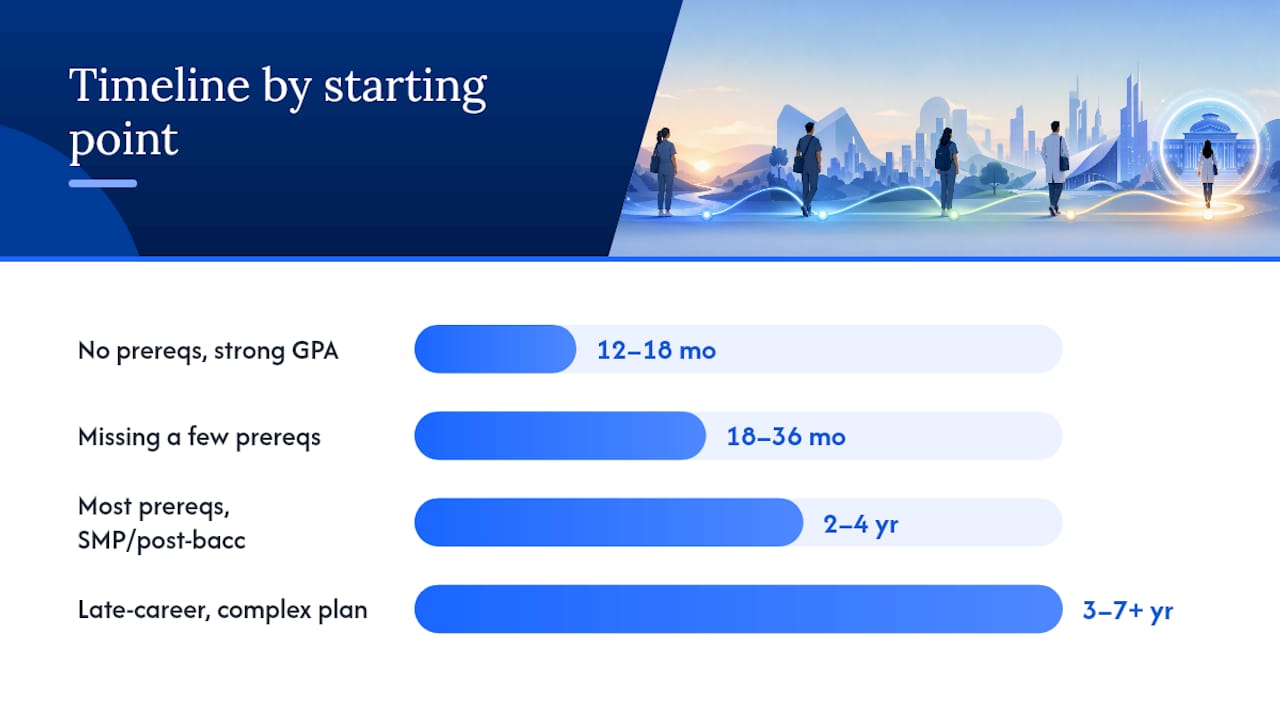
No prerequisites left, strong GPA: 12 to 18 months. If you already have every required science course and a competitive GPA, your timeline is really an application timeline, not an academic one. You’ll spend the first few months building your MCAT score, request letters of recommendation, and draft your personal statement. Submission happens in June, secondaries roll in through July and August, interviews run from September through February, and you’d start medical school the following fall. This is the shortest realistic nontraditional med school timeline, and it’s the one most gap-year applicants fall into.
Missing a few prerequisites: 18 to 36 months. This is the most common bucket, and it’s where sequencing bites hardest. If you need organic chemistry and biochemistry but already have general chemistry and biology, you’re looking at two to three semesters of coursework before you can even schedule the MCAT with confidence. Add a summer for MCAT-dedicated study and you land in the 18 to 36 month range depending on whether courses run consecutively or you hit a scheduling gap.
Missing most or all prerequisites, likely doing a post-bacc or SMP: 2 to 4 years. Career changers coming from unrelated fields typically fall here. A structured post-baccalaureate program takes one to two years depending on pacing, and a Special Master’s Program (SMP) adds another year on top if you’re using it to strengthen a weak science GPA rather than fill prerequisite gaps. Add the application year itself, and you’re realistically at two to four years from your decision date to your first day of medical school.
Late-career, multi-year plan with family or financial complexity: 3 to 7+ years. This bucket includes applicants managing a mortgage, kids, aging parents, or a spouse’s career, all of which affect how fast you can move through coursework and how much travel you can absorb during interview season. It also includes people restarting after a first failed cycle. There’s no shortcut here, but there is a manageable structure, which the ResidencyAdvisor timeline for working applicants lays out phase by phase.
A quick gut check: if you can’t name every prerequisite you’re missing right now, you don’t actually know which bucket you’re in. That’s the first task, before MCAT prep, before shadowing, before anything else.
The Month-by-Month Plan for a Working Applicant
This is the schedule to steal if you’re holding down a full-time job and applying inside an 18-month window. It’s built around five phases, each with a distinct focus, so you’re never trying to do MCAT prep and prerequisite finals in the same month.
- Phase 0, months -18 to -15: audit and commit. Pull your transcript and map every prerequisite against your target schools’ specific requirements (some want biochemistry, some don’t; some accept AP credit, others don’t). Have the money conversation now: post-bacc tuition, MCAT prep materials, application fees, and secondary fees can total several thousand dollars before you ever submit AMCAS. Talk to your employer about flexibility for exam days and potential interview travel.
- Phase 1, months -14 to -10: finish critical prerequisites, light MCAT warm-up. This is your heaviest academic load. Take one evening or weekend course per term, prioritizing whichever science course has the longest downstream sequence (usually chemistry). Spend 3 to 5 hours a week on passive MCAT content review, mostly to identify weak areas early.
- Phase 2, months -9 to -4: ramp to dedicated MCAT study. Once prerequisites are done or nearly done, MCAT prep becomes your primary evening and weekend activity. Budget 10 to 15 hours a week early in this phase, climbing toward 20 to 25 hours a week in the final six weeks before your test date.
- Phase 3, months -3 to 0: test and pivot to the primary application. Take the MCAT before the end of the spring of your application year. Immediately shift your energy to your personal statement, activities section, and letter requests, since AMCAS opens in early May and verification takes several weeks.
- Phase 4, months 1 to 9 after submission: secondaries and interviews while employed. Secondary essays arrive fast, often within two weeks of your primary submission. Interview invitations follow from late summer through winter. This phase is unpredictable, so build slack into your calendar rather than filling it.
A sustainable weekly rhythm during Phase 2 looks like this: two 2 hour weekday study blocks, one 4 hour Saturday practice test or review session, and a Sunday reserved for logging hours and handling application admin. That’s roughly 12 to 16 hours a week, which is demanding but survivable alongside a 40 hour job.
Build in buffer time everywhere. Transcripts take two to four weeks to process once ordered. Letter writers, even generous ones, often need six to eight weeks of lead time before they actually deliver a letter. If you request a letter the week you need it, you’ve already made a scheduling error you can’t fully recover from.
Pro Tip: Block your MCAT test date on your calendar before you build the rest of the study schedule, then work backward. Most working applicants who miss their target test date do it because they scheduled study time first and let the exam date drift, not the other way around.
Post-Bacc and SMP Options: How They Change Your Nontraditional Med School Timeline
Not every gap in your transcript needs a formal program, but once you’re missing more than a handful of prerequisites, structure usually beats improvisation.
Formal (career-changer) post-baccalaureate programs are built for people with little or no prior science coursework. They typically run one year at an accelerated pace or two years part-time, cover the full prerequisite sequence, and often include structured advising and committee letters, which matter a great deal to admissions committees evaluating a nontraditional file.
Academic record-enhancer post-baccs target applicants who already have their prerequisites but need to demonstrate improved academic performance, usually after a rocky undergraduate GPA.
Special Master’s Programs (SMPs) are graduate-level programs, typically one to two years, designed to prove you can handle medical school level coursework. Some carry linkage agreements with affiliated medical schools, which sound appealing but deserve scrutiny.
- Check whether the program reports grades directly to AMCAS as graduate coursework, since this affects how your GPA recalculates.
- Ask what percentage of a cohort actually uses a linkage agreement versus applying broadly, not just the headline acceptance rate.
- Compare stated outcomes against the GPA and MCAT thresholds required to qualify for that outcome. Shemmassian Consulting’s guidance for nontraditional applicants points out that strong linkage numbers often reflect a highly selective admitted cohort, not a guarantee for anyone who enrolls.
- Review program pages directly, like Georgetown’s SMP, to compare curriculum structure and stated outcomes before applying.
Enrollment should accelerate your timeline when it consolidates two or three years of piecemeal coursework into one structured year with built-in advising. It becomes a deliberate delay when you enroll mainly for the prestige of a name-brand linkage program rather than genuine curricular fit. Match the program to your actual gap, not to its marketing page.
When Should You Take the MCAT in a Nontraditional Timeline?
Take the MCAT during the same academic year you plan to submit your primary application, not the year before “just to get it out of the way.” Scores that sit too long can raise questions about currency, and testing too late creates a much bigger problem: it delays your submission into a less competitive part of the cycle.
For working applicants, plan a staged 9 to 12 month runway. Start with a 6 to 10 hour weekly baseline for content review and light practice, then expand to 15 to 25 hours a week in the final 8 to 12 weeks before your test date. That expansion usually requires cutting back other obligations temporarily, which is easier to negotiate with an employer when you plan it months in advance rather than announcing it two weeks out.
For full-time students or applicants on a dedicated gap year, a focused 3 to 6 month block works, since you can front-load 20 to 30 hours a week without competing against a job.
Timing checkpoint: working applicants following the ResidencyAdvisor phased model should aim to schedule the MCAT no later than late April or early May of their application year. Testing later risks pushing your primary submission into July or August, well past the ideal early-June window for rolling-admissions schools.
Choosing a test date is really a risk calculation. Score release typically takes several weeks, and if you test late and your score comes back lower than expected, you have almost no time to retake before application season closes out. Build one retake buffer into your calendar even if you don’t expect to need it.
How to Build Clinical Hours, Research, and Letters While Working Full Time
You don’t need to quit your job to build a competitive application. You need continuity, not volume.
Admissions committees consistently favor one meaningful, longitudinal role over five scattered one-day shadowing experiences. A weekend hospice volunteer shift held for a year tells a stronger story than a dozen unrelated single-day exposures.
- Evening and weekend clinical roles work well for full-time employees: scribing, hospice volunteering, EMT shifts, and community clinic support all run outside standard business hours.
- Remote or async research roles, including data analysis, literature review, or manuscript support, let you contribute meaningfully without being on-site during the workday.
- Observerships condensed into a single week of vacation time can round out clinical exposure if your current schedule doesn’t allow ongoing shifts.
- Letters of recommendation need six to eight weeks of lead time minimum. Ask supervisors and professors who know your work well, not just the most senior name available, and give them your resume, personal statement draft, and a summary of what you’d like them to speak to.
Log hours consistently as you go rather than reconstructing them months later. A dedicated system for tracking clinical hours keeps dates, supervisor contacts, and hour totals accurate, which matters when AMCAS asks for exact figures a year or two after the fact.
Application Season Checklist: Deadlines You Set for Yourself
Official deadlines are the floor, not the target. Build your own earlier deadlines into every step.
- Confirm portal opening dates through AAMC each cycle. AMCAS, AACOMAS, and PostBacCAS each publish their own submission windows, and AAMC’s official guidance is the authoritative source, not a forum post or a program’s marketing page.
- Order transcripts the moment your final grade posts, since processing regularly takes two to four weeks and every school you attended needs to send one separately.
- Request letters of recommendation eight weeks before your personal deadline, not the official one, and follow up with a polite check-in at the four-week mark.
- Set your personal submission deadline several days to a few weeks ahead of the actual portal deadline. ResidencyAdvisor’s post-bacc timeline guidance frames this as the single habit that prevents last-minute document failures.
- Verify program-specific dates directly on program pages, since sample calendars (like the University of Colorado’s structured cohort dates) vary year to year and school to school.
- Watch for portal glitches during peak submission weeks in late May and June, when traffic spikes cause processing delays that have nothing to do with your file being incomplete.
Interview Season While You’re Still Employed
Interview invitations typically arrive with two to four weeks of notice, sometimes less for virtual formats. That’s tight if you need PTO approval, so flag your availability with your employer as soon as you submit secondaries, not after an invite lands in your inbox.
- Request time off in blocks rather than single days when you can, since travel and prep eat more time than the interview itself.
- Set up a quiet, well-lit space for virtual interviews in advance rather than scrambling the morning of.
- Frame your career change in three beats: what you did, what pulled you toward medicine, and what transferable skill you’re bringing (project management, patient communication, resilience under pressure).
- Prepare for the standard nontraditional-specific question, “why now, and why not earlier,” with a specific, honest answer rather than a rehearsed deflection.
Pro Tip: Practice your career-change narrative out loud with a timer. If you can’t explain the pivot in under 90 seconds, an interviewer will lose the thread halfway through.
What If You Need a Repair Year or a Second Cycle?
Not every nontraditional applicant matches on the first attempt, and a second cycle isn’t a sign the plan failed. It’s a sign the plan needs one more targeted pass.
A repair year should be surgical, not a repeat of everything. Focus on the specific weakness: retake courses if your science GPA was the issue, add a semester of longitudinal clinical work if your experience read thin, or retest the MCAT if your score sat below your target schools’ medians.
- Get a clear-eyed read on why your last cycle didn’t result in an acceptance before repeating anything.
- Budget for another year of tuition, application fees, and possibly reduced income if you’re cutting work hours to study.
- Talk with family early about what another year means for shared finances and time, especially if a repair year overlaps with other commitments.
- Change strategy only when the data supports it. If your numbers are competitive and you simply applied to a poorly matched school list, the fix might be a smarter school selection approach rather than another year of coursework.
Turning This Plan Into a Tracked Timeline You Actually Follow
A spreadsheet works until you’re juggling six prerequisite courses, three letter writers, an MCAT date, and fifteen school deadlines at once. That’s usually the point where something falls through.
A working timeline tracker needs a handful of core fields: prerequisite completion status per course, transcript request and delivery dates, your MCAT study milestones and test date, clinical and research hour totals, letter of recommendation status per writer, and each target school’s specific deadline.
For the 18-month working applicant plan, that means setting milestones at each phase transition (end of prerequisite coursework, start of dedicated MCAT study, submission date, secondary deadlines) with buffer reminders triggered two weeks ahead of each one, not on the day itself.
- Readiness scoring works by comparing your current status against what competitive applicants in your target range typically have, then flagging the gap so you know what to fix first.
- A weak clinical-hours score, for instance, tells you to prioritize shifts this month rather than another MCAT practice test you don’t need yet.
- Milestone dashboards catch the quiet failure mode of nontraditional planning: forgetting a small task, like a single missing transcript, until it blocks your entire submission.
- Mobile access matters here specifically because working applicants are managing this timeline in stolen moments, not at a desk, which is where a tool built for iPhone and iPad earns its keep over a static document.
Medschoolpilot’s readiness tracker was built around exactly this problem: too many moving parts, self-reported across scattered documents, with no single view of where you actually stand.
A Real Week From an 18-Month Working Applicant
Here’s what a realistic week looks like during Phase 2, the dedicated MCAT push. Monday and Wednesday evenings: two hours each of MCAT practice, mostly weak-section review. Saturday: a four-hour block, split between a practice test and review. Sunday morning: one hour to log clinical hours from the weekend hospice shift and update application tracking.
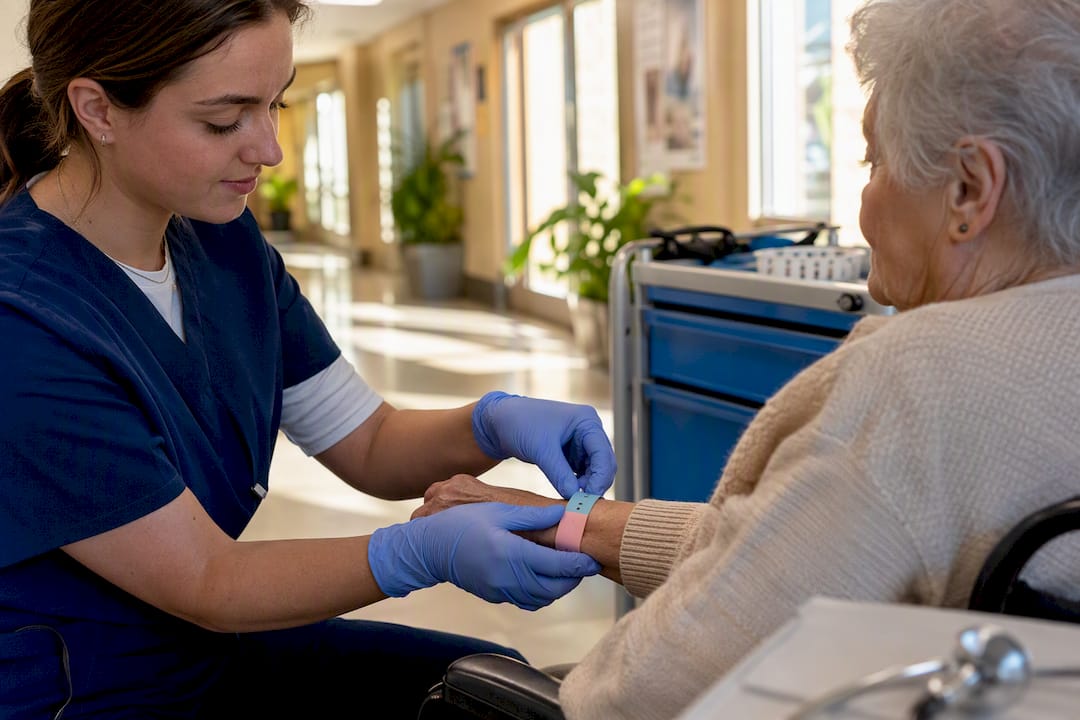
That’s roughly 13 hours a week on top of a full-time job, which is sustainable if you protect it like any other recurring commitment.
Interview requests, when they came, got scheduled with a built-in 48-hour buffer before and after, so a delayed flight or a rough day at work never collided directly with a med school interview. One habit made the biggest difference: reviewing the coming week every Sunday night and moving anything that wasn’t going to happen instead of letting it quietly slip.
— MedSchoolPilot
Ready to Stop Guessing and Start Tracking Your Timeline?
Every plan in this guide works better when it’s actually tracked instead of scattered across a notebook, a spreadsheet, and half-remembered conversations with your letter writers. Medschoolpilot’s readiness tracker was built for exactly this: one workspace holding your prerequisite grid, MCAT milestones, clinical hour logs, letter status, and school-specific deadlines, with a scoring system that flags your weakest area before it becomes a last-minute scramble.
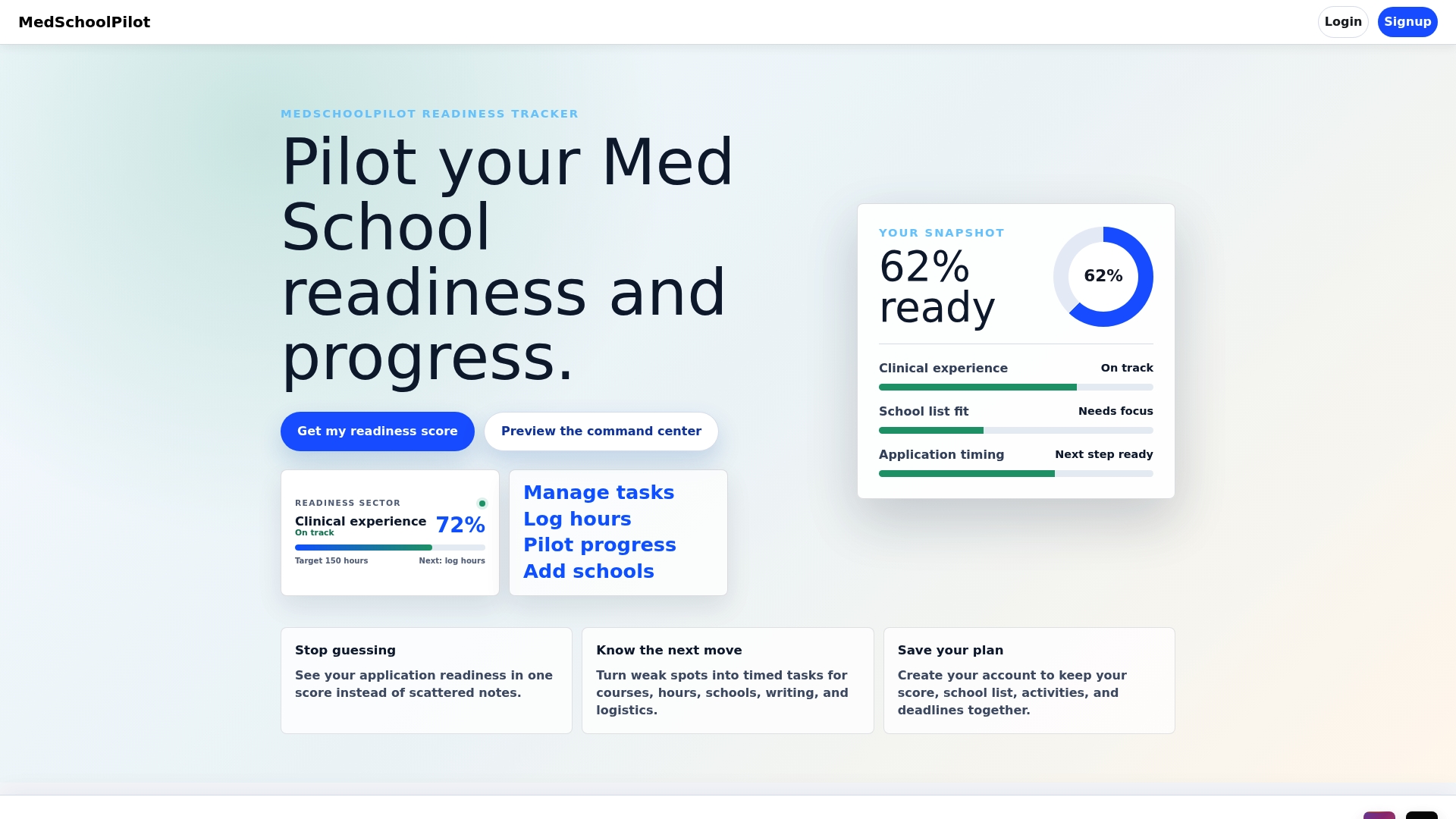
It fits three groups especially well: working applicants managing an 18-month plan around a full-time job, post-bacc or SMP enrollees juggling coursework alongside application prep, and late-career switchers coordinating a multi-year plan with family obligations. Instead of five disconnected tools, you get one dashboard that turns your timeline into a set of trackable, dated tasks.
Start by mapping your own prerequisite gaps and milestones against your target schools at Medschoolpilot, and see exactly where your readiness score stands today.
Sources
- What to Know About Applying to Medical School as a “Nontraditional” — Michigan Medicine
- Application Cycle Timeline Tailored for Older, Working Premed Applicants — ResidencyAdvisor
- Post‑Bacc Application Timeline: When to Finish Prereqs, Transcripts, and Submit — ResidencyAdvisor
- Getting Into Medical School as a Nontraditional Applicant — Shemmassian Consulting
- Admissions structured cohort — dates and deadlines — University of Colorado