
A high MCAT score can pull your application out of the auto-reject pile, but it cannot rewrite your transcript. That is the blunt truth, and the sooner you accept it, the better your strategy will be. If your cumulative GPA sits below 3.0, a 520 MCAT will get a human to open your file, but it will not convince an admissions committee you can handle the academic grind of medical school without additional evidence. If you are in the 3.0–3.4 range with a strong MCAT score, you have real options right now.
Here is where to start based on your GPA band:
- Below 3.0: Prioritize formal academic repair (SMP or postbacc) before applying. A high MCAT buys you a closer look, not an acceptance.
- 3.0–3.4: Target a 514+ MCAT, complete focused upper-level science coursework, and apply strategically to DO programs and holistic-review MD schools.
- 3.4+ with a 512+: Build your application now. Strengthen your narrative, clinical hours, and letters of recommendation, then apply with a well-filtered school list.
Pick the bucket that fits you, then read the sections that apply. Everything here is sequenced to move you forward, not to repeat what you already know.
Table of Contents
- How do admissions committees actually weigh GPA vs. MCAT?
- What does “low GPA” actually mean for med school?
- What are your real options for fixing a weak transcript?
- When is a high MCAT enough, and when should you retake?
- How do you build a strong application when your GPA is weak?
- How do you build a realistic school list for this profile?
- What does a realistic 12–24 month readiness timeline look like?
- What are realistic outcomes, and how long does this actually take?
- Key Takeaways
- What admissions committees actually want to see
- Medschoolpilot helps you decide: repair now or apply this cycle?
- Authoritative sources for your next steps
How do admissions committees actually weigh GPA vs. MCAT?
A high MCAT does one specific thing: it moves your application from automatic screen-out to “worth a closer look.” That is genuinely valuable. But it does not substitute for evidence of sustained academic performance, and committees know the difference.
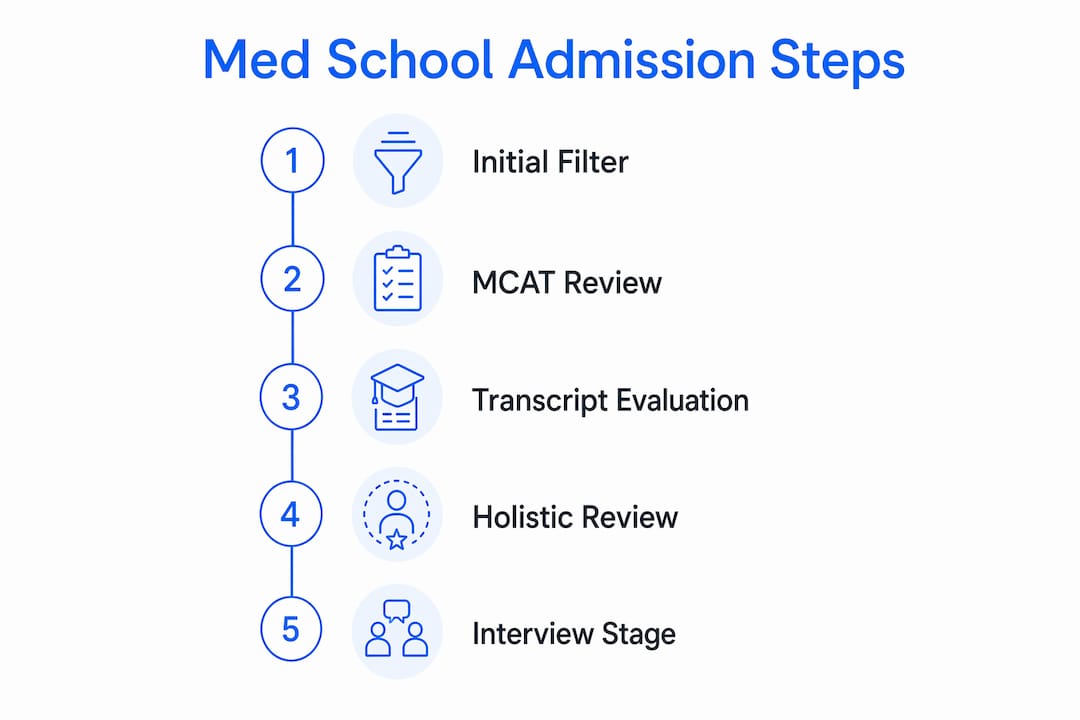
Most programs run a two-stage process. First, an automated filter checks cumulative GPA (cGPA) and science GPA (sGPA) against internal thresholds. Many MD programs use cutoffs in the 2.7–2.9 range; a GPA below that floor often means no human ever reads the file, regardless of MCAT. A high MCAT can sometimes override that filter at schools with holistic-review policies, but it is school-specific, not universal. Stage two is human review, where committees look at grade trends, recent coursework rigor, postbacc or SMP performance, the personal statement, and activities.
What a high MCAT actually accomplishes at stage two is signal intellectual ability. It tells a committee your low GPA may not reflect your ceiling. But they will still ask: why was the GPA low, and what has changed? A high MCAT paired with a flat transcript and no recent science coursework answers neither question. A strong MCAT paired with a 3.7 SMP GPA and a clear narrative answers both.
DO programs and mission-driven MD programs tend to apply these filters more flexibly than large research-heavy MD schools. State schools often give additional latitude to in-state applicants. Knowing which schools lean holistic versus metric-rigid is the core of a smart school list.
Pro Tip: Once you hit 512+, stop chasing marginal MCAT gains. Admissions experts consistently say that a small score bump from 514 to 516 is far less persuasive than a semester of A-level graduate coursework on your transcript. Redirect that study time.
What does “low GPA” actually mean for med school?
Not all low GPAs are equal, and committees read transcripts with more nuance than a single number suggests.

cGPA vs. sGPA: Your cumulative GPA includes every graded course. Your science GPA (sGPA) covers biology, chemistry, physics, math, and related coursework. The sGPA carries more weight because it predicts how you will perform in preclinical courses. A 3.4 cGPA with a 3.1 sGPA is a more serious problem than a 3.3 cGPA with a 3.4 sGPA.
Threshold bands and what they mean in practice:
- 3.5 and above: Competitive for most MD programs with a strong MCAT. Minor weaknesses elsewhere are manageable.
- 3.3–3.49: Below the MD matriculant average of roughly 3.75–3.8, but workable with a strong MCAT score, a strong upward trend, and targeted school selection. DO programs (average matriculant GPA near 3.55) are realistic targets.
- 3.0–3.29: Committees will scrutinize the transcript closely. A 514–518+ MCAT, recent upper-level science A’s, and a postbacc or SMP record are typically needed to compete at MD programs.
- Below 3.0: Formal academic repair is almost always required before applying to MD programs. Many schools use automated cutoffs that filter applications before any human review occurs.
Upward trend matters more than the cumulative number. If your last 30–60 credits show consistent A’s in rigorous science courses, organic chemistry, biochemistry, and upper-level biology, a committee can see a turning point. A flat or downward trajectory with no recent coursework tells a different story. Course rigor matters too: A’s in introductory electives do not carry the same weight as A’s in upper-level science.
Quick self-assessment checklist:
- Is your sGPA within 0.2 of your cGPA, or significantly lower?
- Do your last 30–60 credits show an upward trend?
- Have you completed upper-level science courses (biochemistry, genetics, physiology) with strong grades?
- Are there any D’s or F’s in prerequisites that need to be retaken?
If you answered “no” to two or more of those, academic repair belongs on your timeline before you submit applications.
What are your real options for fixing a weak transcript?
The most persuasive academic repair is recent, rigorous coursework with a 3.6–3.7+ GPA. Graduate-level work, specifically SMP or formal postbacc coursework, carries more weight than retaking undergraduate classes because it demonstrates you can perform at the level medical school demands.
Here is how the main paths compare:
Informal (DIY) postbacc: You enroll in upper-level science courses at a local university without a formal program structure. Flexible and lower cost, but you get no advising support, no committee letter, and no program name that signals intent to committees. Best for applicants with a 3.2+ cGPA who need to fill specific course gaps rather than rebuild a transcript.
Formal postbacc program: A structured curriculum, often with pre-health advising and linkage agreements with medical schools. Takes roughly 1–2 years. Costs vary widely by institution. Strong choice if you need a recognized credential and advising infrastructure. Look for programs with linkage agreements if your GPA is in the 3.0–3.3 range.
Special Master’s Program (SMP): A graduate-level program, often co-enrolled with first-year medical students, designed specifically to demonstrate readiness. Duration is typically 1–2 years. SMP performance should ideally reach a 3.6–3.7+ to be persuasive. This is the most powerful signal for applicants with a cGPA below 3.2 because it directly mimics the medical school environment.
Full master’s degree: A thesis or non-thesis master’s in a biomedical science. Takes 1.5–2 years and costs more than an SMP in most cases. Valuable if you want research depth or a backup credential, but not necessarily more persuasive to admissions committees than a strong SMP.
| Option | Duration | Admissions Impact | Cost Level |
|---|---|---|---|
| DIY postbacc | 6–18 months | Low to medium | Low |
| Formal postbacc | 12–24 months | Medium | Medium |
| SMP | 12–24 months | High | Medium |
| Full master’s degree | 18–24 months | Medium to high | High |
Pro Tip: If your sGPA is below 3.0 with no upward trend, an SMP is almost always the better choice over a formal postbacc. The graduate-level coursework directly addresses the committee’s concern about medical school readiness. If your sGPA is 3.0–3.2 with some recent improvement, a formal postbacc with linkage agreements may get you there faster.
When is a high MCAT enough, and when should you retake?
If your recent science coursework shows consistent A-level grades and your MCAT already reflects your realistic ceiling, keep the score and build the application. Chasing a marginal gain is rarely the right move.
The decision rule is straightforward. Retake the MCAT only when your practice test scores consistently suggest a realistic improvement of roughly three or more points, and when that retake will not displace time you should be spending on academic repair or application work. Admissions experts advise against retaking a 512+ when the rest of the application needs more attention.
Diminishing returns hit hard for low-GPA applicants. Moving from a 514 to a 516 is unlikely to change your outcome if your sGPA is 2.9 and your transcript shows no recent improvement. The same two months spent completing a biochemistry course with an A is a more persuasive document. Committees are looking for evidence of sustained academic performance, and a test score, however impressive, is a single data point.
Two scenarios illustrate the sequencing:
Scenario A: Your cGPA is 3.1, sGPA is 2.95, and your MCAT is 513. Your practice tests are hovering at 513–514. The right move is to pause MCAT prep and complete an SMP or upper-level science coursework. A 514 will not meaningfully change your outcome if the transcript shows no repair.
Scenario B: Your cGPA is 3.3, sGPA is 3.2, and your MCAT is 509. Your practice tests are consistently hitting 513–515. A retake makes sense here because the score gap is real, the improvement is realistic, and your transcript is not in crisis territory. Completing required coursework before testing and using AAMC practice tests as your benchmark is the standard approach.
How do you build a strong application when your GPA is weak?
A strong application pairs an academic fix with experience and a tight narrative. The MCAT signals ability; your activities and letters provide the context that explains the GPA and demonstrates who you are outside a classroom.

Clinical experience: Aim for meaningful, sustained involvement rather than a high hour count spread across multiple short stints. Paid clinical roles, scribe positions, EMT work, or long-term volunteering in a clinical setting carry more weight than a semester of shadowing. Log hours carefully; committees notice when clinical experience is thin or vague.
Research and leadership: Research is not required for every applicant, but it strengthens a file when it is substantive. A published abstract or a meaningful contribution to a lab project is more persuasive than a semester of data entry. Leadership in student organizations or community health initiatives can fill the gap if research is not accessible.
Letters of recommendation: Who you ask matters as much as what they write.
- Prioritize instructors from your recent repair coursework or SMP. A letter from a professor who watched you earn an A in graduate biochemistry directly addresses the committee’s concern.
- Clinical supervisors who can speak to your patient interaction and professionalism add a different dimension.
- Research mentors are valuable if the relationship is substantive.
- When you ask for a letter, give the writer a brief summary of your academic trajectory, your MCAT score, and the specific qualities you hope they can address. Make it easy for them to write something specific.
Personal statement and secondary essays: The GPA explanation should be brief, honest, and forward-looking. State what happened, take accountability without over-explaining, identify the turning point, and point to objective proof of improvement (your SMP GPA, your recent coursework, your MCAT). One paragraph is enough. Committees read hundreds of these; they respect concision and accountability more than elaborate justifications.
Pro Tip: Time your secondaries so that recent A-level coursework or SMP grades are already on your transcript before interview season. If you are completing repair work in the fall, applying in the following cycle gives committees the full picture rather than a promise of future improvement.
How do you build a realistic school list for this profile?
Prioritize schools with explicit holistic review, mission alignment with your background, and a documented willingness to consider academic redemption narratives. Applying broadly to schools with rigid numerical cutoffs wastes application fees and cycles.
What to look for when evaluating schools:
- Does the school publish a holistic review statement in its admissions materials?
- What are the median GPA and MCAT for admitted students (check MSAR for MD programs, AACOMAS for DO programs)?
- Does the school have a history of accepting nontraditional applicants or applicants with postbacc or SMP records?
- Is there in-state preference that could work in your favor?
- Does the school’s mission align with your clinical experience or community background?
Application volume strategy: A realistic list for a low-GPA/high-MCAT applicant typically skews toward DO programs and mission-driven or regional MD programs, with a smaller number of reach schools where your MCAT is well above the median. DO programs are generally more receptive to academic redemption narratives, especially when recent coursework shows clear improvement. State schools often give meaningful preference to in-state applicants, which can shift the calculus even at programs with higher average stats.
Avoid the common mistake of applying to 30 schools without filtering for fit. A focused list of 15–20 schools where your profile makes sense is more productive than a scatter-shot approach.
Pro Tip: Use a readiness tracker like Medschoolpilot to filter your school list against your actual metrics before you apply. Applying to schools where your GPA falls below their automated screening threshold is a direct waste of money and time.
What does a realistic 12–24 month readiness timeline look like?
Before committing to either applying this cycle or entering a repair program, run through this minimum readiness checklist:
- MCAT score at or above your target band for the schools on your list
- Recent science coursework (last 30+ credits) showing an upward trend with A-level grades
- At least two strong letters of recommendation from instructors or supervisors who know your recent work
- Meaningful clinical experience, logged and documented
- A clear, concise narrative that explains the GPA and points to objective proof of improvement
If you cannot check all five, identify which gaps need the most time and build your timeline around closing them.
| Month Range | Primary Tasks | Decision Checkpoint |
|---|---|---|
| Months 1–3 | Enroll in SMP or upper-level postbacc coursework; begin or continue MCAT prep | Confirm program enrollment and MCAT test date |
| Months 4–6 | Complete first semester of repair coursework; take MCAT if practice scores support it | If MCAT ≥ target and semester GPA ≥ 3.6, begin application planning |
| Months 7–9 | Request LORs; draft personal statement; build school list using MSAR/AACOMAS | If repair GPA is below 3.6, continue coursework before applying |
| Months 10–12 | Submit primary applications (AMCAS/AACOMAS open in late May/June); complete secondaries | Confirm all grades and scores are reported before interview invitations |
| Months 13–18 | Interview season; continue any ongoing repair coursework | Evaluate outcomes; if no acceptances, plan second repair semester before reapplying |
| Months 19–24 | Reapplication cycle if needed; complete additional SMP or postbacc credits | Apply with updated transcript showing sustained 3.6–3.7+ repair GPA |
For the 2026–2027 cycle, competitive applicants test by April–June 2026 so scores are available when applications open. Build your MCAT date backward from that window.
A tracker tool converts this table into live milestones. When a deadline shifts or a grade comes in, you can see immediately whether the timeline holds or needs adjustment.
What are realistic outcomes, and how long does this actually take?
Most applicants with a low GPA who eventually matriculate do not get in on their first attempt. That is not discouraging; it is useful information for planning. The typical successful pathway involves one repair cycle (6–18 months of SMP or postbacc work), one application cycle, and sometimes a reapplication. Total time from deciding to repair to matriculation is often 2–3 years.
Outcome categories by profile:
- 3.0–3.4 cGPA with 514+ MCAT and strong repair record: DO interview invitations are realistic in the current cycle. MD interviews are possible at holistic-review and mission-driven programs, particularly with in-state preference.
- Below 3.0 with any MCAT: Formal repair is almost always required first. Even at the highest MCAT scores, applicants with GPAs below 3.0 face acceptance rates well below 50% at MD programs without a demonstrated repair record.
- 3.4+ with 512+ and strong activities: Competitive for a range of MD programs with a well-filtered school list. Reapplication is less likely if the school list is realistic.
Reapplication: If the first cycle does not produce an acceptance, treat it as a data point. Request feedback where schools offer it, identify the weakest element of the application (usually the transcript or a thin activity record), and address it before reapplying. A second application with a stronger repair GPA and additional clinical experience is meaningfully more competitive than a resubmission of the same file.
Cost planning: Budget for SMP or postbacc tuition (which varies widely by institution and program type), MCAT prep materials and test fees, AMCAS or AACOMAS application fees, secondary application fees (which add up quickly across 15–20 schools), and interview travel. These costs are real and worth mapping out before you commit to a timeline.
Pro Tip: Map your anticipated costs by category before you start. Knowing upfront that a full repair cycle plus one application cycle will cost a specific amount helps you make a realistic decision about timing rather than running out of resources mid-cycle.
Key Takeaways
A high MCAT prevents automatic screen-out but rarely erases a very low GPA; the most persuasive fix is recent, rigorous coursework with a 3.6–3.7+ GPA in an SMP or formal postbacc program.
| Point | Details |
|---|---|
| MCAT’s real role | A strong MCAT (512+) triggers human review; it does not substitute for a repaired transcript. |
| GPA band determines next step | Below 3.0 requires formal repair; 3.0–3.4 needs targeted coursework plus a 514+ MCAT; 3.4+ can apply now with a strategic school list. |
| Best repair path | SMP or formal postbacc with a 3.6–3.7+ GPA is the most persuasive signal for committees at MD programs. |
| School list discipline | Prioritize DO programs, holistic-review MD schools, and in-state public programs; filter out schools with rigid numerical cutoffs before applying. |
| Medschoolpilot | Use Medschoolpilot’s readiness tracker and milestone analytics to map your repair timeline, log clinical hours, and filter your school list before committing to a cycle. |
What admissions committees actually want to see
The conventional wisdom says a high MCAT “compensates” for a low GPA. That framing is misleading, and it causes applicants to over-invest in test prep when they should be rebuilding their transcript.
Here is what admissions officers actually describe as persuasive: recent academic performance, consistency over time, and a narrative that is honest without being defensive. A 3.7 SMP GPA earned in the same courses first-year medical students take is more convincing than any test score because it answers the committee’s real question: can this person handle medical school? A high MCAT raises that question; a strong repair record answers it.
The “late bloomer” story is genuinely common among successful applicants, and committees are not hostile to it. What they are hostile to is a low GPA with no explanation, no repair, and an implicit expectation that a high test score should be enough. Accountability and proof are the two things that move a committee. One paragraph in your personal statement that says “here is what happened, here is what I did about it, and here is the evidence” is more persuasive than three paragraphs of context.
At the interview stage, prepare a 60-second answer to the transcript question. State the cause briefly, describe the specific steps you took, and cite the objective evidence: your SMP GPA, your MCAT, your clinical hours. Do not apologize repeatedly. Do not over-explain. Committees respect applicants who have clearly processed the experience and moved forward with a plan.
The applicants who succeed with this profile are not the ones with the highest MCAT. They are the ones who diagnosed the problem accurately, fixed it with the right tool, and presented it clearly.
Medschoolpilot helps you decide: repair now or apply this cycle?
One of the hardest decisions in this process is not whether to fix your transcript, but when you have done enough to apply. That judgment call is easier when you can see your metrics, your school list, and your timeline in one place rather than across a dozen spreadsheets.

Medschoolpilot’s readiness tracker is built for exactly this situation. You can log your repair coursework grades as they come in, track clinical and research hours, score your application readiness against your target school list, and see a live dashboard that tells you whether your current profile clears the threshold for each school you are considering. The milestone analytics flag when a gap in your timeline needs attention before it becomes a problem. If you are weighing a 12-month SMP against applying this cycle, the platform lets you model both scenarios against real school data so the decision is based on your actual numbers, not a guess. Start with the readiness tracker at medschoolpilot.com and convert this article’s sample timeline into a live plan.
Authoritative sources for your next steps
These are the primary resources worth bookmarking as you work through your plan. Each serves a different purpose:
- AAMC / MSAR: The Medical School Admission Requirements database. Use it to look up median GPA and MCAT for every MD program, identify schools with holistic review policies, and filter your list by in-state preference. This is your primary benchmarking tool for MD programs.
- AACOM / AACOMAS: The central application service for DO programs. Use it to research DO school profiles, median stats, and mission statements. If your GPA is in the 3.0–3.4 range, DO programs belong near the top of your list.
- JackWestin AMCAS Guide: Detailed walkthrough of the AMCAS application process and timing for the 2026–2027 cycle. Useful for sequencing your MCAT date and application submission.
- ResidencyAdvisor: MCAT vs. GPA: The clearest breakdown of how GPA bands interact with MCAT scores in admissions screening. Read this before finalizing your school list.
- University of Michigan Pre-Application Tips: Practical guidance on MCAT timing, coursework sequencing, and what to have in place before submitting an application.
- Northwest Health: Low GPA Strategies: A practitioner-focused overview of the most common repair strategies and how to frame them in your application.
Save these links to your planner or export them into your Medschoolpilot workspace so they are accessible when you are evaluating schools or drafting your personal statement.