
An Early Assurance Program (EAP) lets eligible undergraduates secure a conditional seat in medical school before the standard application cycle even opens. According to the AAMC, these are restricted, highly selective pathways with only a handful of designated seats per entering class, and most require a nomination from your undergraduate pre-health advisor rather than an open public application. The short answer on whether to pursue one: if you attend a partner institution, carry a strong GPA in your science prerequisites, and are genuinely committed to medicine, an EAP is worth pursuing seriously.
Quick next steps for this semester:
- Confirm whether your undergraduate institution is a partner school for any EAP (check your pre-health office and the program’s official website)
- Schedule a meeting with your pre-health advisor to discuss nomination eligibility and internal deadlines
- Clarify the MCAT policy for any program you’re considering (waived, required before matriculation, or conditional benchmark)
- Map your prerequisite completion timeline against the program’s coursework requirements
- Begin documenting clinical hours and research experience now, even if you’re only a first-year student
This path fits best if you’re a first- or second-year student at a partner school with a GPA trending above 3.5 in science courses and a clear, articulated reason for choosing medicine.
Key takeaways
Early assurance programs offer a conditional medical school seat before the standard cycle, but only for nominated students at partner institutions who can meet sustained academic benchmarks through graduation.
| Point | Details |
|---|---|
| EAPs are nomination-based | Most programs require a pre-health advisor nomination; self-applications are rare and usually ineligible. |
| MCAT policy varies by program | Some programs waive the MCAT entirely; others require a score or a minimum benchmark before matriculation. |
| Conditionality is binding | A GPA drop, missed prerequisite, or conduct issue can revoke a reserved seat at any point before matriculation. |
| Best fit: partner-school students with strong grades | Students at non-partner schools or with inconsistent academic records are better served by the traditional cycle. |
| Medschoolpilot maps EAP milestones | The readiness tracker converts conditional requirements into dated checkpoints with automated risk flags for both EAP and backup paths. |
Table of Contents
- What are early assurance programs and how do they differ from other pathways?
- How early assurance programs actually work, step by step
- What eligibility and MCAT requirements look like across programs
- Where to find U.S. early assurance programs and what to look for
- Is an EAP worth it? Benefits and trade-offs by student profile
- How to build a competitive EAP candidacy, semester by semester
- Exact steps to take this semester if you want to pursue an EAP
- How a readiness tracker helps you decide between EAP and the traditional cycle
- What the EAP trade-off really comes down to
- Medschoolpilot turns EAP conditions into a trackable plan
- Sources
What are early assurance programs and how do they differ from other pathways?
The AAMC defines Early Assurance Programs as restricted admission pathways that allow select undergraduates, typically in their first or second year, to secure a conditional guarantee of admission before the standard application cycle begins. The word “conditional” is doing a lot of work in that sentence. You get the seat, but you keep it only by meeting specific academic and behavioral benchmarks through the rest of your undergraduate career.
EAPs come in a few distinct flavors:
- Partner-only nomination programs: The medical school partners with specific undergraduate institutions. Only students at those schools can apply, and they must be nominated by a designated campus liaison or pre-health advisor. NEOMED’s pathway is a clear example of this model.
- Open-campus tracks: Some programs accept applications from students at any accredited institution, though nomination or faculty endorsement is still typically required.
- Honors-college collaborations: A smaller category where an honors program at the undergraduate institution has a formal pipeline agreement with a medical school, often with its own GPA and coursework thresholds.
The confusion between EAPs and similar-sounding programs is real, so here is a direct comparison:
An EAP is not the same as a BS/MD program, Early Decision, or direct-entry admission. A BS/MD program is a combined degree you apply to from high school, before you’ve taken a single college course. Early Decision is a binding single-school application you initiate yourself during the standard AMCAS cycle. Direct-entry programs admit students straight from high school into a professional program with no separate undergraduate application. An EAP, by contrast, is a mid-undergraduate pathway where the medical school reaches into your sophomore year and reserves a seat based on your trajectory so far — with conditions attached.
Whether an EAP seat is binding depends on the program. Many are nonbinding in the sense that you can decline the offer, but once you accept, the conditional requirements become binding. Withdrawing after acceptance typically forfeits the seat and may affect how the program views your institution’s future nominees.
How early assurance programs actually work, step by step
The mechanics follow a fairly consistent pattern across programs, though timelines vary.
- Nomination by your campus liaison. Your pre-health advisor or a designated faculty member identifies you as a strong candidate and submits a nomination to the medical school. You cannot self-nominate for most programs. This is why building an early relationship with your pre-health office matters more than most students realize.
- Application materials submission. After nomination, you submit a formal application packet: transcripts, personal statement, letters of recommendation, and sometimes a secondary application specific to the EAP.
- Interview. Programs like Tufts’ EAP invite a small pool for interviews after reviewing applications. Tufts receives over 100 applications, interviews roughly 20 candidates, and admits fewer than that in a given year. The interview is competitive and evaluative, not a formality.
- Conditional offer issued. Accepted students receive a formal conditional offer, which specifies the GPA floor, required coursework, MCAT policy, and any behavioral or professional standards they must maintain.
- Maintenance period. This is the stretch from acceptance through the end of your undergraduate career, typically one to two years. You must meet each checkpoint the program sets, often verified by term-by-term GPA reviews.
- AMCAS or equivalent submission. Even with a reserved seat, most programs require formal AMCAS processing before matriculation. EAP is rarely a literal bypass of administrative steps. You’ll still complete the application; the difference is that your acceptance is already secured, contingent on meeting conditions.
- Matriculation. You enroll in medical school, typically two years after receiving the conditional offer if you applied as a sophomore.
A typical timeline looks like this: apply during your sophomore year, receive a decision by late fall or spring of that year, maintain requirements through junior and senior year, submit AMCAS in the summer before your senior year, and matriculate the following fall.
Pro Tip: Ask your pre-health advisor for the specific internal nomination deadline at your institution. Medical schools set their own EAP deadlines, and your campus liaison often has a submission window that closes weeks before the program’s official deadline. Missing the internal date means missing the cycle entirely.
What eligibility and MCAT requirements look like across programs
Most EAPs share a core set of academic requirements, but the specifics vary enough that you need to verify each program’s rules directly.
Academic coursework typically required by the time you apply:
- One year of general biology with lab
- One year of general chemistry with lab
- One semester of organic chemistry (some programs require the full year)
- One year of physics with lab (often acceptable if in progress)
- Math through calculus or statistics
GPA expectations generally fall in the 3.5–3.7 range for science GPA, though programs phrase this differently. Some list a hard minimum (e.g., 3.4 cumulative), while others describe a “competitive” range without a published floor. Treat any published minimum as a floor, not a target.
MCAT policy categories:
Programs fall into three distinct categories, and confusing them is a costly mistake.
- Waived entirely: The program does not require an MCAT score for admission or matriculation. Tufts’ EAP is a well-known example. Even so, Tufts explicitly recommends that EAP students take practice MCAT exams, because coursework performance carries more weight and MCAT preparation supports success in medical school.
- Required before matriculation: You must sit for the MCAT and submit a score before you can enroll, even though you already hold a conditional seat. The score may or may not have a published minimum.
- Conditional benchmark: You must score at or above a specific threshold. Falling below that benchmark can revoke your seat. NEOMED’s pathway uses this model, requiring students to meet later admission standards including GPA and MCAT benchmarks.
The AAMC notes that some EAPs waive the MCAT while many others set a minimum score as a matriculation condition. Never assume a program’s MCAT policy based on what you’ve read about a different program.
Other requirements commonly evaluated:
- Clinical exposure (shadowing, scribing, patient-facing volunteering)
- Research experience, especially for research-intensive medical schools
- Letters of recommendation from science faculty and clinical mentors
- Interview performance, assessed on communication, motivation, and professionalism
Red flags that commonly cost students their reserved seat:
- A significant GPA drop in any term, particularly in science prerequisites
- Academic dishonesty findings, even minor ones
- Failure to complete required prerequisite courses on schedule
- Unprofessional conduct in clinical or research settings
- Missing a program-mandated check-in or reporting requirement
Where to find U.S. early assurance programs and what to look for
The honest answer is that there is no single comprehensive public database of every EAP in the country. Finding them requires a few targeted searches.
Primary sources to check:
- The AAMC’s Early Assurance Programs page lists programs that have registered with AAMC and provides a starting point for identifying which medical schools offer EAPs.
- Your undergraduate pre-health or pre-medical advising office. This is the most reliable source for programs your institution is actually partnered with. Advisors often have direct contacts at partner medical schools.
- The admissions pages of medical schools you’re interested in. Search “[school name] early assurance program” or check their “special admissions options” section.
- Your undergraduate honors college, if you’re enrolled in one. Some honors programs have formal pipeline agreements that aren’t widely advertised.
Representative program examples:
NEOMED’s Early Assurance pathway partners with ten specific undergraduate institutions in Ohio. Students are nominated by their campus pre-health advisor, not self-selected. This is a partner-only, nomination-driven model with explicit GPA and MCAT benchmarks for matriculation. If you don’t attend one of NEOMED’s ten partner schools, this pathway is not available to you regardless of your qualifications.
Tufts University School of Medicine runs an EAP that is competitive and selective, with detailed course and grade expectations. The MCAT is generally waived for matriculation, but the program’s selectivity means coursework performance is scrutinized closely.
The University of Arizona’s Franke Honors College has collaborated with the University of Arizona College of Medicine on early-assurance pathways, illustrating the honors-college model where an undergraduate honors program serves as the pipeline institution.
For a broader view of how partner-based early-admission systems operate at scale, Direct Admit Wisconsin shows how portal-based confirmations and partner restrictions function in large public university systems, though that program targets high school students rather than undergraduates pursuing medical school.
Checklist for verifying a program’s fit:
- Confirm your undergraduate institution is on the partner list (if partner-only)
- Identify the designated campus liaison or pre-health advisor contact
- Verify the MCAT policy in writing from the program’s official page
- Note the internal nomination deadline at your institution
- Review the conditional requirements and GPA maintenance thresholds
Is an EAP worth it? Benefits and trade-offs by student profile
The case for pursuing an EAP is strong for a specific type of student. For others, the traditional cycle is the better bet.
Core benefits:
- Reduced application stress and cost. EAP applications typically carry no AMCAS application fee, and securing a seat early eliminates the need to apply to 15–25 schools during the standard cycle.
- Freedom to deepen your undergraduate experience. Without the pressure of MCAT prep dominating junior year, you can pursue research, leadership, or clinical work more intentionally.
- Early engagement with the medical school community, sometimes including mentorship or early access to curriculum resources.
Common trade-offs:
- Conditionality is real accountability. A GPA slip or missed prerequisite can cost you the seat. Students who struggle under sustained performance pressure may find the maintenance period more stressful than the traditional cycle.
- Limited flexibility. If your interests shift toward a different specialty, institution, or even a different health profession, you may find yourself constrained by a conditional commitment you made as a sophomore.
- Reduced competitive context. Because you’re not applying broadly, you won’t have the signal of multiple acceptances to calibrate your options.
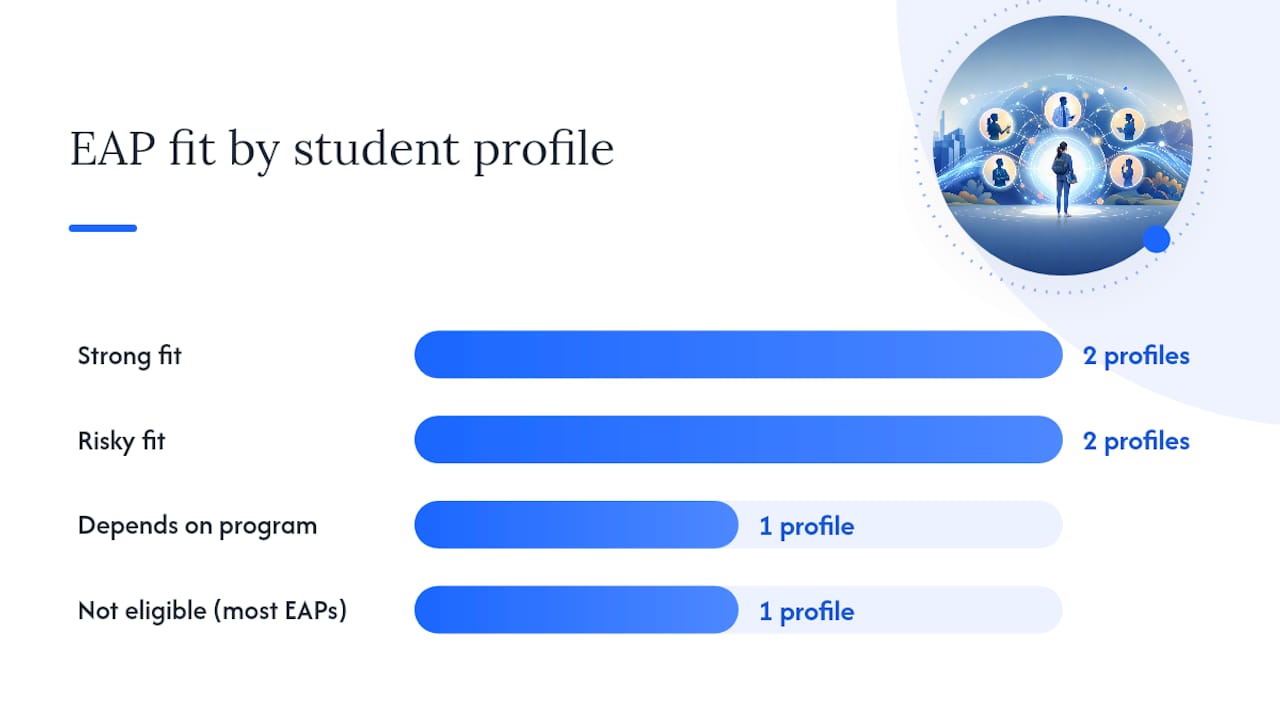
| Student profile | EAP: pursue it | Traditional cycle: better fit |
|---|---|---|
| Attends a partner school, GPA 3.6+ in sciences | Strong fit | Less relevant |
| Certain about medicine, committed to one institution | Strong fit | Less relevant |
| Undecided on specialty or school preference | Risky fit | Better fit |
| Needs MCAT score to demonstrate competitiveness | Depends on program | Often better fit |
| Applying from a non-partner school | Not eligible for most EAPs | Only option |
| Strong grades but inconsistent performance history | Risky fit | Better fit |
The context matters here: NEOMED’s regular-decision matriculants in recent years had MCAT scores near the 90th percentile, which illustrates how competitive the overall admissions pool remains even when EAP seats exist. An EAP is not a shortcut for a borderline applicant. It’s an accelerated path for a strong one.
How to build a competitive EAP candidacy, semester by semester
Getting nominated requires more than a good GPA. Programs want students who look like future physicians, not just strong test-takers.
Academic plan:
- Complete general biology and general chemistry (with labs) by the end of freshman year or early sophomore year.
- Begin organic chemistry in sophomore fall. Aim for a B+ or higher in every science course. Programs that waive the MCAT scrutinize these grades more carefully than anything else on your application.
- Maintain a cumulative science GPA above 3.5 from the start. A strong upward trend helps, but a dip in sophomore year, right when you’re applying, is hard to explain.
- Take calculus or statistics by the end of sophomore year if not already completed.
Experience plan:
- Log at least 100 hours of direct patient contact before applying. Shadowing counts, but patient-facing roles (scribing, medical assistant, volunteer in a clinical setting) carry more weight.
- If your school has research opportunities, start in freshman year. Even a semester as an undergraduate research assistant demonstrates scientific curiosity and follow-through.
- Take on one leadership role in a pre-med or health-related organization. Programs want evidence you can manage responsibility alongside coursework.
Advising and nomination strategy:
- Introduce yourself to your pre-health advisor in the first semester of freshman year, not when you need a nomination.
- Ask explicitly what the advisor looks for in a nominee. Different advisors weight different factors.
- Request letters of recommendation from science faculty who have seen you perform in a lab or discussion section, not just in a large lecture.
- Ask recommenders early, at least six weeks before the internal deadline.
MCAT timing:
- If the program requires an MCAT score, plan to sit for it in spring of junior year at the latest, giving you time to retake if needed before matriculation.
- Even for programs that waive the MCAT, take at least two full-length practice exams during sophomore or junior year. Tufts recommends this explicitly because MCAT preparation reinforces the science content you’ll need in medical school.
Interview preparation:
- Practice answering “Why medicine?” with a specific, personal narrative, not a generic answer about helping people.
- Prepare for questions about your clinical experiences: what you observed, what surprised you, what confirmed your interest.
- Know the program’s mission and curriculum. Interviewers notice when candidates haven’t read the program’s own materials.
Pro Tip: Use the AMCAS vs. AACOMAS breakdown to understand which application system your target EAP uses before you start building your materials. Some osteopathic programs have their own early-assurance tracks that run through AACOMAS, not AMCAS.
Exact steps to take this semester if you want to pursue an EAP
This is the to-do list. Work through it in order.
- Email your pre-health advisor this week. Ask whether your institution is a partner school for any EAPs and what the internal nomination timeline looks like. If your school has a pre-health committee, ask how the committee nomination process works.
- Pull the official program pages for any EAPs you’re eligible for. Read the conditional requirements in full, not just the headline GPA number.
- Request unofficial transcripts and calculate your current science GPA. If it’s below 3.5, identify which courses are dragging it down and make a plan to address them before the nomination window.
- Identify two to three faculty members who could write strong letters of recommendation. Begin building those relationships now if you haven’t already.
- Start a clinical hours log. If you’re not yet in a clinical setting, find one this semester. Programs want to see consistent, ongoing exposure, not a rushed block of hours right before the application.
- Mark the internal nomination deadline on your calendar and work backward to set personal deadlines for each application component.
- Prepare a backup plan. Even if you receive a conditional EAP seat, keep your MCAT preparation on track and stay familiar with the traditional AMCAS cycle. Conditions can be revoked.
Fallback planning checklist:
- Keep your MCAT study schedule active regardless of EAP status
- Maintain a list of 8–12 medical schools you’d apply to in the traditional cycle
- Track your clinical hours consistently so they’re documented if you need them for a regular application
- Stay current on AMCAS opening dates and personal statement deadlines
How a readiness tracker helps you decide between EAP and the traditional cycle
The decision between pursuing an EAP and staying in the traditional cycle isn’t purely philosophical. It comes down to where you stand on a set of measurable criteria, and a readiness tracker makes that assessment concrete.
Here’s how a tracker workflow maps to EAP requirements:
- GPA checkpoints: Set a milestone for each semester’s science GPA with a target floor (e.g., 3.5 cumulative by end of sophomore fall). An automated score flag triggers when a term grade threatens to pull the cumulative below the threshold.
- Coursework completion: Map each required prerequisite to a specific semester. If organic chemistry isn’t scheduled until junior year but the program requires it by application time, the tracker surfaces that conflict immediately.
- MCAT benchmarks: If the program requires a score, set a milestone for a full-length practice exam by a specific date, then a real exam date with a target score range.
- LOR receipt: Log recommender names and set a deadline for each letter, with a reminder two weeks before the internal nomination deadline.
- Clinical hours: Track hours by category (shadowing, patient contact, volunteering) so you can see at a glance whether you’ll hit the program’s threshold before the application window.
When the tracker shows all milestones on track, the EAP path is viable. When two or more milestones are flagged as at-risk simultaneously (a GPA dip plus an incomplete prerequisite, for example), the tracker makes the case for staying in the traditional cycle visible before you’ve committed to a path you can’t maintain.
Pro Tip: Keep both an EAP path and a traditional-cycle backup active in your tracker simultaneously. Set separate milestone sets for each. If the EAP path shows risk, you haven’t lost time on the backup. If both paths stay green, you’re in the strongest possible position.
What the EAP trade-off really comes down to
The conventional wisdom on EAPs tends to frame them as either a golden ticket or a trap. Neither is accurate. An EAP is a contract: the medical school gives you certainty early, and you give them accountability for the next two years of your academic life.
The students who struggle with EAPs aren’t usually the ones who fail academically. They’re the ones who accepted a conditional seat before they were genuinely certain about their direction. Sophomore year is early. A student who accepts an EAP at 19 and then discovers a deep interest in public health, biomedical engineering, or research that pulls them away from clinical medicine is in a genuinely difficult position. The seat doesn’t flex.
That said, for students who are certain, who attend a partner school, and whose grades are already strong, the EAP path removes a significant amount of noise from junior and senior year. You can pursue research more deeply, take a course outside your comfort zone, or invest in clinical work without the MCAT looming over every decision. That freedom has real value.
If you lose an EAP seat, whether through a grade drop, a missed prerequisite, or a change in direction, the path forward is straightforward: contact the program to understand whether an appeal is possible, then redirect your energy to the traditional cycle. A strong senior year, a competitive MCAT score, and a clear explanation of what happened can still produce a successful application. One setback in sophomore year does not define a medical school application.
Medschoolpilot turns EAP conditions into a trackable plan
Securing an EAP seat is only half the challenge. Keeping it through two years of undergraduate coursework, while also maintaining a backup plan for the traditional cycle, requires tracking more moving parts than most students manage with a spreadsheet.
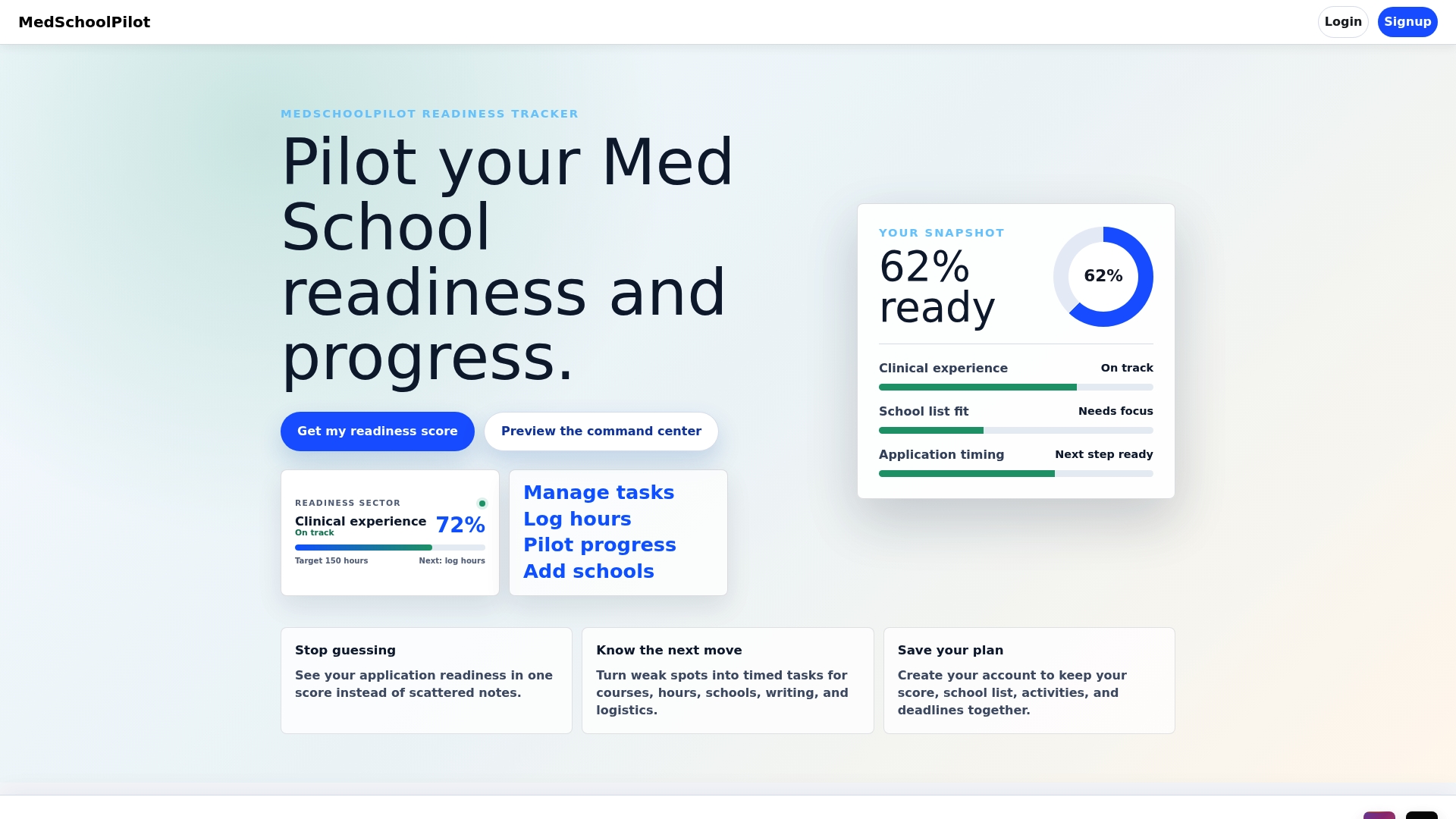
Medschoolpilot’s readiness tracker converts your program’s conditional requirements into dated milestones with automated scoring and risk flags. If your science GPA dips toward a program threshold, the platform surfaces that risk before it becomes a lost seat. If a prerequisite isn’t scheduled in time, the timeline view shows the conflict immediately. You can run an EAP path and a traditional-cycle backup side by side, so you’re never caught without options.
The tracker is a planning tool, not an admissions guarantee. What it does is remove the guesswork from knowing where you stand. Start with free access to Medschoolpilot and map your EAP requirements this week.
Sources
These are the primary sources to consult when verifying program-specific rules. Each one covers something different.
- Information About Early Assurance Programs | Students & Residents
- Early Assurance Program | School of Medicine
- Reserve a Medical School Seat Through Early Assurance | NEOMED
- Direct Admit Wisconsin - Universities of Wisconsin