
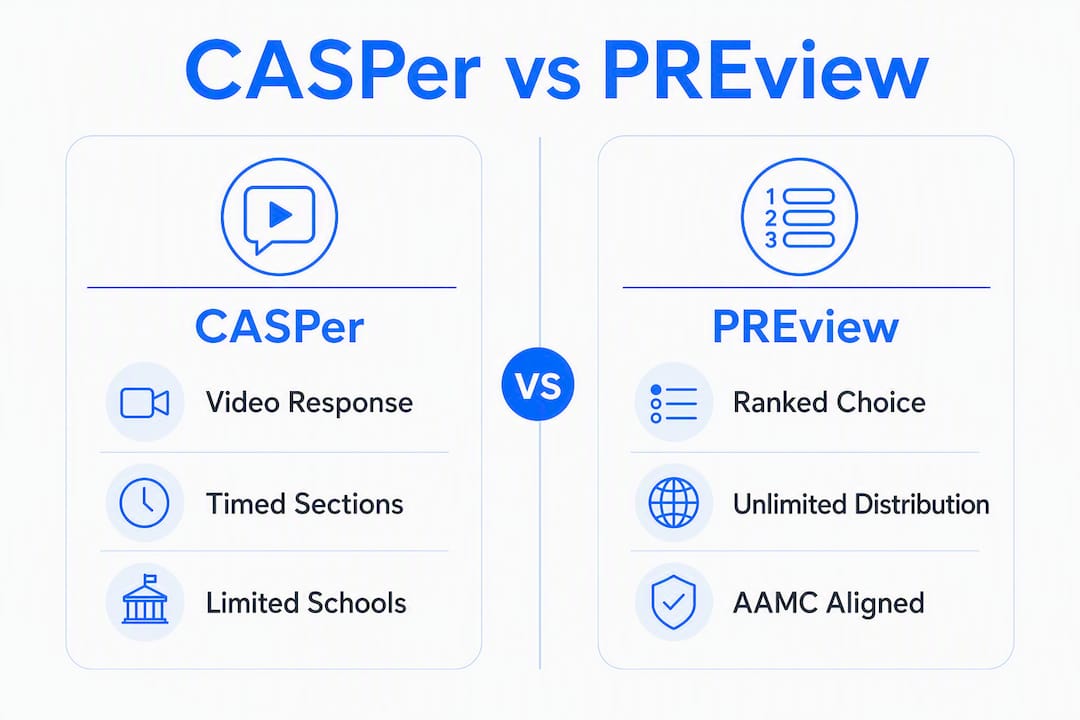
CASPer is an open-response situational judgment test (SJT) where you write and speak your own reasoning under time pressure. AAMC PREview is a multiple-choice SJT where you rate pre-written responses against an expert consensus model. For most U.S. applicants, CASPer and PREview serve different schools and test entirely different skills — so your school list, not personal preference, should drive which one you take.
Before you do anything else:
- Check every school’s admissions page to confirm whether it requires CASPer, PREview, both, or neither — and do not rely on third-party summaries.
- Schedule the exam that covers the most schools on your list first, then decide whether a second test is worth the cost and time.
- Register early so scores reach programs before secondary applications are due; late registration is the most common and most avoidable mistake.
The sections below walk through format, scoring, school verification, cost, and separate preparation plans for each exam.
Table of Contents
- How do CASPer and PREview compare at a glance?
- What actually happens on test day for each exam?
- What does each exam actually measure?
- Which U.S. medical schools require CASPer, PREview, or both?
- How are scores reported, and what do admissions committees do with them?
- What do CASPer and PREview cost, and when should you register?
- Do you need CASPer, PREview, both, or neither?
- How should you prepare differently for each exam?
- Key Takeaways
- Why SJT planning deserves its own column in your school list
- Medschoolpilot keeps your SJT requirements from falling through the cracks
- Useful sources and where to verify current requirements
How do CASPer and PREview compare at a glance?
The table below captures the most decision-relevant differences between the two exams. One number worth flagging before you read it: CASPer is currently required by a significant number of U.S. medical schools, while PREview is required by fewer programs and recommended by several others. That gap alone shapes most applicants’ priorities.
| Dimension | CASPer | AAMC PREview |
|---|---|---|
| Format | Video responses + typed open responses | Rate pre-written actions on a 4-point scale |
| Duration | ~65–85 minutes | ~90–105 minutes |
| Scored output | Performance bands/quartiles (school-facing) | 1–9 score (student and school receive it) |
| Who sees results | Programs; applicant sees limited quartile info | Both the applicant and participating schools |
| Requiring schools (approx.) | ~33 U.S. medical schools | ~14 required, ~16 recommended |
| Cost | ~$85 (includes limited school distribution) | ~$100 (unlimited distribution) |
| Distribution model | Per-school fees after included count | One fee, unlimited schools |
| When to take | Before secondaries open (typically June–August) | Same window; check school deadlines |
Pro Tip: If your list includes eight or more PREview schools, the flat unlimited-distribution fee often makes PREview cheaper per program than CASPer’s per-school add-on model. Run the math on your actual list before assuming CASPer is the lower-cost option.
What actually happens on test day for each exam?
CASPer test-day flow
CASPer runs in two distinct sections. The video section gives you one minute per spoken response to answer questions about a scenario you just read or watched. The typed section gives you 3.5 minutes per prompt pair to write out your reasoning. Total test time, including short breaks, runs roughly 65–85 minutes.
Key technical and policy details:
- You need a computer (not a tablet), a working webcam and microphone, and a supported browser — Chrome is the standard recommendation.
- Your testing environment must be quiet, well-lit, and free of other people; ID verification happens at the start.
- There is no void option after submission. Once you finish, the results go to your selected programs.
- Score distribution to schools typically happens within a few weeks of your test date; check the Acuity Insights website for the current cycle’s release schedule.
PREview test-day flow
PREview presents scenario sets where you read a professional situation and then rate a list of possible responses on a four-point effectiveness scale. The exam contains 186 total items, and the full session runs approximately 90–105 minutes.
Key technical and policy details:
- Same computer and browser requirements as CASPer; no tablets.
- PREview does offer a void option at the end of the session — you can cancel your score before it is released if you feel the sitting went badly.
- Your 1–9 score is released to both you and your selected schools, so you will actually see your result.
- AAMC administers PREview, so registration goes through your AAMC account.
What does each exam actually measure?
The competency lists overlap, but the underlying task is fundamentally different. CASPer asks you to generate reasoning. PREview asks you to evaluate options against a professional standard.

CASPer’s nine competencies
Acuity Insights built CASPer around nine non-cognitive competencies, including:
- Collaboration and teamwork
- Communication
- Empathy and compassion
- Ethics and professional responsibility
- Equity and diversity awareness
- Problem-solving under pressure
- Resilience and adaptability
- Self-awareness
- Service orientation
Scenario themes tend to involve team conflict, witnessing a colleague behave unethically, navigating a difficult patient or client interaction, or responding to a personal failure. Your clinical volunteering stories, leadership moments, and experiences navigating cultural differences all produce strong material here — because you are writing your own answer, your specific experiences can show up directly.
PREview’s AAMC competency model
PREview targets eight AAMC core competencies: service orientation, social skills, cultural competence, teamwork, ethical responsibility to self and others, resilience and adaptability, reliability and dependability, and capacity for improvement. The scenarios cover similar themes — a colleague cutting corners, a patient who is upset, a team disagreement — but your job is not to write your own response. You rate how effective each listed option is, and your score reflects how closely your ratings match the AAMC’s expert consensus.
That distinction matters practically. PREview tests alignment with the AAMC’s specific model of professional behavior, not everyday moral instincts. Knowing what sounds ethical is not enough. You need to understand how the AAMC defines professional effectiveness, which is why official practice materials are non-negotiable for PREview prep.
Which U.S. medical schools require CASPer, PREview, or both?
No single list stays current all year. Schools update requirements between cycles, and a school that accepted either exam last year may specify one this year. Verify each program’s requirement directly on its admissions page and through centralized resources like AAMC/MSAR — third-party summaries lag behind official updates.
General categories to know:
- CASPer-only schools: Programs that have integrated Acuity Insights’ platform into their holistic review and do not accept PREview as a substitute. Baylor College of Medicine and Boston University School of Medicine have publicly listed CASPer as part of their process.
- PREview-only schools: Programs that use AAMC’s tool exclusively, often because it integrates directly with AMCAS.
- Schools that accept either: A smaller group; always confirm this in writing before assuming your existing score transfers.
- Schools that require neither: Still a significant portion of U.S. allopathic programs — do not assume every school on your list needs an SJT.
Verification checklist:
- Open each school’s admissions requirements page directly.
- Cross-reference with MSAR (AAMC’s Medical School Admission Requirements database).
- Add an “SJT required” column to your school list spreadsheet and mark CASPer, PREview, both, or none for each program.
- Use Medschoolpilot’s readiness tracker to log this requirement alongside your other application milestones so nothing slips through.
Pro Tip: Adding a school late in the cycle that requires a different SJT than the one you already took can mean a rushed registration, an extra fee, and scores that arrive after a school’s deadline. Build your SJT calendar from your finalized school list, not the other way around.
How are scores reported, and what do admissions committees do with them?
CASPer score reporting
CASPer results go directly to your selected programs. You do not receive a numeric score the way you do with the MCAT. Instead, applicants typically see performance band or quartile information after a delay, while schools receive a more detailed breakdown. The quartile report tells you roughly where you landed relative to other test-takers, but it does not give you the granular feedback you would need to diagnose specific weaknesses.
Admissions committees use CASPer as a non-cognitive signal in holistic review. It supplements GPA and MCAT data with evidence of how you think through ambiguous professional situations. Most programs do not publish a CASPer cutoff score the way they publish MCAT ranges.
PREview score reporting
PREview reports a 1–9 score to both the applicant and participating schools, along with confidence bands that indicate the precision of your score. You see your result. That transparency is useful: if your score is low, you know before schools do, and you can factor that into your application strategy.
Committees that use PREview are evaluating your alignment with AAMC’s professional competency model. A score of 5 or above is generally considered competitive, though individual programs set their own thresholds and most treat it as one data point in a holistic file review.
By the numbers: CASPer is required by approximately 33 U.S. medical schools; PREview is required by roughly 14 and recommended by about 16 more. If your list skews toward CASPer schools, prioritize that exam. If it splits evenly, you may need both.
What do CASPer and PREview cost, and when should you register?
Fee comparison
| Exam | Base fee | Distribution model | Extra costs |
|---|---|---|---|
| CASPer | ~$85 | Limited schools included; per-program fee after that | Adds up quickly for large school lists |
| PREview | ~$100 | Unlimited distribution | One-time fee regardless of school count |
These figures reflect reported cycle examples and can shift year to year — always confirm current fees on the Acuity Insights and AAMC websites before registering.
Registration timing
- CASPer: Register and test between May and August for the standard cycle. Aim to have scores distributed before secondaries open at your target schools, which typically means testing no later than July for most programs.
- PREview: AAMC opens registration in the spring. Test by July or early August to give schools time to receive and review your score before secondary deadlines.
Fee assistance
- PREview: AAMC’s Fee Assistance Program (FAP) covers the PREview exam fee for eligible applicants. If you qualify for FAP, apply before registering.
- CASPer: Acuity Insights offers its own financial aid program. Check the Acuity Insights website for current eligibility criteria and application deadlines — the window typically opens in the spring alongside registration.
Do you need CASPer, PREview, both, or neither?
Work through this decision in four steps:
- Mark every school’s SJT requirement on your list (CASPer, PREview, both, or none).
- Group schools by exam. If 80% of your list requires CASPer and two schools require PREview, your priority is clear.
- Pick the earliest test date that covers your highest-priority group and still gets scores to schools before their secondary deadlines.
- Only register for both if separate schools on your finalized list explicitly require each one.
Common edge cases
- A school says “SJT required” without specifying which one: Contact admissions directly. Do not assume either exam qualifies.
- You already took CASPer and then added a PREview-only school: Check whether that school’s deadline still allows time to register and test. If not, reconsider whether to add the school at all.
- A school says it “recommends” PREview but does not require it: Treat this as optional unless you have bandwidth. Prioritize required exams first.
Sample clarification email
Subject: SJT Requirement Clarification — [Your Name], Applicant [Cycle Year]
Dear Admissions Team,
I am applying to [School Name] in the current cycle and want to confirm your situational judgment test requirement. Your admissions page lists [CASPer / PREview / an SJT] as part of the application. Does your program accept both CASPer and AAMC PREview, or is one specifically required?
Thank you for your time. I look forward to your response.
[Your Name] | [Email] | [AAMC ID]
Keep it short. Admissions offices receive hundreds of these; a direct question gets a faster answer.
How should you prepare differently for each exam?
Treating CASPer and PREview as interchangeable is the most common mistake applicants make. They test opposite cognitive tasks. One requires you to generate; the other requires you to calibrate. Separate preparation plans are not optional — they are the point.

CASPer preparation checklist
CASPer benefits from timed expressive practice — the goal is to get faster and clearer at organizing your reasoning under pressure, not to memorize ethical frameworks.
- Timed typed practice: Set a 3.5-minute timer and write full responses to scenario prompts. Focus on structure: acknowledge the situation, state your reasoning, name a concrete action.
- Video response drills: Record yourself answering a prompt in one minute. Watch it back and cut filler words. Clarity matters more than polish.
- Build a response template: A simple three-part structure (what I notice, what I would do, why) keeps you from freezing mid-response.
- Typing speed baseline: If you type under 50 words per minute, spend two weeks on typing drills before your test date. Slow typing eats into response quality.
- Use Medschoolpilot’s CASPer prep guide for scenario banks and timed practice sets built specifically for the medical school cycle.
PREview preparation checklist
PREview requires calibration to AAMC’s definitions of professional effectiveness. Practicing with official AAMC sample items is the single most important thing you can do.
- Download AAMC’s official practice materials and work through every sample scenario with the answer key open. Understand why the AAMC rates each option the way it does.
- Rating drills: Practice rating response options before checking the key. Track where your ratings diverge from the AAMC consensus and look for patterns.
- Avoid the “nicest answer” trap. The highest-rated response is often not the most empathetic-sounding one — it is the most professionally effective one by AAMC’s definition.
- Timed full-length practice: Simulate the full 186-item session at least once before test day. Stamina matters for a 90-plus-minute rating task.
Sample 6-week plan
| Week | CASPer focus | PREview focus |
|---|---|---|
| 1 | Baseline timed typed practice (3 scenarios) | Read AAMC competency definitions; do 20 sample items |
| 2 | Video response drills; build response template | Rating drill: items, check key, log divergences |
| 3 | Full timed typed session | Identify rating patterns; focus on weak competency areas |
| 4 | Video + typed mixed practice; typing speed check | Full-length timed simulation (186 items) |
| 5 | Peer review of video responses; refine template | Second full simulation; compare to week 4 divergence log |
| 6 | Light review; rest two days before test | Light review; confirm registration and tech setup |
Key Takeaways
Your school list determines which exam you take — CASPer covers more U.S. medical schools, but PREview’s unlimited distribution model and transparent scoring make it the smarter choice when your list skews toward AAMC-affiliated programs.
| Point | Details |
|---|---|
| Verify requirements first | Check every school’s admissions page and MSAR before registering for either exam. |
| CASPer has broader reach | Roughly 33 U.S. medical schools require CASPer versus approximately 14 that require PREview. |
| PREview score is visible to you | You receive a 1–9 score; CASPer applicants see only limited quartile information. |
| Prepare separately for each | CASPer needs expressive timed practice; PREview needs calibration drills using AAMC sample keys. |
| Medschoolpilot tracks it all | Use Medschoolpilot’s readiness tracker to log SJT requirements, deadlines, and score distribution milestones for every school on your list. |
Why SJT planning deserves its own column in your school list
Most premeds treat CASPer and PREview as afterthoughts — something to handle once the MCAT is done and the school list is set. That sequencing creates the exact problem admissions advisors flag most often: a finalized list with two different SJT requirements, one exam already taken, and a second registration deadline two weeks away.
The smarter move is to build SJT requirements into your school list from day one, the same way you track GPA ranges and MCAT medians. When you know upfront that 10 of your 15 schools require CASPer and three require PREview, you can schedule both exams in May or June, get scores out early, and move on. You are not scrambling in August.
There is also a preparation argument here that most guides understate. CASPer and PREview are not just different formats — they test opposite cognitive modes. CASPer rewards people who can think fast, communicate clearly, and structure a response under pressure. PREview rewards people who can suppress their instinctive “nice” answer and align with a specific professional model they had to study. Conflating the two in your prep is like studying for the verbal section of one test by doing math drills for another. The content overlaps; the skill does not.
If you are applying this cycle, the most useful thing you can do this week is open your school list, add an SJT column, and fill it in for every program. That single step tells you exactly which exams to take, in what order, and how much to budget.
Medschoolpilot keeps your SJT requirements from falling through the cracks
Knowing which exam each school requires is only half the problem. The other half is keeping that information organized across a 15-to-20-school list while managing MCAT retakes, clinical hours, letters of recommendation, and secondary deadlines simultaneously.
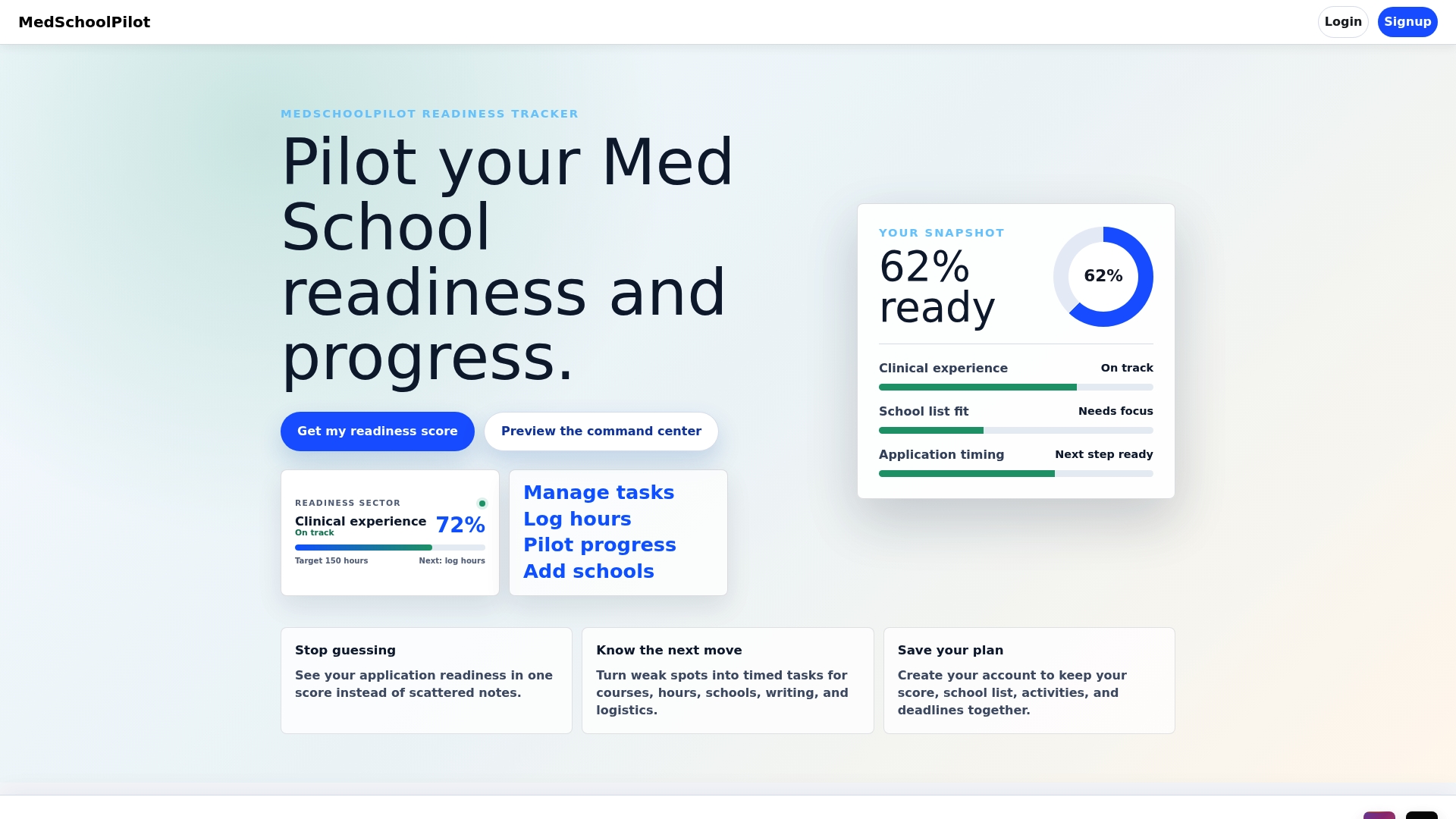
Medschoolpilot’s readiness tracker gives you a single workspace where you can log each school’s SJT requirement, set score distribution reminders, and track your overall application readiness score as you complete each milestone. The platform integrates your clinical hours tracking, school list selection, and deadline management so nothing gets missed when the cycle accelerates in July and August. For CASPer-specific preparation, the CASPer prep guide on Medschoolpilot walks through timed practice sets and scenario frameworks built for medical school applicants.
Start tracking your application for free and add your SJT requirements today — before registration windows open and dates fill up.
Useful sources and where to verify current requirements
Requirements change every application cycle. Verify fees, test dates, and school-specific SJT policies between April and July, when programs publish updates for the upcoming cycle.
- AAMC PREview official information and registration — Yale OCS maintains a clear summary with links to AAMC’s official PREview pages.
- Acuity Insights / CASPer official site — University of Rochester’s Greene Center links directly to Acuity Insights registration and current cycle details.
- AAMC MSAR (Medical School Admission Requirements) — cross-reference school-level admissions data including SJT requirements.
- Medschoolpilot readiness tracker — log SJT requirements, deadlines, and score distribution milestones for your full school list in one place.
- Individual school admissions pages — always the primary source; check each program directly before finalizing your test calendar.
This article provides general informational guidance about CASPer and AAMC PREview. Requirements, fees, and policies change annually. Confirm current rules with each school’s admissions office and the official AAMC and Acuity Insights websites before making registration decisions.