
Use AMCAS for MD programs, AACOMAS for DO programs, and TMDSAS for most Texas public medical schools. The single biggest structural difference: AMCAS caps you at 15 activity entries and requires three “Most Meaningful” essays, while AACOMAS places no limit on entries and has no “Most Meaningful” requirement. That one distinction shapes how you write, what you include, and how long the whole process takes.
Before you draft a single sentence of your personal statement or request one letter, decide whether you’re applying MD, DO, or both. That decision determines which platform you’re writing for and whether you need to build two distinct versions of your materials.
- Apply through AMCAS if you’re targeting allopathic (MD) programs at most U.S. medical schools.
- Apply through AACOMAS if you’re targeting osteopathic (DO) programs.
- Apply through TMDSAS if you’re targeting most Texas public medical schools, regardless of degree type.
- Apply through more than one system if you’re casting a wide net across MD and DO programs, or applying both inside and outside Texas.
Table of Contents
- What are AMCAS, AACOMAS, and TMDSAS?
- How do AMCAS and AACOMAS compare side by side?
- How do you tailor your personal statement for MD vs. DO programs?
- How does the activities section work differently in AMCAS vs. AACOMAS?
- What do letters of recommendation look like across these systems?
- How do MCAT scores and GPA work across AMCAS and AACOMAS?
- What should you budget for fees and processing timelines?
- Should you apply to both MD and DO programs?
- What mistakes do applicants most commonly make?
- Managing multiple CAS systems without losing your mind
- Key Takeaways
- Medschoolpilot keeps your AMCAS and AACOMAS applications on track
What are AMCAS, AACOMAS, and TMDSAS?
AMCAS is the American Medical College Application Service, administered by the AAMC. It’s the centralized portal for most allopathic MD programs in the United States. You fill out one application, and AMCAS distributes it to every MD school you designate. Most U.S. MD programs participate, with the notable exception of many Texas public schools.
AACOMAS is the American Association of Colleges of Osteopathic Medicine Application Service, run by AACOM. It serves all accredited U.S. osteopathic medical schools. Like AMCAS, it centralizes your coursework, activities, letters, and personal statement into one submission that goes to every DO school you select.
TMDSAS is the Texas Medical and Dental Schools Application Service. It covers most Texas public medical schools, including both MD and DO programs within that system. If you’re applying to UT Southwestern, UT Health San Antonio, or similar institutions, TMDSAS is your portal, not AMCAS.
The practical use-case breakdown: if you’re applying only to MD programs outside Texas, you need AMCAS. Only DO programs, you need AACOMAS. Texas public schools, you need TMDSAS. Applying broadly across all three types means running multiple applications simultaneously, which is manageable with the right workflow.
How do AMCAS and AACOMAS compare side by side?
| Feature | AMCAS (MD) | AACOMAS (DO) | TMDSAS (Texas) |
|---|---|---|---|
| Who uses it | Most U.S. MD programs | All U.S. DO programs | Most Texas public MD/DO schools |
| Activity entries | 15 maximum | Unlimited | — |
| “Most Meaningful” requirement | Yes — 3 required | No | No |
| Personal statement length | 5,300 characters | 5,300 characters | 5,000 characters + extra essays |
| GPA calculation | BCPM vs. non-science split | Grade replacement allowed | Separate calculation |
| MCAT submission | Sent directly from AAMC | Sent directly from AAMC | Sent directly from AAMC |
| Verification timeline | ~4–6 weeks | ~3–4 weeks | Often earlier for Texas cycle |
| Base fee (first school) | Verify at AAMC | Verify at AACOM | Verify at TMDSAS |
| Per-school fee | Verify at AAMC | Verify at AACOM | Verify at TMDSAS |
| Secondary applications | Triggered after verification | Triggered after verification | Varies by school |
| Best for | MD-only applicants | DO-only applicants | Texas-focused applicants |

A few things worth unpacking from that table. The activities limit is the most operationally significant difference. With AMCAS, you have 15 slots and must choose three to elevate with extended “Most Meaningful” essays. Every entry counts. AACOMAS gives you room to document a broader range of experiences without forcing that triage. If you have ten clinical experiences across different settings, AACOMAS lets you list them all; AMCAS makes you choose which ones to keep and which to cut or combine.
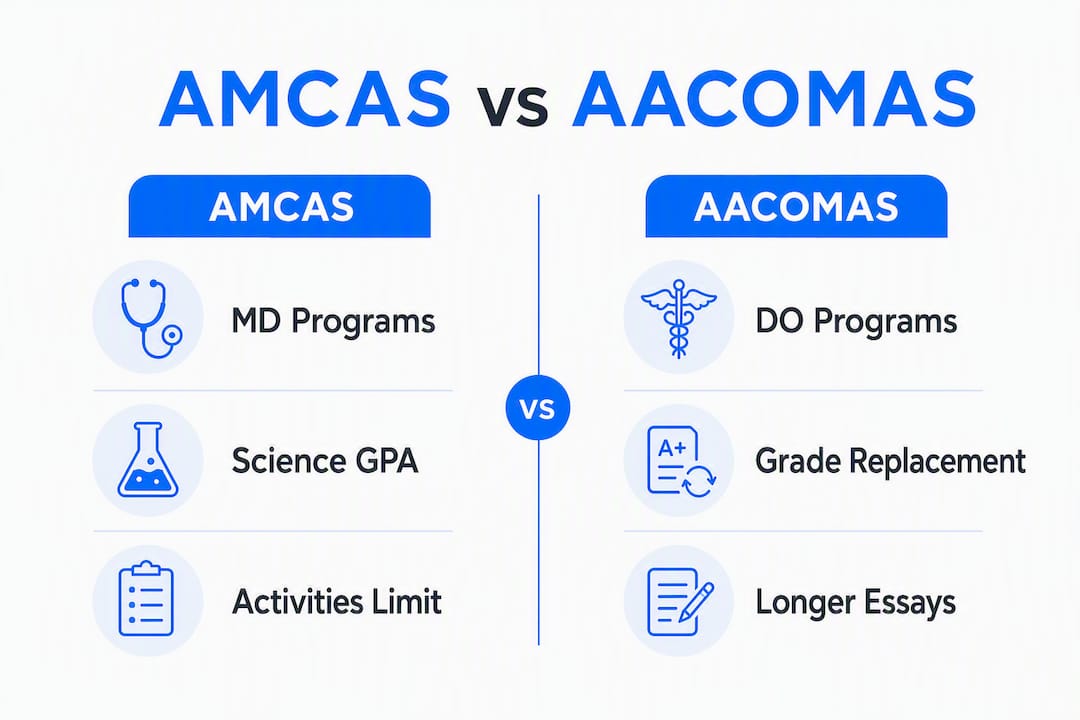
The GPA calculation difference matters more than most applicants realize. AMCAS separates your science GPA (BCPM: biology, chemistry, physics, math) from your non-science GPA, and schools see both. AACOMAS allows grade replacement for repeated courses, which can raise your calculated GPA, but not every DO school uses the replaced figure in their internal review. More on that in the GPA section below.
Pro Tip: Fee amounts for all three services change year to year. Always verify current figures directly on the AAMC, AACOM, and TMDSAS official sites before you pay. Budget for both the base fee and per-school fees, since adding schools late in the cycle adds up fast.
How do you tailor your personal statement for MD vs. DO programs?
Both AMCAS and AACOMAS use a 5,300-character personal statement, so the length constraint is identical. What differs is what admissions committees are looking for when they read it.

MD programs want to see your commitment to evidence-based medicine, scientific curiosity, and clinical exposure. The narrative should demonstrate that you understand what physicians do and why you’re drawn to that specific path. DO programs want all of that, plus clear evidence that you understand and embrace osteopathic philosophy: the whole-patient approach, the role of the musculoskeletal system, and ideally some firsthand exposure to osteopathic manipulative treatment (OMT). Admissions committees at DO schools are reading for that distinction. A personal statement that could have been written for any MD program, with no mention of osteopathic principles, is a missed opportunity.
The most efficient approach: write one strong master statement that tells your story, then create two targeted versions. Your MD version stays focused on clinical experiences, scientific reasoning, and your motivation for medicine broadly. Your DO version adds or expands a paragraph that explicitly addresses osteopathic philosophy, your exposure to a DO physician or OMT, and why that approach resonates with you. You’re not rewriting from scratch; you’re swapping one section and sharpening the framing.
TMDSAS complicates this slightly. Its main personal statement is capped at 5,000 characters, and the platform requires additional essays (a Personal Characteristics Essay and a Challenge Essay) with their own prompts and character limits. If you’re applying to Texas schools alongside MD or DO programs elsewhere, write your master statement to fit 5,000 characters so it works across all three platforms without cutting.
Pro Tip: Keep a master personal statement file with clearly labeled sections (e.g., “DO paragraph,” “Texas challenge essay”). When you finalize each portal version, copy from the master rather than editing the live application. One accidental save in the wrong portal can overwrite work you can’t recover.
How does the activities section work differently in AMCAS vs. AACOMAS?
The activities section is where the AMCAS vs. AACOMAS structural gap is most concrete. AMCAS limits you to 15 entries with 700 characters per description, and you must designate three of those as “Most Meaningful,” each with an expanded essay. AACOMAS sets no cap on entries and generally offers longer description fields, giving you more room to document the full breadth of your experience.
What this means in practice:
- For AACOMAS: — List everything relevant. More entries give the committee a fuller picture, and you’re not penalized for thoroughness. Use the longer description fields to add context, hours, and outcomes.
The “Most Meaningful” entries in AMCAS deserve real attention. These aren’t just your three best activities; they’re the three that most shaped your path to medicine. The expanded essay space is where you explain what you learned, how it changed you, and why it matters to your future as a physician. Admissions readers spend more time on these than on standard entries.
Pro Tip: Build a master spreadsheet with every experience you’ve had: dates, hours, organization, supervisor, and a 2–3 sentence description. When you sit down to fill out AMCAS or AACOMAS, you’re pulling from a complete inventory rather than trying to reconstruct your history from memory. Medschoolpilot’s clinical hours tracker is built exactly for this.
What do letters of recommendation look like across these systems?
Both AMCAS and AACOMAS accept committee letters, individual letters, and letter packets. The mechanics are similar: recommenders upload letters to the portal (or to a letter service), and the system attaches them to your application. What varies is what individual schools require.
Most MD programs want a minimum of three letters, typically two science faculty, one non-science faculty, and one clinical supervisor or physician. DO programs often want the same mix, with one important addition: many DO schools request or strongly prefer a letter from a DO physician. If you’re applying to DO programs and haven’t shadowed a DO, that’s worth addressing before you request your letter packet.
Using a centralized letter service like Interfolio solves a real logistical problem for dual applicants. Your recommenders upload once; you direct letters to AMCAS, AACOMAS, or TMDSAS from a single dashboard. Without that, you’re asking recommenders to upload separately to each portal, which creates friction and delays.
Check each target school’s specific requirements before you request letters. Some schools cap the total number of letters they’ll review. Others specify that a committee letter replaces individual letters entirely. Getting this wrong means either missing a required letter or flooding a school with more letters than they’ll read.
How do MCAT scores and GPA work across AMCAS and AACOMAS?
Your MCAT scores go to both systems the same way: you send them directly through your AAMC account, and both AMCAS and AACOMAS receive them. Schools see all scores from all test dates unless a program specifies otherwise.
GPA is where the systems diverge. AMCAS calculates two GPAs: your BCPM (biology, chemistry, physics, math) and your non-science GPA. Both appear on your verified application, and schools weigh them independently. There’s no grade replacement; every grade you earned is in the calculation.
AACOMAS uses a different approach. It allows grade replacement for repeated courses, meaning the higher grade can replace the lower one in the calculated GPA. This can meaningfully raise your AACOMAS GPA if you retook courses after a rough semester. The catch: not every DO school uses the AACOMAS-calculated GPA in their internal review. Some recalculate using original grades. Keep both your original and replacement transcripts organized in your records, because you may need to explain the discrepancy if a school asks.
Transcript verification is the step that triggers the clock on both systems. Submit your official transcripts early, because AMCAS verification typically takes 4–6 weeks while AACOMAS runs closer to 3–4 weeks. Schools don’t see your file until verification is complete, and secondaries don’t get triggered until after that. Every week you wait on transcripts is a week lost in a rolling admissions cycle.
What should you budget for fees and processing timelines?
Both AMCAS and AACOMAS charge a base fee for your first school designation, then add a per-school fee for each additional program. The exact amounts change annually, so treat any figure you read in a blog post as a starting point and verify the current numbers on the AAMC and AACOM official sites before you pay.
| Step | AMCAS | AACOMAS | TMDSAS |
|---|---|---|---|
| Verification timeline | ~4–6 weeks | ~3–4 weeks | Often earlier in Texas cycle |
| Rolling admissions | Yes | Yes | Yes |
| When secondaries trigger | After verification | After verification | Varies by school |
| Recommended submission window | As early as June | As early as May/June | As early as May |
The rolling admissions point deserves emphasis. Both AMCAS and AACOMAS fill seats throughout the cycle, not just at a single deadline. An application verified in June competes for more open seats than one verified in September. AACOMAS typically verifies faster than AMCAS, which means DO applicants who submit early can sometimes receive interview invitations before MD applicants in the same cycle have even been verified.
Practical checklist before you hit submit:
- Official transcripts ordered and confirmed received by the portal
- All activity entries complete with accurate hours and dates
- Personal statement finalized and within character limits
- Letters assigned to your application (not just uploaded by recommenders)
- Fee payment confirmed
- Verification status monitored in the portal dashboard
Should you apply to both MD and DO programs?
You can, and many applicants do. The key is treating each application as its own product rather than a copy-paste job.
Here’s a step-by-step workflow that keeps the process manageable:
- Build an activities master spreadsheet — List every experience with canonical descriptions, hours, and dates. For AMCAS, select your 15 strongest and flag your three “Most Meaningful.” For AACOMAS, use the full list.
The personal statement is the piece that requires the most deliberate tailoring. Your activities list and letters can largely transfer with minor adjustments, but a DO application that reads like an MD application signals to the committee that you didn’t think carefully about why you want to be a DO.
When does TMDSAS matter for your application?
TMDSAS covers most Texas public medical schools, including both MD and DO programs within that system. If UT Southwestern, Texas A&M, or similar institutions are on your list, you need TMDSAS regardless of whether you’re also using AMCAS or AACOMAS for programs elsewhere.
A few things that catch applicants off guard: TMDSAS has its own essay prompts, including a Personal Characteristics Essay and a Challenge Essay, each with separate character limits. The main personal statement is capped at 5,000 characters, shorter than the 5,300-character limit on AMCAS and AACOMAS. If you write your master statement at 5,300 characters, you’ll need to trim it for TMDSAS.
Some Texas programs use AMCAS for specific tracks, such as MD/PhD or JD/MD dual-degree programs, rather than TMDSAS. Always verify at the school level before assuming TMDSAS is the right portal. Texas-specific rules are frequently misunderstood, and public Texas schools prioritize in-state applicants, so the essay strategy and school selection logic differs from out-of-state MD or DO applications.
If you’re applying both in Texas and outside Texas, plan your personal statement around the 5,000-character floor so it works across all three systems without requiring a separate edit.
What mistakes do applicants most commonly make?
The most common errors aren’t strategic; they’re operational. Mis-entered transcript data, character-limit overruns, incorrectly assigned letters, and waiting on verification before starting secondaries are the four that derail otherwise strong applications.
Quick fixes:
- Transcript errors: — Build a master list of every course you’ve taken, with the exact course name, credit hours, and grade as it appears on your official transcript. Enter AMCAS and AACOMAS course data from this list, not from memory.
Pro Tip: Before requesting any letters, check each target school’s specific requirements. Some DO programs require a letter from a DO physician. Some schools cap total letters at three. Requesting the wrong mix means either scrambling for a new letter mid-cycle or having letters that don’t match what the school wants.
Managing multiple CAS systems without losing your mind
Running AMCAS and AACOMAS simultaneously means tracking two verification timelines, two sets of secondary deadlines, two activity lists, and two personal statement versions, plus letters that need to reach both portals. Managing that independently, in separate documents and browser tabs, is how applicants miss deadlines or submit the wrong version to the wrong portal.
A single organizational platform solves this. Medschoolpilot is built for exactly this kind of multi-system complexity. Its readiness tracker maps your progress across every component of the application, from clinical hours to letter status to school-specific requirements. You can log activities once and reference them when filling out either portal, track which letters have been uploaded and assigned, and monitor your verification status without digging through email threads.
Key features that matter for AMCAS/AACOMAS management:
- Milestone timelines that flag when to submit transcripts, request letters, and expect verification
- Clinical, research, and volunteer hours logging that feeds directly into your activities master
- School-specific requirement flags so you know which DO schools want a DO letter before you request your packet
- Deadline tracking across multiple CAS systems in one calendar view
The workflow looks like this in practice: set your submission target dates in Medschoolpilot, assign tasks (transcript requests, letter requests, essay drafts) with due dates, import your activity master, and use the school list tool to flag which programs need tailored materials. When verification completes, you’re not scrambling; you’re executing a plan you already built.
Managing multiple systems independently increases the risk of format errors and missed deadlines. A single tracker reduces that risk to near zero.
Key Takeaways
AMCAS is for MD programs, AACOMAS is for DO programs, and TMDSAS covers most Texas public schools; the biggest structural difference is AMCAS’s 15-activity cap with three required “Most Meaningful” essays versus AACOMAS’s unlimited entries.
| Point | Details |
|---|---|
| Choose your system first | AMCAS for MD, AACOMAS for DO, TMDSAS for most Texas public schools; decide before writing materials. |
| Activities limits drive strategy | AMCAS caps entries at 15 with three “Most Meaningful” essays required; AACOMAS allows unlimited entries with no such requirement. |
| Tailor personal statements, not rewrite | Both systems use a 5,300-character limit; swap one paragraph for DO philosophy rather than starting over. |
| Submit early in rolling admissions | AACOMAS verifies in roughly 3–4 weeks vs. 4–6 weeks for AMCAS; earlier submission means earlier interview consideration. |
| Medschoolpilot centralizes the workflow | Use Medschoolpilot to track deadlines, log hours, monitor letter status, and manage school-specific requirements across all three CAS systems. |
The Medschoolpilot perspective on choosing and managing CAS systems
The conventional advice is to apply broadly and apply early. Both are correct, but they miss the more important point: applying broadly to the wrong mix of programs, with a personal statement that doesn’t speak to the specific degree type, wastes money and time. The AMCAS vs. AACOMAS decision isn’t just logistical; it’s a signal about what kind of physician you want to be.
DO programs aren’t a fallback. They’re a different philosophy of medicine, and admissions committees can tell immediately whether an applicant understands that. The applicants who do well across both systems are the ones who write genuinely distinct personal statements, not two versions of the same story with “osteopathic” inserted in one paragraph.
The operational side is where most applicants underestimate the complexity. Two verification timelines, two sets of secondaries, letters that need to reach two portals, and activity lists that need to be curated differently for each system. The students who handle this well aren’t necessarily the most organized by nature; they’re the ones who build a system before they start, not after they’ve already missed something.
A modular approach to writing and a single tracker for deadlines and documents is the difference between a cycle that feels controlled and one that feels like constant catch-up. Prioritize accuracy in your transcript and course entry above everything else; a verification error costs weeks. And tailor rather than rewrite wherever possible; your story doesn’t change between AMCAS and AACOMAS, only the emphasis does.
Medschoolpilot keeps your AMCAS and AACOMAS applications on track
Coordinating AMCAS, AACOMAS, and TMDSAS from separate spreadsheets and calendar apps is where good applications fall apart. Medschoolpilot gives you one place to track every moving piece: your readiness score, clinical and volunteer hours, letter status, school-specific requirements, and submission milestones across all three systems.
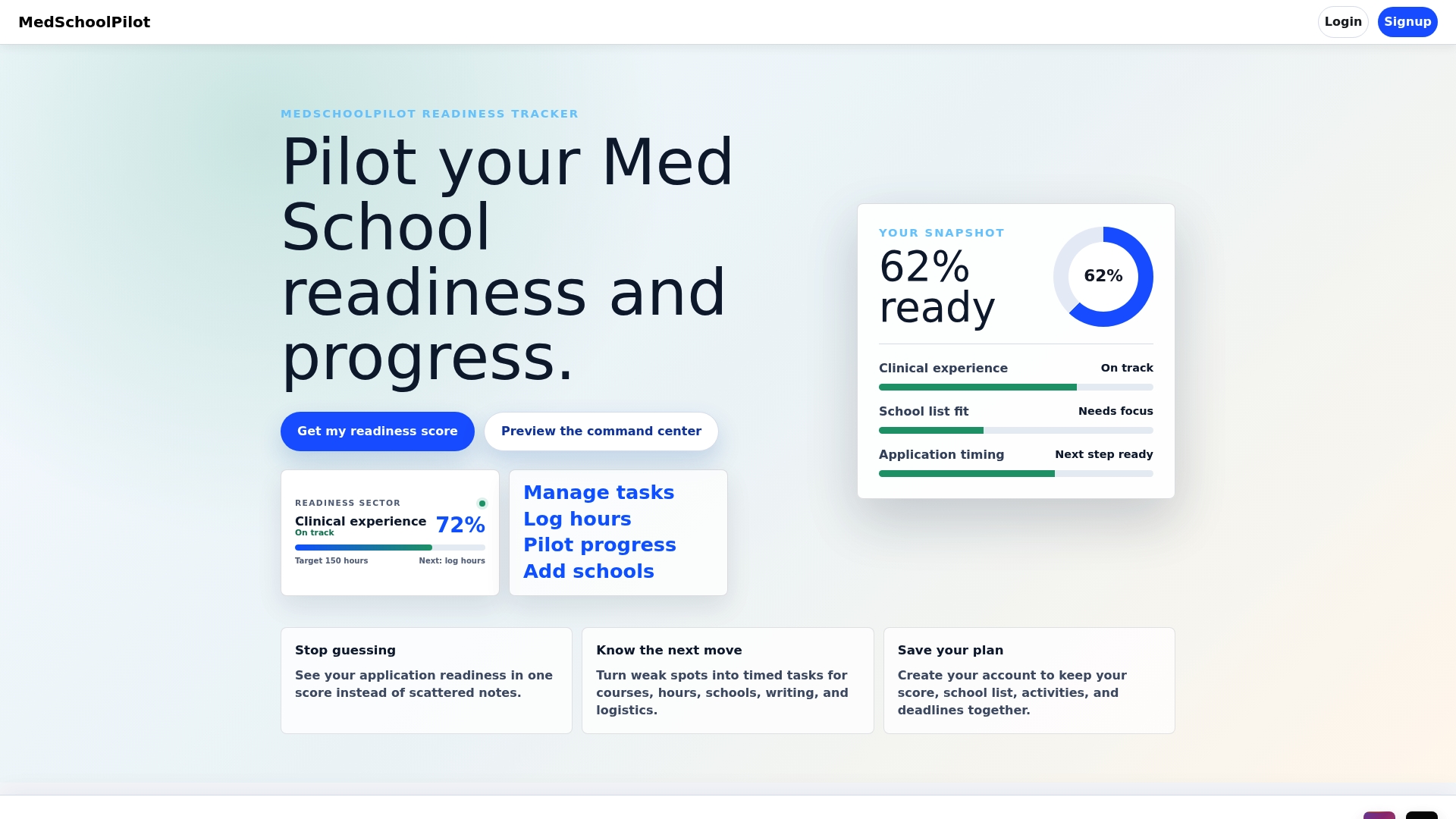
The readiness tracker shows you exactly where you stand before you submit, so you’re not guessing whether your file is complete. School list tools flag which programs need a DO letter, which use TMDSAS instead of AMCAS, and what each secondary requires. You build the plan once; the platform keeps you on it.
Start tracking your application readiness for free, or watch how Medschoolpilot works before you sign up.