
Secondary applications typically land in your inbox 2 to 4 weeks after AMCAS verifies and transmits your primary application, with the heaviest volume typically occurring mid-summer. The single rule that matters most once that email arrives: aim to submit within 7 to 14 days, and never sacrifice quality to beat that window. A rushed essay at day 4 rarely beats a sharp one at day 12.
Here’s what to do the moment a secondary lands:
- Log the date received and the stated deadline in your tracker, not just your memory.
- Check the school portal for exact instructions. Some schools give you three weeks from receipt rather than a fixed calendar date, per MSAR’s secondary application guidance.
- Slot it into your priority queue based on deadline pressure, rolling review status, and how long the prompts will take.
Turnaround target: Med School Insiders recommends the 7 to 14 day window as the sweet spot between showing genuine interest and producing thoughtful, error-free writing. Miss that window occasionally and it’s not catastrophic. Blow past 21 days on multiple schools and you start losing ground in rolling admissions cycles.
Key Takeaways
Hitting the 7 to 14 day secondary turnaround requires prewritten essay modules, a weekly production cadence, and a triage system built before invitations start arriving.
| Point | Details |
|---|---|
| Secondaries follow verification | Expect arrival 2 to 4 weeks after AMCAS transmission, with volume peaking in July and August. |
| Target 7 to 14 days | Submit within this window, but never rush a weak essay just to beat the clock. |
| Prewrite core modules | Draft “why medicine,” diversity, and challenge essays before secondaries arrive to speed up personalization. |
| Triage by five questions | Sort incoming secondaries by deadline, rolling review status, fit, time cost, and strategic priority. |
| Track systematically | Medschoolpilot converts deadline, status, and priority fields into a live, actionable timeline as volume scales past what a spreadsheet can handle. |
Table of Contents
- When Does the Secondary Applications Timeline Actually Start?
- Building a Week-by-Week Plan for Secondary Season
- How to Pre-Write Secondary Prompts Before They Arrive
- Which Secondaries Should You Complete First?
- What Happens If You Miss a Secondary Deadline?
- What’s the Best Way to Track Multiple Secondaries?
- When Do Interview Invitations Follow Secondary Submissions?
- What Structured Speed Actually Looks Like
- Managing Secondary Season Without Losing Track of Anything
- Where to Verify Deadlines and Policies
- Frequently Asked Questions
- Sources
When Does the Secondary Applications Timeline Actually Start?
The secondary applications timeline doesn’t start on a fixed date. It starts the moment AMCAS verifies your primary application and transmits it to your schools, and that single event determines almost everything about when your inbox fills up.
AMCAS begins transmitting verified applications to medical schools starting in summer, which is why late June marks the earliest realistic date for secondary invitations. Verification itself typically takes several weeks after you submit, longer during the June and July crunch when AMCAS processes a flood of applications simultaneously. That backlog is the reason two students who submit their primary a day apart can see secondaries arrive weeks apart. Verification speed, not submission speed alone, drives the clock.
Here’s the sequence that produces the secondary season:
- AMCAS opens for the application cycle, usually in May.
- First submission day follows shortly after, typically late May or early June.
- Verification happens on a rolling basis and can take anywhere from a few days to several weeks depending on submission volume and application complexity.
- Transmission to schools begins in late June, once your application clears verification.
- Secondary release follows transmission, ranging from same-day for some schools to several weeks for others.
The rhythm plays out roughly like this across the cycle:
| Period | What’s happening |
|---|---|
| May | Primary application prep, personal statement finalized, school list locked |
| Late June | AMCAS transmission begins; first secondaries start trickling in |
| July | Secondary volume peaks; most applicants juggling 5 to 15 active prompts |
| August | Second wave of secondaries; interview invitations begin for early submitters |
| September onward | Remaining secondaries arrive; interview season intensifies through spring |
Secondaries commonly begin arriving in late June, with the bulk landing in July and August, which is exactly what you’d expect once you track the AMCAS verification bottleneck. If your primary went in during the first wave in late May or early June, expect your first secondary sometime in July. Submit in August or later, and you’re likely looking at a September start, sometimes later.
Not every school moves at the same pace, and that variability is not a glitch. Some schools send secondaries to every verified applicant automatically, often within 24 to 48 hours of transmission. Other schools screen applications first, filtering by GPA, MCAT score, or state residency before deciding who gets invited to the secondary stage. There is no single release schedule that applies across the board, and treating one school’s timeline as the norm for all of them is a mistake that catches a lot of applicants off guard. Admissions advisors note this variability explicitly: plan for a range, not a date.
This matters for your own scheduling. If you applied to a mix of automatic-release and screened schools, expect secondaries to arrive in bursts rather than a steady trickle. That’s actually useful information. It means you can predict, roughly, which invitations are coming based on each school’s known pattern, something worth researching through each school’s MSAR listing before the season starts. Schools that use screening tend to send secondaries later but with a higher signal that you’re a serious contender, which should factor into how you prioritize your response.
If you’re also weighing AACOMAS or TMDSAS applications alongside AMCAS, the same verification-to-transmission logic applies, though the specific timelines and portals differ. Understanding how AMCAS and AACOMAS diverge on verification speed and secondary release patterns helps you set realistic expectations for each service rather than assuming they all move in lockstep.
Building a Week-by-Week Plan for Secondary Season
Secondary season rewards preparation more than raw effort. The students who handle 20 to 30 secondaries without burning out aren’t necessarily faster writers. They just started earlier and built a system before the deadlines started stacking up.
Before secondaries arrive (May, ideally by early June): finish your core personal statement content, research each school’s mission and curriculum structure, and set up your tracking system. This is also when you draft your first-pass answers to the prompts you can predict: “why medicine,” “describe a challenge,” “diversity contribution.” You won’t know exact word counts yet, but you’ll have raw material ready to shape.
Once secondaries start landing, the cadence shifts fast:
- Week 1 of peak season: Expect 2 to 5 secondaries to arrive. Treat this week as calibration. Submit your first one or two within 5 to 7 days to build momentum and confirm your editing workflow actually works under real conditions.
- Weeks 2 and 3: This is peak production. If you applied broadly to 20 to 30 schools, expect to submit multiple secondaries per week during this stretch, often 5 to 7 in your heaviest week. Block dedicated writing time daily rather than trying to knock out three essays in one marathon Saturday session.
- Weeks 4 through 6: Volume typically eases as your early batch clears and later-release schools send their invitations. Use lighter weeks to catch up on any secondary approaching its deadline and to revisit earlier submissions for quality control if you have flexibility built in.
If you applied to fewer schools, say 12 to 18, your peak weeks will be gentler, but the same daily-block principle holds. Consistency beats intensity here.
A realistic daily block during peak weeks looks like 90 minutes to 2 hours, split between drafting one prompt and editing a previous draft. Trying to draft and polish in the same sitting usually produces worse writing than separating the two tasks by at least a few hours, ideally overnight.
Pro Tip: Set a hard 14 day cap on any single secondary and mean it. If you’re still stuck on a draft at day 12, submit what you have rather than pushing to day 20 for marginal polish. A completed application with a solid essay beats a perfect essay that arrives too late to matter for rolling review.
Build in one buffer day per week where you do nothing but catch up, rest, or handle whatever slipped. Secondary season without a scheduled pause tends to end in either missed deadlines or a burned-out applicant turning in weaker essays by August. Neither outcome serves you.
How to Pre-Write Secondary Prompts Before They Arrive
The single biggest lever for hitting the 7 to 14 day turnaround target is work you do before any secondary shows up in your inbox. Admissions advisors consistently point to prewriting core modules as the difference between calmly personalizing existing material and scrambling to draft from scratch under deadline pressure.
Most secondary prompts fall into a short list of recurring categories, and you can draft a flexible module for each one months before school-specific versions arrive:
- Why medicine: your core motivation narrative, adaptable in length from 250 to 1,000 words.
- Why this school: a skeleton built from curriculum structure, mission statement themes, and specific opportunities, ready for you to swap in school-specific details.
- Diversity or unique perspective: how your background, identity, or experiences shape your approach to medicine.
- Challenge or failure: a structured story with a clear setup, obstacle, and lesson.
- Research or scholarly work: a summary of your project, its significance, and what you learned.
- Additional information or “anything else”: a flexible module covering gaps or context your primary application didn’t fully capture.
The “why this school” essay deserves its own checklist because it’s the one prompt that can’t be templated wholesale. Before you personalize it, pull specifics from the school’s MSAR profile and its own website: curriculum format (problem-based vs. traditional lecture), unique tracks or dual-degree options, clinical partnerships, and any research centers that align with your interests. Generic praise about “commitment to underserved populations” reads as filler when half your applicant pool writes the same line. Specific details, a named program, a clinical rotation site, a faculty member’s research focus, signal that you actually did the homework.
Once a real secondary prompt arrives, your workflow should look like this: pull the matching module, adjust length and tone to the school’s specific wording, insert two or three school-specific details, then move to editing. Draft first, edit later, ideally with at least a few hours between the two steps so you’re reading with fresh eyes.
Pro Tip: Read every draft out loud before submitting. Awkward phrasing that looks fine on screen almost always announces itself the moment you hear it.
Run a final proofreading pass checking for the wrong school name (a genuinely common error when you’re personalizing ten essays in a week), correct word counts, and consistent formatting. A polished template beats a rushed original draft nearly every time.
Which Secondaries Should You Complete First?
When five secondaries land in the same week, you need a system for deciding what gets your attention first, not a gut feeling that changes daily. Five questions will sort your queue reliably:
- What’s the stated deadline? A school with a 2 week window from receipt outranks one giving you 30 days, regardless of how much you like either school.
- Does the school use rolling admissions review? If yes, earlier completion genuinely matters, since your file gets reviewed as soon as it’s complete rather than after a fixed cutoff.
- How strong is your mission fit? Schools where your background and goals align tightly deserve more editing time and a faster spot in the queue, since they’re likely to yield real interview traction.
- How long will this actually take? A single short-answer prompt takes 30 minutes. A 1,000 word “why this school” essay takes hours across drafting and editing. Estimate honestly.
- How strategically important is this school to your overall list? A reach school and a safety school with identical deadlines don’t deserve identical urgency if your list has a clear priority order.
Sort what lands into three tiers based on those answers.
Tier 1 covers secondaries with short deadlines, rolling review, strong mission fit, or high strategic priority. These get worked on within 48 hours of arrival and finished inside your 7 to 14 day target without exception.
Tier 2 includes solid schools with reasonable deadlines and no unusual urgency. These fill your daily writing blocks after Tier 1 work is moving, typically completed within the standard window but without the same day-one urgency.
Tier 3 holds lower-priority schools or ones with generous deadlines (three weeks or more). These can wait a few days while you clear higher-priority work, as long as you’re not letting them slide past 14 days without a reason.
Batch similar work together rather than bouncing between prompt types all day. If three schools all ask a “why medicine” variant, draft all three personalizations in one focused session using your prewritten module. Save your longest, most demanding essays for a dedicated deep-work block, ideally your sharpest hours of the day, rather than squeezing them between other tasks.
What Happens If You Miss a Secondary Deadline?
Missing a deadline under rolling admissions carries more weight than missing one under a fixed-deadline school, because rolling review rewards early completion directly. A school reviewing files as they come in has likely already interviewed or accepted a chunk of its class by the time a late secondary arrives. Every week you’re late is a week of shrinking seats, not just a technicality.
That doesn’t mean a missed deadline automatically means give up. Here’s how to decide what to do next:
- Submit late only if your materials genuinely add value. A polished, honest essay submitted a few days late usually still gets reviewed and can still result in an interview, especially at schools without a hard cutoff.
- Contact admissions before assuming the worst. A short, professional email explaining the delay and confirming whether late submission is still accepted costs you nothing and sometimes buys you flexibility.
- Consider withdrawing your application to that school if the delay is severe (multiple weeks past a hard deadline) and the school explicitly states it won’t review late files. Redirecting that time toward schools still actively reviewing your file is often the better use of your remaining season.
- Document everything. Note the date you contacted admissions, what they said, and when you actually submitted. If questions come up later, you’ll want the record.
Most schools would rather receive a complete secondary a few days late than not receive one at all, but check the specific school’s stated policy through its MSAR listing before assuming leniency.
What’s the Best Way to Track Multiple Secondaries?
A minimal tracker needs six fields to function: school name, date received, stated deadline, prompts required, status (not started, drafting, editing, submitted), and priority tier. That’s genuinely all you need to avoid the two most common failures of secondary season: forgetting a deadline entirely and losing track of which draft is actually final.

A basic spreadsheet works fine for applicants managing 10 to 15 schools. Add a column, sort by deadline, and you’ve got a functional system. Where spreadsheets start breaking down is volume. Once you’re juggling 25 or more active secondaries with overlapping deadlines and varying prompt counts, a static grid stops giving you the actionable view you need. You end up scrolling and recalculating priority by hand every time something new lands.
This is where a dedicated readiness platform earns its place. Medschoolpilot takes the same fields you’d track manually, deadline, status, priority, and turns them into a live timeline that flags what needs attention today versus what can wait. Instead of you recalculating your Tier 1 queue every time a new secondary arrives, the readiness scoring system surfaces it automatically, factoring in how each pending task affects your overall application progress.
Use a spreadsheet if your list is short, your deadlines are spread out, and you’re comfortable manually updating it daily. Move to an integrated tool once volume climbs past what you can eyeball in thirty seconds each morning, or once you’re managing secondaries alongside clinical hours, letters of recommendation, and MCAT retake prep simultaneously. That’s the exact bottleneck structured, batched time-blocking is designed to solve: reducing the mental overhead of tracking so your actual writing time stays protected.
When Do Interview Invitations Follow Secondary Submissions?
Interview invitations typically start arriving in August for the earliest, fastest-turned secondaries, with the bulk of invitations spreading from September through the following spring. Earlier submission genuinely improves your odds at schools using rolling review, since your file enters the review pool sooner and against a less crowded interview calendar.
A few actions matter once your secondaries start going out:
- Start basic interview prep, common questions, your own story, mock sessions, around the time your first two or three secondaries are submitted, not after your first invitation arrives.
- Send a letter of continued interest (LOCI) only to schools where you have genuinely new, meaningful information to share, not as a generic check-in.
- Send a brief thank-you note within 24 to 48 hours after any interview, keeping it specific to something discussed rather than generic.
- Track interview invitation dates alongside your secondary submission dates. The pattern you see (which schools moved fast, which are still silent) tells you where to focus updates and where to simply wait.
Treat early August as your unofficial deadline for having interview basics in place, even if your specific invitations haven’t landed yet.
What Structured Speed Actually Looks Like
The advice to “move fast” on secondaries gets misread constantly. Speed without structure just produces rushed, generic essays that read like exactly what they are. Structured speed, prewritten modules, a real weekly cadence, a triage system you actually follow, is what lets you hit that 7 to 14 day window without your writing quality collapsing under the pressure.
Preparedness beats motivation here. The applicants who handle 25 secondaries calmly aren’t working harder in July than everyone else. They did the thinking in May, when the pressure wasn’t on yet.
If you take one habit from this, make it a daily 60 to 90 minute drafting block, scheduled like an actual commitment, not squeezed in when you feel like it. That single habit, repeated through July and August, is usually the entire difference between a calm secondary season and a chaotic one.
Managing Secondary Season Without Losing Track of Anything
Secondary season is the one stretch of the application cycle where volume alone can wreck an otherwise strong applicant. Medschoolpilot was built around exactly this problem: a readiness tracker that turns your scattered deadlines, drafts, and school-specific requirements into one workspace instead of six browser tabs and a panic-inducing spreadsheet.
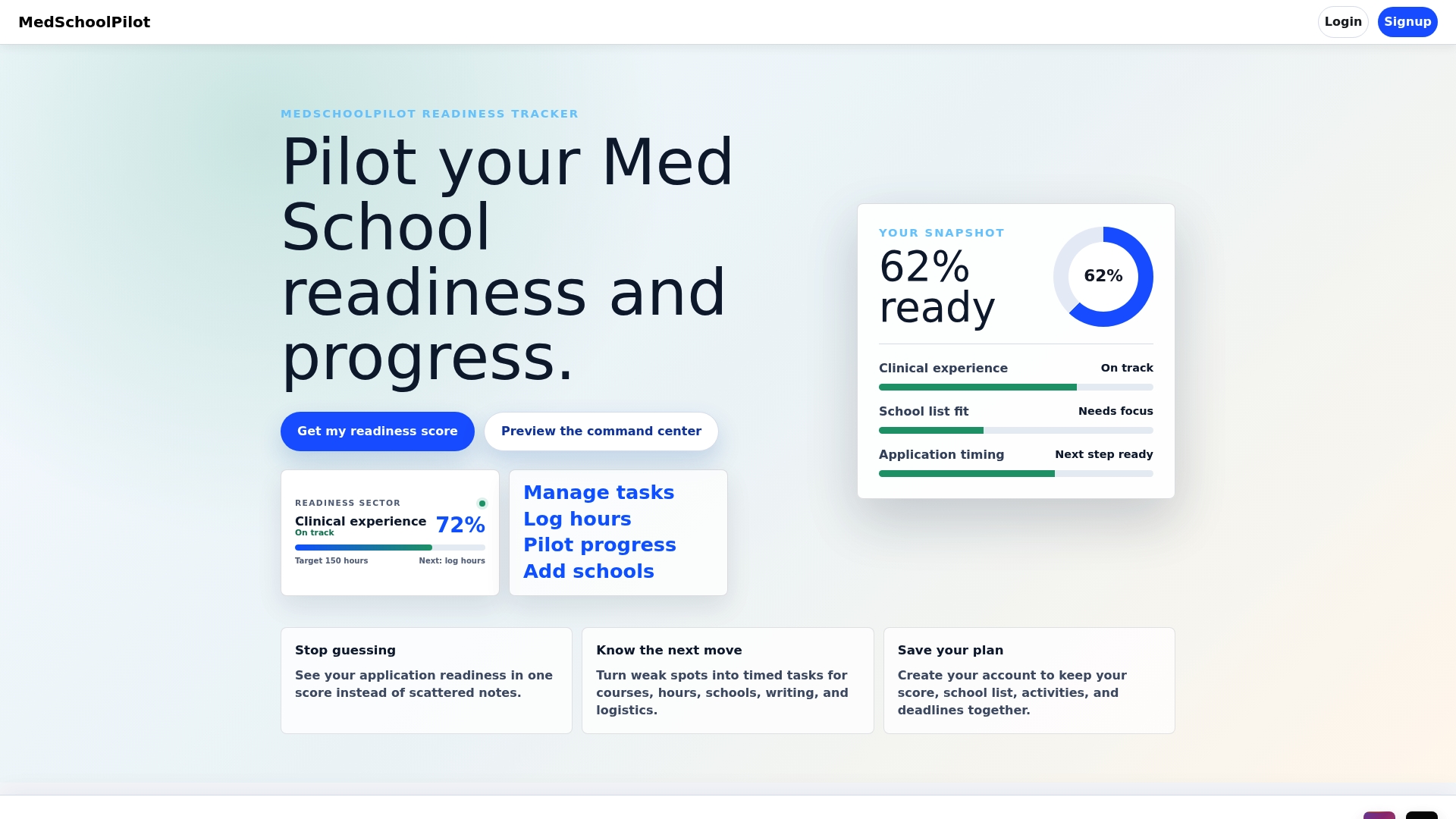
The platform’s readiness scoring flags which schools need attention today based on deadline proximity and your actual progress, so you’re not manually recalculating your Tier 1 queue every morning. School profiles, like the one for Medical University of South Carolina, surface deadline and fit details in the same place you’re already tracking your tasks, cutting out the constant tab-switching between MSAR, school websites, and your own notes.
If you’d rather manage secondaries from your phone between clinical shifts, the MedSchoolPilot iOS app mirrors the same tracking workflow on mobile. Start by setting up your readiness tracker with your current school list, and you’ll have a working priority queue built before your first secondary even lands.
Where to Verify Deadlines and Policies
Check MSAR’s secondary application guidance and each school’s own admissions page for exact deadline rules, since some schools use relative windows rather than fixed dates. Confirm your AMCAS transmission status directly through your AAMC account for the most current verification timing.
Frequently Asked Questions
When do secondary applications typically come out? Most secondaries arrive 2 to 4 weeks after AMCAS verifies and transmits your primary application, with the earliest invitations landing in late June and the heaviest volume in July and August.
How fast should I submit secondaries? Aim for 7 to 14 days per secondary. That window balances showing genuine interest with producing an essay that’s actually well-written, rather than rushed just to beat a self-imposed clock.
What is a good secondary turnaround time for med school applications? 7 to 14 days is the widely recommended benchmark. Submitting in 3 to 5 days rarely improves your odds enough to justify the drop in essay quality that speed usually forces.
Do all medical schools send secondaries at the same time? No. Some schools release secondaries automatically to every verified applicant within days of transmission. Others screen first, filtering by academic metrics before deciding who receives an invitation, which pushes their timing later.
What happens if I submit a secondary late? Impact depends on the school’s review model. Rolling admissions schools penalize lateness more heavily since seats fill as files complete. Contact admissions directly to confirm whether a late submission is still worth sending.
How many secondaries should I expect if I applied to 20 to 30 schools? Expect a heavy cluster in July and August, often several submissions due per week during peak weeks. Batching by prompt type and prewriting core modules makes that volume manageable without burning out.
Sources
- Secondary Applications - What to Expect and How to Approach Them | Med School Insiders
- Secondary Essay Season: Week-by-Week Strategy