
Premed is not a major. It is an undergraduate track built around specific prerequisite courses, sustained clinical exposure, a competitive GPA, and MCAT preparation, all aimed at a single goal: getting into medical school. If you’re starting this path today, five things matter immediately: lock in your science prerequisites, track your BCPM GPA separately from your cumulative GPA, start clinical hours now rather than later, map out MCAT timing before junior year, and get on your advisor’s calendar this semester.
TL;DR:
- Prioritize completing specific prerequisite courses early, including biology, chemistry, physics, biochemistry, and statistics, to avoid delays later in the process.
- Track your science GPA separately from your overall GPA, since both are scrutinized differently by medical schools, especially your BCPM GPA.
- Focus on building deep, sustained clinical experience in patient-facing roles rather than short-term shadowing to strengthen your application.
- Plan to take the MCAT by spring of your junior year, using full-length practice tests and active recall methods to improve your scores efficiently.
- Applying early during the primary cycle and maintaining organized, up-to-date application components significantly improves your chances of acceptance.
Table of Contents
- What Does Premed Actually Require? A Quick Checklist
- Coursework and Choosing a Major: Sequencing Prerequisites the Smart Way
- Your Premed Timeline: From Freshman Year to Application Day
- What Counts as Meaningful Clinical and Research Experience?
- MCAT Basics: What It Tests and How to Prepare
- Inside the Application: AMCAS, Secondaries, and Interviews
- Study Strategies and Wellbeing: What Actually Prevents Burnout
- Where to Find Reliable Premed Resources and Community Support
- Paying for the Premed Path: Financial Planning Basics
- MD Versus DO: What the Difference Means for Your Planning
- What to Do If You Don’t Get In the First Time
- MedSchoolPilot’s Take: Planning Beats Panic
- Organize Your Premed Requirements Without the Spreadsheet Chaos
- Sources
What Does Premed Actually Require? A Quick Checklist
Before anything else, audit where you stand against the baseline. Medical schools expect a specific academic foundation, and skipping a piece early costs you time later.
- Coursework: one year each of biology, general chemistry, and organic chemistry with labs, plus physics, biochemistry, and often statistics and English/writing, according to AACOM’s premed requirements.
- GPA: track your BCPM GPA (biology, chemistry, physics, math) separately from your cumulative GPA. Schools scrutinize both, but BCPM signals whether you can handle science-heavy coursework.
- Clinical exposure: start shadowing or working in a patient-facing role by sophomore year, not senior year.
- Research (optional but valuable): begin exploring lab or clinical research opportunities during your first two years.
- MCAT: plan to sit for it by January or spring of junior year, leaving time for a retake if needed.
Coursework and Choosing a Major: Sequencing Prerequisites the Smart Way
Any major works for premed, as long as you complete the prerequisites. Admissions committees care more about intellectual curiosity and sustained academic performance than which major sits on your transcript, according to The Princeton Review’s guidance on choosing a premed major. A philosophy major with a 3.8 GPA and strong MCAT score competes just as well as a biology major with the same numbers.
That said, sequencing matters more than major choice. A common approach front-loads biology, general chemistry, and math in year one, then organic chemistry and physics in year two, saving biochemistry and upper-level electives for junior year when you’re also studying for the MCAT. This avoids stacking three lab sciences with a demanding major curriculum in the same semester.
- Science majors get built-in overlap between coursework and MCAT content but face steeper GPA risk if the major itself is grade-punishing.
- Humanities or social science majors often protect GPA and diversify your application, but you’ll need to schedule prerequisites as electives with intention.
- Minors can fill gaps efficiently. A math or statistics minor, for instance, covers a requirement many schools list separately.
Whatever you choose, keep BCPM GPA and cumulative GPA on two separate mental ledgers. A dip in one non-science course won’t sink you the way a string of weak science grades will.
Your Premed Timeline: From Freshman Year to Application Day
Most students follow a four-year runway before applying, though roughly half of matriculating students at schools like the University of Michigan Medical School had graduated two or more years before starting medical school. Gap years are normal, not a red flag.
- Freshman and sophomore years: Complete core prerequisites, start clinical volunteering, and explore research labs. This is also when you should introduce yourself to your premed advisor.
- Junior year: Finish remaining prerequisites, take the MCAT in the winter or spring, and begin building your school list.
- Summer before senior year (or your application year): Submit your primary application as early in the cycle as possible. AACOM’s premed timeline recommends having your application materials ready well before the June opening date, since applying before July 4 meaningfully improves your odds through rolling admissions.
- Senior year or gap year: Complete secondaries, interview, and wait on decisions while finishing coursework or working.
If you need more time for the MCAT, research, or GPA repair, a gap year or post-baccalaureate program is a legitimate option, not a failure. Post-bacc programs specifically help students who changed career direction late or need to strengthen a science GPA before applying.
What Counts as Meaningful Clinical and Research Experience?
Admissions committees read hundreds of applications listing “shadowed a physician for a weekend.” What stands out is depth, not a checklist of activities. A single sustained role, whether as an EMT, medical scribe, hospice volunteer, or CNA, tells a stronger story than five short-term ones.
- Patient-facing roles (scribing, CNA work, EMT service) carry more weight than pure observation because they show you understand the emotional and practical realities of care.
- Shadowing still matters, especially early on, but works best paired with a longer-term commitment elsewhere.
- Research doesn’t require publication to count. A year in a lab, even without a paper, demonstrates scientific reasoning. Publication helps, but it’s the exception, not the expectation.
- Reflection matters as much as hours. Committees value applicants who can articulate what a role taught them about medicine, according to the AMA’s tips for premed applicants.
Pro Tip: If you volunteer weekly at a food bank or tutoring program, log the hours and specific tasks as you go. A few sentences each month turns into a detailed, honest AMCAS entry with a polished resume later, instead of a vague memory you’re reconstructing the night before the deadline.
MCAT Basics: What It Tests and How to Prepare
The MCAT covers four sections: biological and biochemical foundations, chemical and physical foundations, psychological/social/biological foundations of behavior, and critical analysis and reasoning skills (CARS). It tests applied reasoning far more than memorization, which is why cramming content the week before rarely works.
Your MCAT score and GPA function together, not separately. A strong MCAT can offset a mediocre GPA in some cases, and vice versa, but committees look for consistency between the two. A 3.9 GPA paired with a well-below-average MCAT raises questions about grade inflation or test anxiety that you’ll need to address elsewhere in your application.
AAMC’s official prep guidance recommends full-length practice tests under timed conditions, spaced practice over months rather than weeks, and active recall tools like Anki instead of passive rereading.
Matriculant benchmarks vary by school, and campus advising offices such as the University of Iowa’s pre-health advising center publish school-specific GPA and MCAT ranges. Check your target schools’ numbers directly rather than relying on a single national average, since ranges shift year to year and by institution.
Inside the Application: AMCAS, Secondaries, and Interviews
The primary application, AMCAS for MD programs and AACOMAS for DO programs, opens in May and includes coursework, activities, personal statement, and letters of recommendation. Verification, when AMCAS certifies your GPA and coursework, typically takes several weeks, which is exactly why submitting early matters.
- Secondaries arrive after your primary is verified and vary by school. Many schools use rolling admissions, so a fast secondary turnaround (within one to two weeks) keeps you competitive in the applicant pool.
- Letters of recommendation: most schools want two science faculty letters plus one non-science letter, though some prefer a committee letter if your school offers one. Ask professors who know your work well, not just those who gave you an A.
- Interviews range from traditional one-on-one formats to multiple mini-interviews (MMIs) and group formats. Practice out loud, not just in your head, and schedule mock interviews through your advising office weeks before your first real one.
Gather letters and finalize your school list well before AMCAS opens so your only bottleneck is verification, not paperwork on your end.
Study Strategies and Wellbeing: What Actually Prevents Burnout
Active learning beats passive review for both coursework and MCAT prep. Spaced repetition tools like Anki, timed practice questions, and the Pomodoro technique (25 minutes of focused work, then a short break) consistently outperform marathon rereading sessions, a point echoed in AAMC’s own MCAT prep recommendations.
- Use full-length AAMC practice exams under real timing conditions at least once every two weeks in the final stretch before your test date.
- Protect sleep during exam weeks. Cognitive performance drops faster from sleep debt than from an extra hour of study.
- Build in a genuinely off day each week. Advisors consistently push back against the “study every waking hour” mentality because it produces diminishing returns.
Pro Tip: Pick a major that keeps you intellectually engaged, even if it’s not science-heavy. Advisors and admissions data both point the same direction: forcing a mismatched major to look impressive often backfires on GPA, while a major you’re genuinely curious about tends to protect both grades and sanity.
Where to Find Reliable Premed Resources and Community Support
Skip the anecdotal panic threads when you need real answers. The AAMC and AACOM publish the actual prerequisite and timeline standards schools use. MSAR (the Medical School Admission Requirements database) gives school-specific data on GPA, MCAT, and mission fit.
- Your campus pre-health advising office should be your first stop for personalized sequencing questions.
- Communities like r/premed or PreMedCC offer peer support, but treat them as anecdotes, not policy. The AMA specifically cautions against letting forum anxiety override institutional guidance.
- Medschoolpilot’s premed articles library and science GPA calculator guide cover many of these mechanics in more depth.
Paying for the Premed Path: Financial Planning Basics
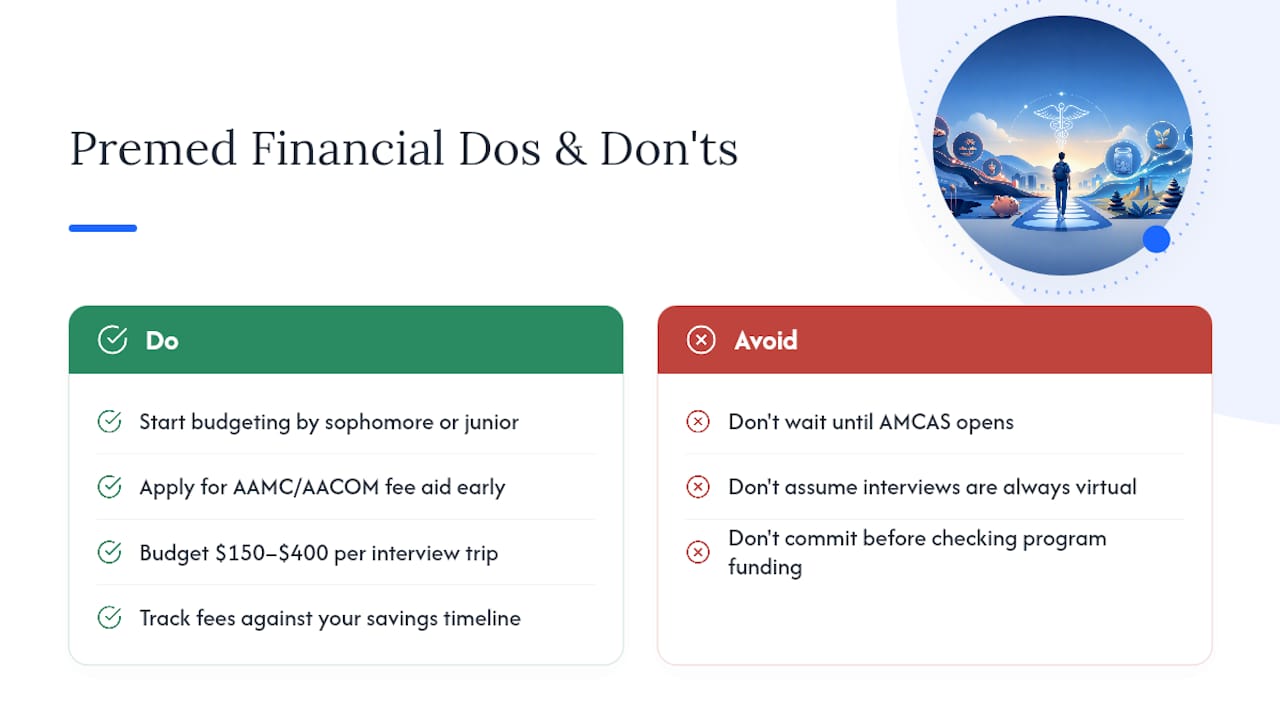
Premed costs stack up long before the first tuition bill. MCAT prep courses, official AAMC practice materials, application fees through AMCAS or AACOMAS, secondary application fees (often $75 to $150 each), and travel for interviews all add up fast, and most of it lands in a single application cycle.
Start budgeting during sophomore or junior year, not the month AMCAS opens. Fee Assistance Programs through AAMC and AACOM reduce or waive primary application costs, MCAT registration fees, and some prep resources for students who qualify based on financial need. Apply for these programs as soon as eligibility opens each year, since documentation review takes time and benefits don’t apply retroactively to fees already paid.
Interview travel is often the biggest surprise cost. Some schools offer virtual interviews or travel stipends, but many still expect in-person visits. Budgeting $150 to $400 per trip, once flights, ground transportation, and sometimes a hotel are factored in, keeps a multi-school interview season from becoming a financial emergency.
Post-bacc and formal gap-year programs carry their own tuition, which ranges widely depending on whether the program is a certificate track or a full second bachelor’s-equivalent course load. Research funding options, including institutional scholarships and federal aid where applicable, before committing to a program.
Building a simple spreadsheet or using a planning tool to track upcoming fees against your savings timeline prevents the scramble that hits many applicants in the fall of their application year, right when secondaries and interview invitations pile up simultaneously.
MD Versus DO: What the Difference Means for Your Planning
Both MD (Doctor of Medicine) and DO (Doctor of Osteopathic Medicine) physicians complete residency, get licensed, and practice across every specialty, including surgery. The core academic difference for premeds is coursework and application timing rather than career ceiling.
DO programs use AACOMAS instead of AMCAS, and osteopathic schools generally emphasize osteopathic manipulative medicine (OMM) as an additional curriculum component layered onto the standard medical science coursework. Prerequisite courses overlap heavily between MD and DO tracks, so the science foundation you build (biology, chemistry, physics, biochemistry) serves both paths without extra coursework in most cases.
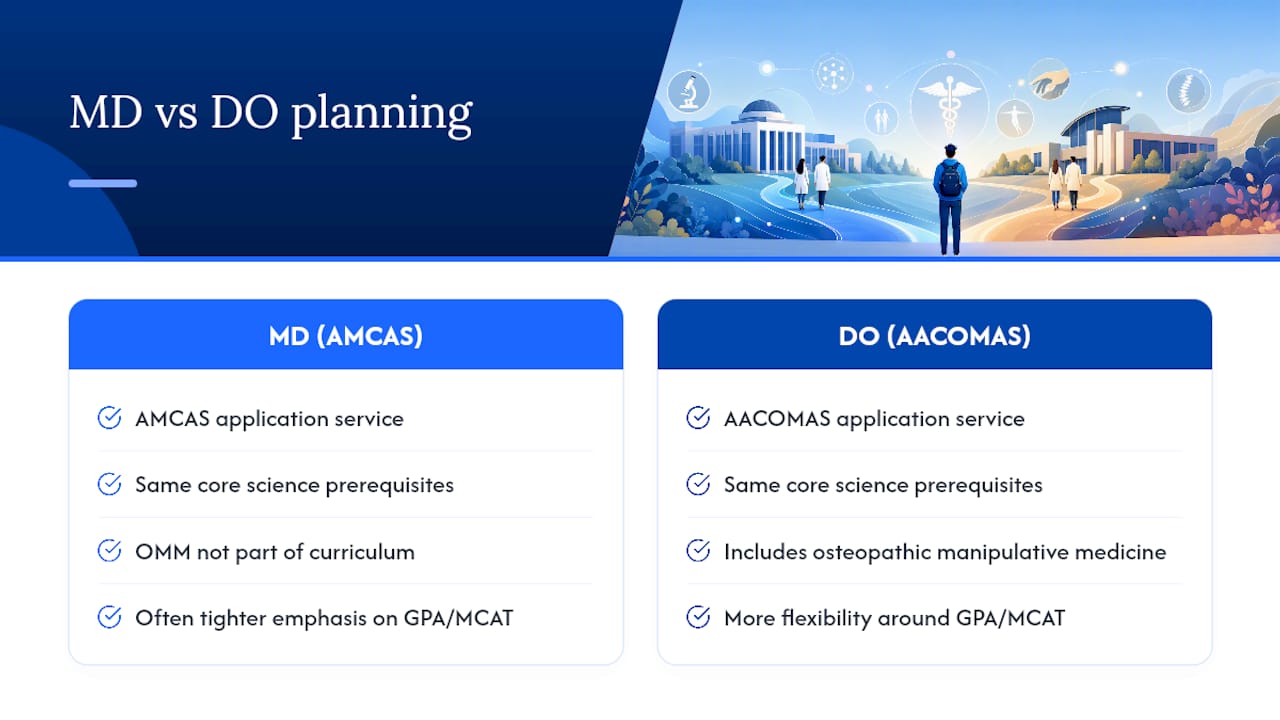
Admissions statistics differ somewhat between the two tracks, with DO programs historically showing more flexibility around slightly lower GPA or MCAT averages, though this varies by individual school and shifts year to year. That flexibility doesn’t mean lower standards. It means DO admissions committees often weigh nontraditional paths, extended timelines, and life experience a bit differently than some MD programs.
Practically, this means you don’t need to decide between MD and DO early in your premed years. Complete the same core science sequence, gather the same clinical and research experience, and apply to both AMCAS and AACOMAS schools if your goals and school list support it. Many successful applicants apply to both simultaneously, treating the decision as one of program fit and location rather than a hard fork in the road taken freshman year.
What to Do If You Don’t Get In the First Time
A rejected application cycle is not the end of the path, and reapplicants make up a meaningful share of every incoming class. The first step is an honest audit, not a rushed resubmission with the same materials.
Request feedback from any schools that offer it, and talk with your premed advisor about where your application likely fell short: GPA, MCAT, limited clinical depth, weak letters, or a personal statement that didn’t land. Reapplying without addressing the actual weakness rarely changes the outcome.
Common fixes include:
- Retaking the MCAT if your score sat meaningfully below your target schools’ averages, ideally after a structured study block rather than a rushed retake.
- Adding a post-bacc year or upper-level coursework to strengthen a BCPM GPA that didn’t reflect your actual ability.
- Deepening one clinical role rather than adding several shallow new ones, since reviewers notice padding.
- Rewriting the personal statement and activity descriptions rather than reusing the same file with minor edits.
- Widening or adjusting the school list based on where your numbers and mission fit actually align, sometimes including a mix of MD and DO programs.
Give yourself a full application cycle to make these changes count, since a rushed reapplication with cosmetic tweaks tends to produce the same result twice.
MedSchoolPilot’s Take: Planning Beats Panic
The biggest gap we see between what premed advice promises and what actually helps is specificity. Generic advice says “get clinical experience” and “keep your GPA up.” Neither tells you what to do this Tuesday.
What separates students who stay on track from those who scramble senior year isn’t raw intelligence or even MCAT prep quality. It’s whether they treated premed like a project with milestones, rather than a vague four-year mood. The students who track their BCPM GPA every semester, log clinical hours as they happen instead of reconstructing them later, and revisit their MCAT timeline every few months rarely hit application season in crisis mode.
That’s the entire philosophy behind Medschoolpilot’s readiness tracker and customizable timelines: turn “I should probably work on this” into a dated task with a visible score. Talk to your advisor regularly, but pair that conversation with a system that keeps your actual data in front of you.
— MedSchoolPilot
Organize Your Premed Requirements Without the Spreadsheet Chaos
A platform exists for the common problem of managing multiple components, deadlines, and lacking a centralized overview. Instead of juggling separate spreadsheets and mental notes, a readiness tracker can integrate progress, hours, and timelines into one dashboard with an indicative scoring system.
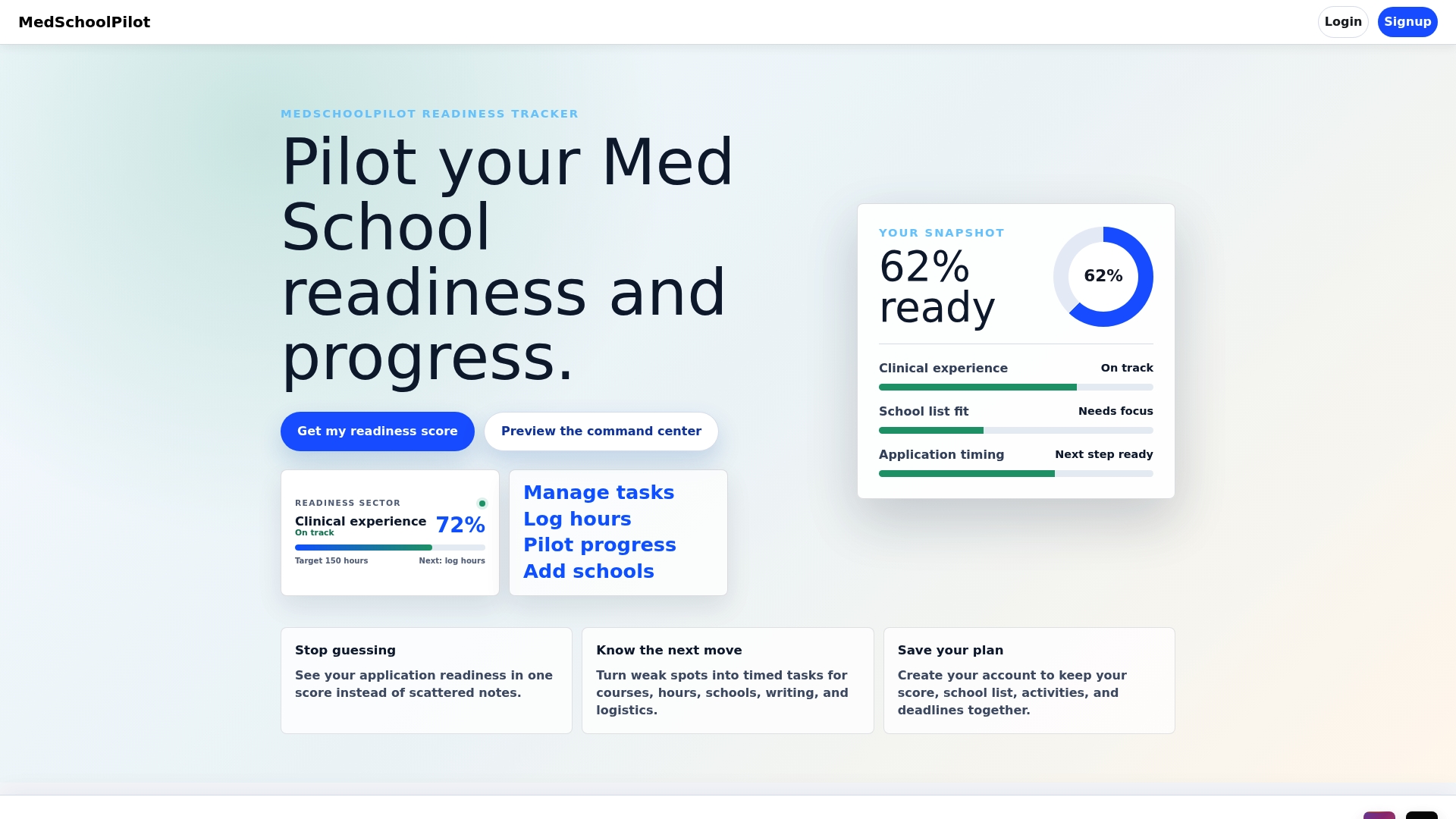
The MedSchoolPilot iOS app lets you log hours and check milestones from your phone between classes, so tracking becomes a five-minute habit instead of a Sunday-night scramble. Such tools can complement campus advisors by providing tracking and deadline calculations while advisors offer judgment and context. Start building your readiness score and see exactly which prerequisite, hour, or milestone needs attention next at Medschoolpilot.
Sources
- Class profile | University of Michigan Medical School
- Preparing for the MCAT | AAMC
- Top tips for premeds on getting into medical school | AMA