
Mission fit is the degree to which your experiences, values, and goals match what a specific medical school exists to do, whether that’s training rural doctors, military physicians, or biomedical researchers. The single best thing you can do right now is pick one target school, find one concrete program or community partnership on its website, and identify one experience from your own life that connects to it directly.
That’s the whole game in miniature. Admissions committees don’t want a recycled paragraph about “helping people.” They want evidence that you understand what makes their program different and that you’d actually thrive there. The AAMC Mission-Aligned Selection Framework formalizes this idea for admissions offices, and the MSAR (Medical School Admission Requirements) database is where you’ll do most of your homework as an applicant.
Before you read another paragraph, do this:
- Pick one school you’re genuinely excited about and open its mission or “about” page in a new tab.
- Find one named program, clinic, or partnership that reflects that mission (not just a slogan).
- Write down one specific experience from your own activities list that connects to it.
- Save the URL and the date you found it. You’ll need it during secondary season.
Roughly a third of the work of writing a strong secondary essay happens before you type a single sentence. It happens when you actually read what a school says about itself instead of assuming every MD program wants the same applicant. MedSchoolPilot’s evidence tracker exists largely because this research step gets skipped or done sloppily under deadline pressure, and that’s usually where mission-fit answers fall apart.
Key Takeaways
Mission fit determines whether committees see your application as tailored evidence of alignment or as a generic submission, and specific, documented experience beats mission-statement language every time.
| Point | Details |
|---|---|
| Research before you write | Find one named program or partnership on a school’s site before drafting any secondary essay. |
| Map experience to evidence | Connect a specific activity, with hours or an outcome, to each school’s actual mission domain. |
| Use MSAR’s mission fields | Compare curriculum, class profile, and expanded mission data instead of relying on rankings alone. |
| Avoid mission-statement echoing | Cite named programs and measurable outcomes rather than repeating the school’s own language back. |
| Track evidence per school | A spreadsheet or a tool like MedSchoolPilot keeps hours, URLs, and draft sentences organized for secondary season. |
Table of Contents
- What Does Mission Fit Actually Mean for Medical Schools?
- Why Does Mission Fit Matter During the Admissions Cycle?
- What Are the Common Mission Domains at U.S. Medical Schools?
- How Do You Research a School’s Mission Before Applying?
- How Do You Show Mission Fit in Your Application?
- How Do You Build a Mission-Fit Mapping Worksheet?
- What Mistakes Weaken Mission-Fit Signals?
- How Much Does Mission Fit Actually Influence Admission?
- How Do You Honestly Assess Your Own Values for Genuine Fit?
- How Do You Find Fit With Niche or Less Common Missions?
- What Do Strong Mission-Fit Statements Look Like by Mission Type?
- Does Mission Fit Matter More at Public or Private Medical Schools?
- Mission Fit Is a Research Problem Before It’s a Writing Problem
- How MedSchoolPilot Helps You Track and Prove Mission Fit
- Where to Find Trustworthy Mission-Fit Information
- Frequently Asked Questions About Mission Fit
- Sources
What Does Mission Fit Actually Mean for Medical Schools?
Mission fit means a school evaluates whether your experiences, attributes, and metrics align with what it’s specifically trying to accomplish, not just whether you meet a GPA and MCAT cutoff. This is the practical translation of “holistic review” that gets thrown around constantly in premed forums without much explanation.
The AAMC’s own mission-aligned selection guidance defines mission-aligned selection as a process where a program uses its mission to define what “merit” even means, then links that definition to specific competencies, experiences, and academic metrics it looks for in applicants. In plain terms: a school built to produce primary care doctors for underserved rural counties is not grading you against the same rubric as a school built to produce physician-scientists. The metrics might overlap, but the weighting doesn’t.
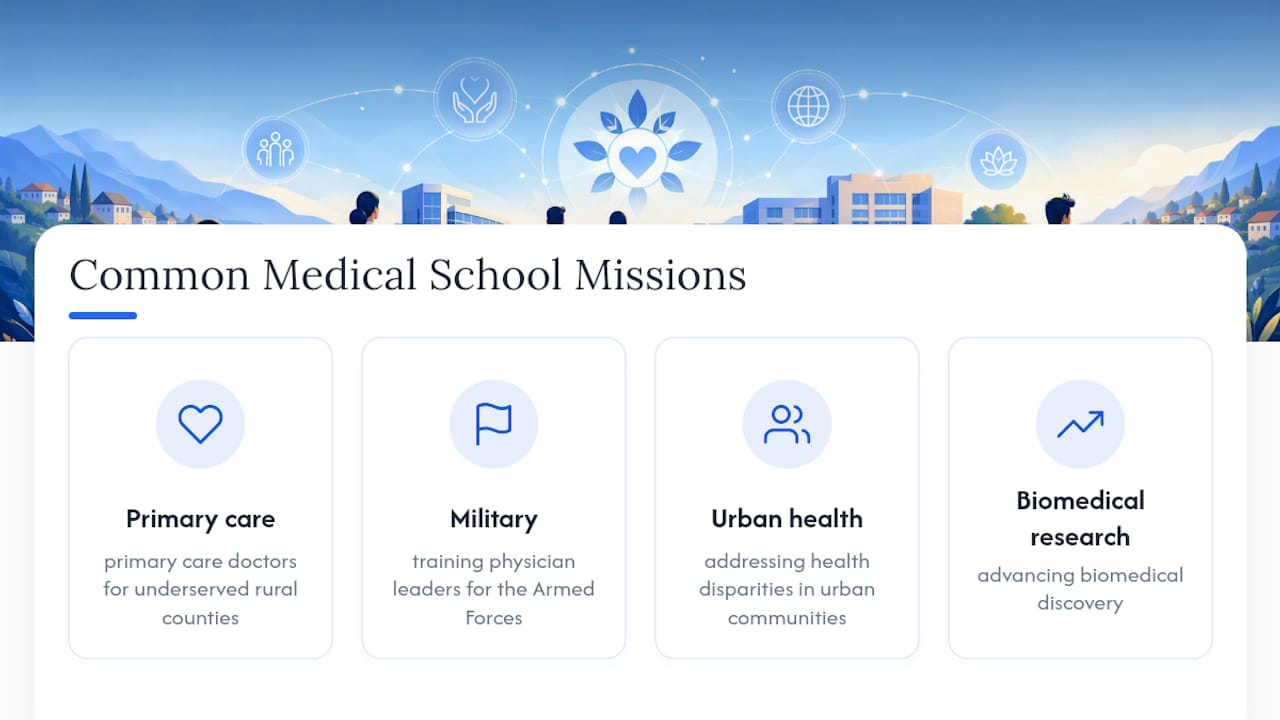
You’ll see this show up in mission language that clusters into a handful of recurring categories. Some schools talk about “training physician leaders for the Armed Forces.” Others talk about “addressing health disparities in urban communities” or “advancing biomedical discovery.” A few blend two or three of these openly. None of this language is decorative. Admissions offices build curricular tracks, required rotations, and even scholarship structures around it, and the AAMC’s expanded MSAR mission fields now let schools describe in more detail how mission shapes curriculum, admissions criteria, and student outcomes. That’s a direct signal that AAMC wants applicants reading this material, not skimming past it.
Worth noting: mission-aligned selection has also become part of a broader admissions debate. Some commentators frame it as a way for schools to define merit and context without relying on protected characteristics in the wake of shifting legal constraints around race-conscious admissions. You don’t need to take a side on that debate to use the framework. You just need to understand that “mission fit” is now doing real analytical work inside admissions offices, not just appearing as a feel-good phrase on a website banner.
Why Does Mission Fit Matter During the Admissions Cycle?
Mission fit carries the most weight at three specific points: secondary essays, interview evaluation, and final selection or waitlist movement. It rarely shows up as a line item on your primary application, but it quietly shapes everything that happens after you submit it.
Secondary essays are where schools ask “why us” directly, and this is the first real test of whether you’ve done your homework. A generic answer here doesn’t just fail to help you. It actively signals that you mass-applied without differentiating your reasons, which readers notice fast because they read hundreds of these essays a cycle.
Interviews, especially multiple mini interview (MMI) stations built around ethical scenarios or community health questions, often probe fit indirectly. An interviewer might ask how you’d handle a patient with limited English proficiency at a school with a strong immigrant-health mission, and a thoughtful, specific answer reads very differently from a rehearsed one.
Consider a hypothetical but realistic scenario: two applicants have nearly identical MCAT scores and GPAs. One writes a secondary essay describing volunteer hours at a free clinic and mentions the school’s mission to serve underserved populations in one sentence. The other names the school’s actual student-run clinic, describes a specific patient population it serves, and explains how their own 200 hours at a community health center map onto that exact clinical model. Reviewers scoring against a mission-aligned rubric will consistently rate the second essay higher, even though both applicants did comparable work.
Mission-fit signals tend to influence:
- Whether you get an interview invite at all, particularly at schools with more mission-specific secondary prompts.
- How favorably reviewers score you on holistic-review rubrics that explicitly weigh “fit with institutional mission.”
- Where you land in a school’s internal ranking once they move from admit/deny to a wait list or a scholarship decision.
It’s worth being precise about what mission fit is not. It’s not a proxy for demographic quotas, and admissions offices frame it around experiences, competencies, and demonstrated commitment rather than protected characteristics. The AAMC’s own guidance is explicit that mission-aligned selection is about aligning applicant attributes with program goals, evaluated equitably and in context.
What Are the Common Mission Domains at U.S. Medical Schools?
Most U.S. medical schools cluster their mission language into seven recognizable domains, and each one leaves specific, checkable fingerprints on a school’s website and curriculum. Knowing these domains before you start researching saves you hours of aimless browsing.
Service to underserved populations. Look for required community-based rotations, student-run free clinics, and named partnerships with federally qualified health centers. Drexel’s MD program is a strong example: its site lists thousands of student service hours annually, embedded service requirements, and named student-run clinics as concrete proof of its community-engagement mission, not just a mission statement paragraph.

Primary care workforce development. Signals include dedicated primary care tracks, rural or family medicine scholarship programs, and explicit residency placement data in primary care specialties published on the admissions page.
Research and biomedical innovation. Look for named research institutes, MD/PhD program size, funded summer research stipends, and faculty publication volume mentioned on program pages.
Military and public health service. The Uniformed Services University (USU) School of Medicine is the clearest example in the country. Its brochure describes tuition-free education tied to active-duty service obligations, curricular emphasis on operational and military medicine, and explicit leadership training for military physicians. There’s no ambiguity about what USU wants: applicants who are prepared to serve, not just interested in medicine.
Community engagement and civic partnership. Watch for named neighborhood partnerships, health fairs, and community advisory boards mentioned by name rather than in general terms.
Diversity and health equity. Look for pipeline programs, pathway partnerships with historically underrepresented communities, and specific equity-focused curricular content.
Rural health. Signals include rural rotation requirements, satellite campuses in rural regions, and loan-repayment or scholarship programs tied to rural practice commitments.
Pro Tip: A genuine mission-driven program almost always names specifics: exact clinical sites, named community partners, funded scholarship amounts tied to service years, or hour requirements. If a program page only uses adjectives like “compassionate” or “innovative” with no named site or partner attached, treat that as marketing copy rather than mission evidence.
How Do You Research a School’s Mission Before Applying?
Start with the MSAR school profile, then work outward through the school’s own website, curriculum pages, and student-facing materials in that order. This sequence matters because MSAR gives you the compressed, comparable version first, and the school’s own pages give you the texture and specifics you’ll actually quote later.
- Pull up the school’s MSAR profile. The MSAR database now includes expanded mission fields where participating schools describe how mission shapes curriculum, student life, and outcomes, per AAMC’s own description of the redesigned tool.
- Read the mission or values page directly on the school’s website. Don’t stop at the homepage tagline; look for a dedicated “mission and values” or “about the school” page.
- Check curriculum pages for required tracks. Rural health tracks, urban underserved tracks, and scholarly concentration programs are usually described in detail here.
- Search for named community partnerships. Look for phrases like “in partnership with,” “affiliated clinic,” or specific neighborhood and organization names.
- Find student-run clinic pages. These are often buried under student organizations or “student life,” not under admissions.
- Review the class profile. This tells you what kind of applicant the school actually admits, which is a second, harder-to-fake signal of fit.
- Attend an info session or watch a recorded one. Admissions officers often say things in these sessions that never make it onto the website.
For sources, prioritize the school’s own brochures and PDFs (they tend to be more detailed and durable than webpages, which get redesigned), curriculum pages, student organization sites, and admissions FAQs. Princeton’s Health Professions Advising office specifically recommends going beyond the mission statement itself: talk to current students, attend info sessions, and ask pointed questions that generate specific, citable answers rather than repeating what’s already on the homepage.
When you search, use targeted queries like “[school name] student-run clinic,” “[school name] rural health track,” or “[school name] service commitment scholarship” rather than generic terms. PDF brochures tend to rank well for these searches and often contain more granular detail than the main site. Log every URL you find in a spreadsheet with the date you accessed it and a screenshot if the page looks likely to change. Secondary season moves fast, and you don’t want to be re-searching a page you already found in June.
How Do You Show Mission Fit in Your Application?
You demonstrate mission fit differently at each stage of the application, and treating them all the same is one of the fastest ways to sound generic. Here’s how the tactics shift stage by stage.
Primary application (personal statement and activities). Keep your personal statement broadly about your motivation for medicine, not school-specific. Save mission-matching for your activities descriptions, where you can quietly emphasize the parts of an experience (hours, populations served, leadership) that will resonate later with mission-specific schools.
- Do: describe concrete outcomes and populations served in your activity entries.
- Don’t: try to reference specific schools in your primary application; it isn’t the right venue and reads as unfocused.
Secondary essays. This is where mission-fit work pays off directly. According to Med School Insiders’ guidance on mission fit, every secondary and interview will probe why you chose that particular school, and applicants who go beyond the mission statement to cite specific programs get taken far more seriously than those who don’t.
- Do: name the exact program, clinic, or partnership and connect it to a specific experience of yours with a number or outcome attached.
- Don’t: quote the mission statement back at the school. They wrote it. They know what it says.
Letters of recommendation. Ask recommenders to describe specific moments that show your values in action, not general praise. If a letter writer supervised you at a community health center, ask them to mention the specific population you served and any measurable impact, since that reinforces service-mission fit far better than “hardworking and compassionate.”
Interviews, including MMI stations. Prepare two or three specific talking points per school tied to real programs, and practice weaving them naturally into answers about scenarios or ethics rather than saving them for a scripted “why us” moment.
- Do: mention a named faculty member, clinic, or track if you’ve researched it, and explain specifically why it matters to your goals.
- Don’t: recite mission-statement language verbatim; interviewers hear this constantly and tune it out.
Here’s what tailored phrasing looks like in practice, mapping one lived experience to three different mission types:
Admissions readers can spot keyword stuffing quickly: an applicant who echoes mission-statement language without attaching a specific program, number, or outcome. The fix is always the same. Anchor every claim to something measurable and named, whether that’s hours, a patient population, a clinic, or a specific faculty relationship.
How Do You Build a Mission-Fit Mapping Worksheet?
A mission-fit mapping worksheet forces you to convert vague enthusiasm into specific, reusable evidence before secondary season starts, when you’ll be writing 15 to 25 essays under real time pressure. The structure is simple: one row per school, with columns that walk from the school’s own language down to a sentence you can actually submit.
| Mission Phrase | School Signal | Your Experience | Evidence | Draft Secondary Sentence |
|---|---|---|---|---|
| “Serving medically underserved urban communities” | Student-run free clinic in a specific neighborhood | 300 hours as a patient navigator at a community health center | Logged hours, supervisor contact, multiple patients navigated to specialty care | “My 300 hours navigating patients to specialty care taught me the logistics your student-run clinic depends on daily.” |
| “Advancing translational biomedical research” | Named research institute with MD/PhD pipeline | Two years in a lab studying a specific translational question | Poster presentation, one co-authored abstract, 15 hours weekly | “Two years developing a translational research question in [lab] showed me why your institute’s model of pairing MD students with bench research this early matters.” |
Fill this out for every school on your list, even ones you’re less excited about, because the process of finding the row’s contents is what forces genuine research. Store it in a spreadsheet with a tab per school, or inside a workspace like MedSchoolPilot, where you can log clinical hours and activities once and pull them into school-specific notes without re-digging through your own application every time.
Pro Tip: Keep a “raw evidence” column separate from your “draft sentence” column. You’ll often reuse the same raw evidence (say, 300 hours at a community clinic) across five or six schools, but the sentence needs to change every time to reflect that specific school’s actual program.
What Mistakes Weaken Mission-Fit Signals?
The most common mistake is writing an essay that could be submitted to any school with a five-minute find-and-replace, and reviewers notice this pattern instantly. Here are the six mistakes that show up most often, along with the fix for each.
- Generic essays with no named program. Fix: replace every sentence that could apply to any school with one that names a specific clinic, track, or partnership.
- Shallow examples with no measurable outcome. Fix: attach a number, a population, or a specific result to every experience you cite.
- Mismatched goals between your stated interest and the school’s actual strength. Fix: don’t claim a passion for rural medicine at a school with no rural infrastructure; find the domain that genuinely matches instead.
- Overemphasizing prestige metrics instead of substance. Fix: research rank obsession does nothing for a mission-aligned rubric; swap ranking talk for program-specific reasoning.
- Ignoring school-specific programs entirely. Fix: spend 30 minutes finding one named program before writing a single word of the secondary.
- Failing to document evidence early. Fix: build your mapping worksheet in the spring, not the week secondaries drop.
Here’s a bad-to-fixed example for the most common mistake:
Bad: “I am passionate about serving underserved communities and believe your school’s mission aligns with my values.”
Fixed: “My 300 hours as a patient navigator at [clinic] showed me how much coordination underserved patients need to access specialty care, which is exactly the gap your student-run clinic in [neighborhood] fills.”
The second version survives a find-and-replace test. Swap the school name into the first version and it reads identically everywhere. Swap it into the second and it breaks, because it’s actually specific.
How Much Does Mission Fit Actually Influence Admission?
Mission fit can outweigh a modest metrics gap at mission-driven regional and primary-care-focused schools, but it rarely overrides a large gap at highly competitive research institutions where MCAT and GPA screens are stricter earlier in the process. Understanding this distinction should shape how you build your school list, not just how you write your essays.
At state schools with strong residency preferences or explicit rural/primary-care mandates, admissions committees are often willing to weigh a slightly lower MCAT score against strong, specific evidence of commitment to that mission. This is part of why the AAMC’s own guidance on choosing a medical school pushes applicants to research curriculum and mission fit rather than chasing rankings alone.
At highly selective research-intensive schools, the applicant pool is deep enough that most candidates already clear the numeric bar, so committees lean harder on research productivity, publication history, and evidence of scholarly trajectory. Mission fit still matters here, but it shows up as fit with a research culture rather than fit with a service mission.
When you’re building your list, a reasonable split looks like this: a handful of schools where your metrics and mission alignment are both strong (your best shot), a larger group of schools where metrics are competitive and you’re doing real mission-fit homework to differentiate yourself, and a smaller number of reach schools where fit alone won’t compensate for a real numeric gap. Use MSAR’s class profile data and expanded mission fields to sanity-check each tier before you commit to it, and check our guide on matching your MCAT to realistic school targets if you’re still calibrating that list. If your metrics sit below a school’s typical range, leaning harder into documented, specific mission alignment is one of the better levers available, a point covered in more depth in our guide for applicants with a low GPA and high MCAT.
How Do You Honestly Assess Your Own Values for Genuine Fit?
Start by listing your actual activities and asking which ones you’d keep doing even without an application deadline attached, since that’s a rough proxy for genuine motivation versus resume-building. This exercise sounds obvious, but almost no one does it before writing secondaries, and it shows.
Go through your activities list and rate each one honestly on two axes: how much you actually cared about it while doing it, and how much depth you brought to it (hours, leadership, a specific outcome). Experiences that score high on both are your real mission-fit evidence. Experiences that score low on genuine interest, even if they look good on paper, are the ones that produce the generic, forgettable essays reviewers skim past.
Be honest about mismatches too. If you spent 400 hours in a wet lab because it looked good, not because you loved the work, don’t force a research-mission narrative onto it. It’s a more effective use of your energy to lean into whichever domain your actual behavior supports, even if that domain feels less prestigious than the one you assumed you’d write about. Treating a secondary essay as separate spreadsheet work rather than an extension of self-reflection is a subtle mistake, since the strongest secondary essays read like they were easy to write, precisely because the applicant wasn’t stretching to manufacture a connection.
How Do You Find Fit With Niche or Less Common Missions?
Niche missions rarely announce themselves on a homepage, so you have to dig into second and third-tier pages: named research centers, specific grant-funded initiatives, and faculty bios rather than the general mission statement. Schools with unusual focuses, tribal health, LGBTQ+ health equity, addiction medicine, disaster and emergency preparedness, wilderness medicine, tend to bury this information under a specific institute or center page rather than the main “about” section.
Search for named centers or institutes attached to the school (a “Center for X Health” is a strong signal), and check whether faculty listed there also teach required or elective courses, which tells you the mission is embedded in curriculum rather than existing only as a research silo. Look at recent news releases or grant announcements on the school’s press page; niche missions are frequently funded by specific federal or foundation grants that get announced publicly and name the initiative directly.
If a mission is genuinely obscure, reaching out to a current student or faculty member listed on that center’s page is often more productive than continuing to search the website. Princeton’s HPA office specifically recommends this kind of direct outreach precisely because niche missions don’t always generate enough public content to research from a search engine alone.
What Do Strong Mission-Fit Statements Look Like by Mission Type?
The strongest mission-fit statements share one structure regardless of domain: a specific personal detail, a specific school program, and a clear line connecting the two without restating the mission itself. Here’s how that structure adapts across different mission types.
For a rural health mission: “Growing up in a town with one family physician for 4,000 people taught me what continuity of care actually costs a community when it’s absent. Your required rural longitudinal rotation is the kind of training that prepares students to be that one physician, not just visit for a rotation.”
For a diversity and equity mission: “Coordinating a bilingual health literacy program for 200 families showed me how much unmet need exists when clinical materials aren’t built for the population they’re meant to serve. Your pipeline partnership with [named community organization] is doing exactly that work upstream.”
For a military and public health mission: “Four years in ROTC taught me how medical readiness functions inside a chain of command, not just inside a clinic. USU’s emphasis on operational medicine and leadership training is the only model that trains physicians for that exact environment.” (This is the sort of specificity a school like USU explicitly rewards, given its brochure’s focus on service obligation and leadership.)
For a research and innovation mission: “Spending two summers troubleshooting a failed assay taught me more about scientific patience than any successful result would have. Your MD/PhD pipeline’s emphasis on early bench exposure matches exactly the kind of sustained problem-solving I want to keep doing.”
Notice that none of these restate the mission statement. Each one leads with a personal detail, then draws a specific line to a named program or curricular feature.
Does Mission Fit Matter More at Public or Private Medical Schools?
Public medical schools generally weigh mission fit heavily around state residency and regional service commitments, while private schools tend to weigh it around specific institutional values that can range from research output to community engagement. Both types use mission fit, but the shape of what they’re checking for differs enough that it should change how you apply.
At many public schools, mission fit is partly baked into the residency requirement itself: a state school’s mission is often explicitly to serve that state’s population, so an applicant who can point to ties, family, prior work, or specific interest in that state’s healthcare gaps has a real advantage over an out-of-state applicant with identical numbers. Our guide to schools that are friendlier to out-of-state applicants is worth reading if residency mismatches are a concern for your list.
At private schools, mission variance is wider. Some private schools run heavily toward primary care and community service (Drexel’s model is a clear example), while others run heavily toward research output and physician-scientist training. This means you can’t treat “private school” as a single fit category the way you might loosely treat “public school, home state” as one. Research-intensive private and public flagship schools alike tend to weight publication history and research trajectory more heavily than community-service hours, simply because that’s what their mission and funding structure reward.
The practical takeaway: don’t assume a private school cares less about mission fit than a public one, or that a public school’s fit concerns begin and end with residency. Read each school’s mission language individually, because the domain matters more than the public or private label attached to it.
Mission Fit Is a Research Problem Before It’s a Writing Problem
Most premeds treat mission fit as an essay-writing challenge, something to solve with clever phrasing once the secondary prompt lands in their inbox. That’s backward. By the time you’re staring at a blank text box with a 48-hour turnaround, the writing is the easy part. The research, the part where you actually figure out what a school cares about and whether your own experiences genuinely match, is the part that gets skipped, and it’s the part that separates a forgettable secondary from one that gets flagged for a strong interview invite.
What we’d push back on is the common advice to “just be yourself and it’ll show.” That’s true only if you’ve already done the work of mapping your actual experiences against a school’s actual priorities. Authenticity without specificity still reads as generic to a reviewer who’s read 400 essays that month. The applicants who come across as genuine are usually the ones who did the unglamorous spreadsheet work months earlier, not the ones with the strongest natural writing voice.
Structured tracking matters here more than most applicants assume. When you log clinical hours, research time, and leadership activities in one place as you accumulate them, mapping that evidence to a school’s mission during secondary season takes an afternoon instead of a week of frantic memory-jogging. That’s the entire premise behind building a readiness and evidence system rather than reconstructing your activities list from memory every time a new prompt lands.
How MedSchoolPilot Helps You Track and Prove Mission Fit
Mission-fit research generates a lot of scattered information fast: URLs, program names, hour counts, and half-written sentences you’ll want to reuse across schools. MedSchoolPilot gives that information one home instead of a dozen open browser tabs and a half-finished spreadsheet.
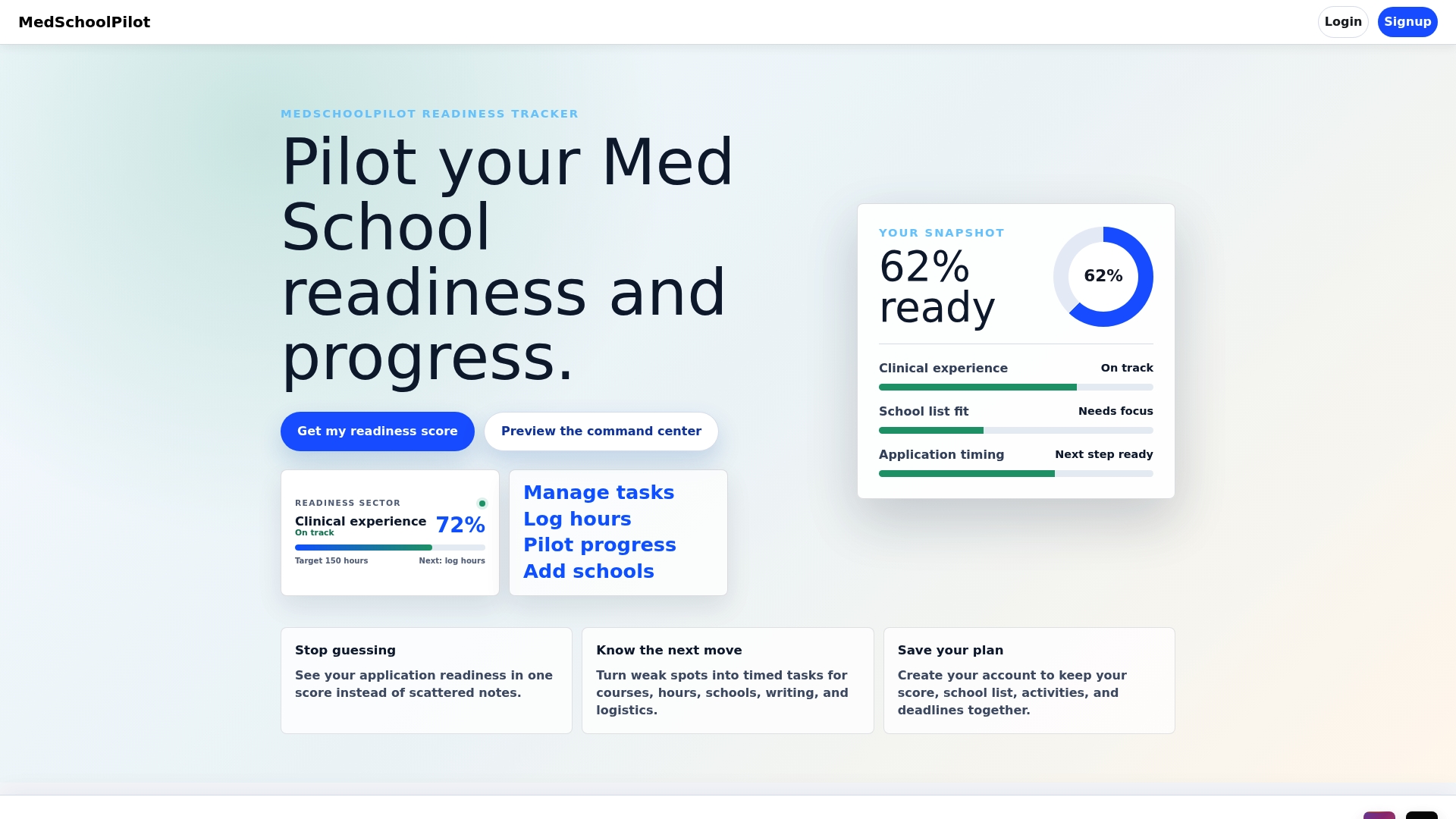
Two ways applicants actually use it during secondary season: first, logging clinical, research, and volunteer hours as they happen so the evidence is already organized and dated when a secondary prompt asks you to prove commitment, rather than reconstructing timelines from memory in July. Second, using the readiness tracker’s school-list features to keep notes on each program’s mission signals alongside your own metrics, so you can see at a glance where your evidence is strong and where a school’s secondary essay will need more specific research before you write it.
If you’re still building your evidence habit, our guide on tracking clinical hours for med school applications walks through the basics. When you’re ready to see how the tracker itself works, check out a walkthrough of MedSchoolPilot’s planning tools, or get instant free access to MedSchoolPilot and start organizing your mission-fit research before the next secondary prompt lands in your inbox.
Where to Find Trustworthy Mission-Fit Information
Save these sources now, before secondary season creates the time pressure that makes careful research harder.
- AAMC’s mission-aligned selection page: the primary framework document explaining how programs define merit relative to mission.
- MSAR database: school-by-school profiles including expanded mission fields, curriculum details, and class statistics.
- AAMC’s guide to choosing a medical school: practical advice on weighing mission and curriculum against selectivity.
- Med School Insiders’ mission-fit guide: tactical advice on demonstrating fit in secondaries and interviews.
- USU School of Medicine’s admissions brochure: a model for reading a highly distinctive, mission-specific program page.
- Drexel’s service-mission page: an example of concrete, named service signals rather than mission slogans.
- Princeton HPA’s mission-fit guidance: advice on going beyond the mission statement through student and faculty contact.
Save the PDFs, program names, and community partner pages you find as you go. Websites get redesigned every application cycle, and the exact page you cited in March might not exist in the same form by August.
Frequently Asked Questions About Mission Fit
What does “mission fit” mean in a medical school secondary essay? It means demonstrating that your specific experiences and goals align with what that particular school is trying to accomplish, shown through named programs and measurable evidence rather than restated mission language.
Is mission fit more important than GPA and MCAT scores? Not usually. Metrics still screen applicants at most schools, but strong, specific mission-fit evidence can help close a modest gap, particularly at mission-driven regional or primary-care-focused programs.
How do I find a school’s mission if it’s not clearly stated? Check the MSAR profile first, then search curriculum pages, named research centers, and recent grant announcements, which often reveal a niche mission that isn’t summarized anywhere on the homepage.
Can I use the same mission-fit example for multiple schools? Yes, the underlying experience can repeat, but the sentence connecting it to each school’s specific program must change every time to stay credible.
Do interviewers actually check whether you’ve researched their mission? Frequently, especially in MMI scenarios built around ethics or community health, where a well-researched, specific answer clearly reads differently than a generalized one.
Sources
- Mission-aligned selection and retention | AAMC
- Medical School Mission Fit: What It Means and How to Embody It | Med School Insiders
- USU School of Medicine admissions brochure (2026)
- Drexel MD program — Passion for service