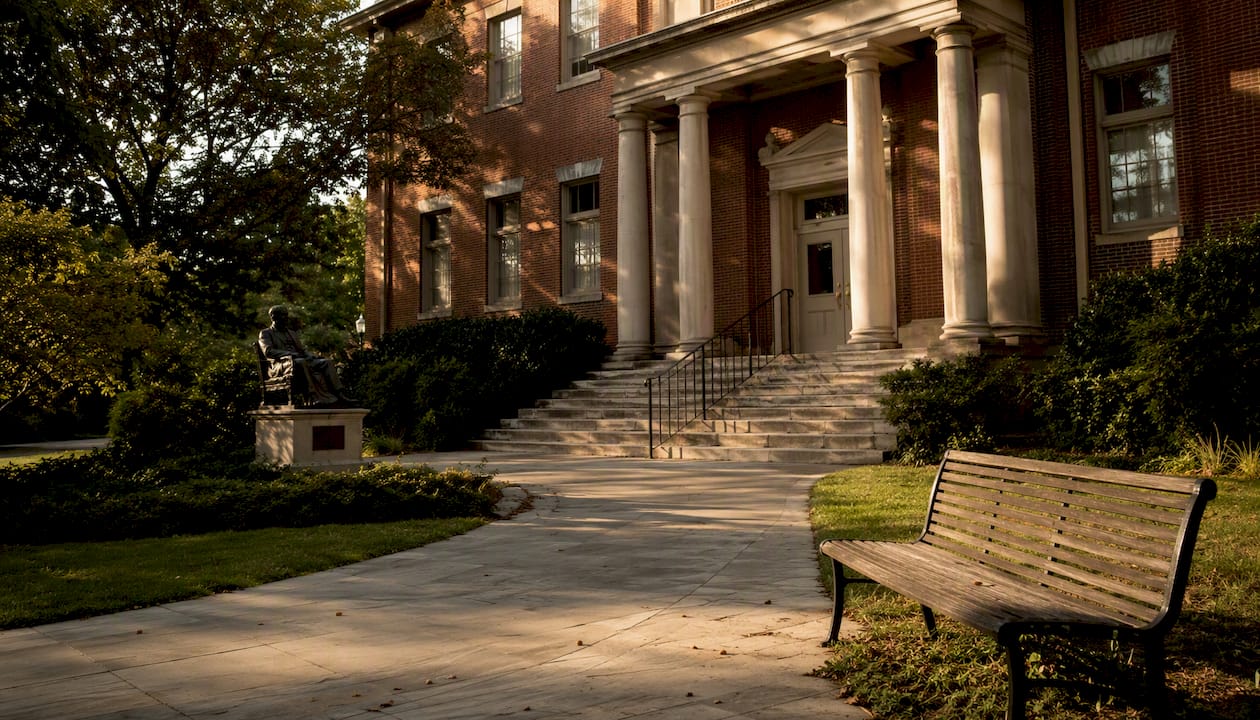
Four HBCU medical schools are operating right now: Howard University College of Medicine in Washington, D.C.; Meharry Medical College in Nashville; Morehouse School of Medicine in Atlanta; and Charles R. Drew University of Medicine and Science in Los Angeles. Two more are in development:
- Xavier Ochsner College of Medicine (XOCOM) — New Orleans, LA; partnership announced, pursuing LCME accreditation, not yet enrolling students
- Morgan State University Maryland College of Osteopathic Medicine — Baltimore, MD; announced, in early development, targeting DO training
Together, these historically Black medical schools have produced a disproportionate share of the nation’s Black physicians despite operating with far smaller endowments than most non-HBCU peers. That outsized contribution, combined with two new schools in the pipeline, makes this a genuinely different moment for Black representation in medicine.
Key Takeaways
Four HBCU medical schools are fully operational today, two more are in development, and recent philanthropic investments are improving the financial foundation across all of them.
| Point | Details |
|---|---|
| Four established schools | Howard, Meharry, Morehouse, and CDU are the operating HBCU MD programs; all are LCME accredited. |
| Two new schools in development | XOCOM (MD, New Orleans) and Morgan State (DO, Baltimore) are announced but not yet enrolling students. |
| Pipeline programs are decisive | Formal programs like Meharry’s MSEAP strengthen applications and provide support networks during medical school. |
| Apply early and verify tuition | All established schools use rolling admissions; confirm current tuition on each school’s official financial aid page annually. |
| Medschoolpilot tracks your readiness | Use Medschoolpilot’s readiness scoring and hour-logging tools to manage deadlines and milestones across multiple HBCU applications. |
Table of Contents
- How the Flexner Report and decades of underfunding shaped today’s HBCU medical school landscape
- At-a-glance comparison of HBCU medical schools for applicants
- Profiles of the four established HBCU medical schools
- What applicants should know about the two new HBCU medical schools
- Why choose an HBCU medical school — and what to weigh honestly
- Admissions basics and pipeline programs to prioritize
- How to plan your HBCU medical school applications with a readiness checklist
- Why the growth of HBCU medical schools matters beyond the rankings
- Medschoolpilot helps you track every step of your HBCU application
- Sources
How the Flexner Report and decades of underfunding shaped today’s HBCU medical school landscape
Before 1910, more than a dozen Black medical schools operated across the United States. The 1910 Flexner Report, which graded medical schools on research infrastructure and laboratory resources, effectively condemned most of them. Schools that lacked the endowments to build research facilities closed within a generation. By mid-century, only Howard and Meharry survived. Morehouse opened in 1975 specifically to address the gap the closures left, and Charles R. Drew followed a community-founded model rooted in the 1965 Watts uprising and the health inequities it exposed.
The financial picture has shifted recently. Bloomberg Philanthropies announced multi-hundred-million-dollar investments through its Greenwood Initiative aimed at strengthening the endowments and long-term sustainability of the nation’s historically Black medical schools. Experts view these gifts as a turning point that will substantially increase scholarship capacity and programmatic support.
That gap explains both why so few HBCU medical schools exist today and why the two new schools represent something more than institutional expansion. They are a direct response to a century of resource inequity.
At-a-glance comparison of HBCU medical schools for applicants
The figures below are drawn from official school pages, university financial services, and published press releases. Tuition and class-size numbers change annually; verify current figures directly on each school’s admissions or tuition and fees page before you apply.
Tuition figures are approximate and sourced from published school pages. Confirm current costs on each school’s official financial aid or student budget page before making decisions.
Profiles of the four established HBCU medical schools
Howard University College of Medicine
Howard is the largest and oldest HBCU medical school, founded in 1868 and consistently one of the top producers of Black physicians in the country. Its mission centers on compassionate patient care, research, and socially conscious service.
- Location: Washington, D.C.
- Program: MD (four-year allopathic)
- Accreditation: LCME accredited
- Class size: Approximately 120 students per year
- Notable programs: Public health dual-degree options, research opportunities through NIH proximity
- Tuition direction: Private tuition; confirm current figures on the Howard College of Medicine homepage
- Pipeline focus: Strong pre-med pipeline through Howard’s undergraduate programs
Howard’s D.C. location gives students access to federal health agencies, Capitol Hill health policy work, and a dense network of affiliated teaching hospitals. If you want research exposure alongside clinical training, Howard’s proximity to NIH is a concrete advantage few schools can match.
Meharry Medical College
Meharry was founded in 1876 and has trained more Black and underrepresented minority physicians and dentists than any other institution in the country. Its mission explicitly emphasizes serving minority and underserved communities, and it accepts qualified students regardless of race or ethnicity.
- Location: Nashville, TN
- Program: MD (four-year allopathic)
- Accreditation: LCME accredited
- Class size: Approximately 80 students per year
- Notable programs: MSEAP (Medical Science Enrichment and Achievement Program) and other summer enrichment pipeline programs; problem/diagnosis-based curriculum
- Tuition direction: Private tuition; confirm on Meharry’s School of Medicine programs page
- Pipeline focus: Formal pipeline programs for early-stage premed students from underrepresented backgrounds
Meharry’s curriculum has modernized toward problem-based and diagnosis-focused learning rather than heavy lecture formats, which suits students who learn best through clinical reasoning from day one.
Morehouse School of Medicine
Morehouse School of Medicine is the only one of the four established schools founded after the Civil Rights era, opening in 1975 specifically to address the physician shortage in underserved communities. It remains an independent institution with a tight community-health focus.
- Location: Atlanta, GA
- Program: MD (four-year allopathic)
- Accreditation: LCME accredited
- Class size: Approximately 75 students per year
- Notable programs: Community health and primary care emphasis; research centers focused on health disparities
- Tuition direction: Private tuition; student budget information available on MSM’s official site
- Pipeline focus: Partnerships with Atlanta-area community health organizations
Atlanta’s health ecosystem, including the CDC headquarters and Grady Memorial Hospital, gives Morehouse students clinical exposure that is hard to replicate elsewhere. The school’s relatively small class size means you get more faculty contact than at larger programs.
Charles R. Drew University of Medicine and Science (CDU)
CDU was founded in 1966 in direct response to the health inequities exposed by the Watts uprising. It is a community-founded, nonprofit institution with a mission rooted in social justice and health equity, and it operates through a joint MD program with UCLA.
- Location: Los Angeles, CA
- Program: MD (via CDU/UCLA David Geffen School of Medicine joint program)
- Accreditation: LCME accredited through the CDU/UCLA arrangement
- Class size: Approximately 24 students per year (the Drew/UCLA PRIME-LA cohort)
- Notable programs: PRIME-LA (Program in Medical Education for the Latino Community); GME affiliations with community clinics
- Tuition direction: Varies; confirm through UCLA’s financial aid office and CDU’s program pages
- Pipeline focus: Community-embedded clinical training; CDU/UCLA GME arrangements provide residency pathways
CDU’s model is deliberately small and community-embedded. If you want to train in one of the most medically underserved urban environments in the country, with close clinic partnerships and a social-justice institutional identity, CDU is unlike anything else on this list.
What applicants should know about the two new HBCU medical schools
Xavier Ochsner College of Medicine (XOCOM)
Xavier University of Louisiana and Ochsner Health announced a partnership to establish XOCOM as an allopathic MD-granting school in New Orleans’ downtown BioDistrict. It is described as the first HBCU medical school in the Gulf South. The school is pursuing LCME accreditation and has not yet enrolled its first class. Ochsner Health’s role as a clinical partner is central to the model: it provides the hospital infrastructure and faculty pipeline that new medical schools typically spend years building from scratch.
Morgan State University Maryland College of Osteopathic Medicine
Morgan State, a public HBCU in Baltimore, has announced plans to open the Maryland College of Osteopathic Medicine, which would grant DO degrees and focus on increasing Black physician representation in the Mid-Atlantic region. The school is in early development and has not yet published enrollment timelines or tuition figures. Its public university status could eventually make it one of the more affordable HBCU health programs in the country.
The typical path from announcement to first class runs through several stages: formal announcement and partnership agreements, submission of a pre-accreditation application to LCME (for MD programs) or COCA (for DO programs), site visits and candidacy status, recruitment of a founding dean and core faculty, and finally enrollment of the inaugural class. That process typically takes four to seven years from announcement.
Pro Tip: Sign up for official mailing lists on both XOCOM’s and Morgan State’s news pages. Both schools will announce accreditation milestones, application opening dates, and seat counts through official press releases before the information reaches third-party sites.
Why choose an HBCU medical school — and what to weigh honestly
The clearest case for an HBCU medical school is mission alignment. These schools were built specifically to train physicians for underserved communities, and that mission shapes everything from curriculum design to clinical placement sites to the culture inside the building. If your goal is to practice in a community health center, work in a medically underserved area, or focus on health disparities research, you will find institutional infrastructure at these schools that most non-HBCU programs simply do not have.
Practical considerations worth researching before you commit:
- Endowment size: Historically smaller than peer non-HBCU schools, though recent philanthropic investments are changing this. Smaller endowments have historically meant fewer institutional scholarships.
- Residency placement: All four established schools have active GME partnerships and residency placement support. CDU’s UCLA affiliation and Meharry’s long track record are worth examining specifically. Ask each school for its most recent match list.
- Research opportunities: Howard’s NIH proximity and Morehouse’s health disparities research centers stand out. CDU’s community-clinic model offers a different kind of research exposure, focused on population health.
- Class selectivity: These schools are competitive. Meharry and Howard regularly receive thousands of applications for fewer than 100 seats.
- Out-of-state applicants: All four established schools accept out-of-state students. If you are weighing in-state vs. out-of-state cost dynamics, the out-of-state friendly med schools guide on Medschoolpilot is worth reading alongside each school’s published tuition figures.
Pro Tip: When you contact admissions offices, ask three specific questions: What pipeline or enrichment programs are currently active? What does your residency match support look like in the final year? And what institutional scholarships are available for incoming students? The answers will tell you more than any ranking.
Admissions basics and pipeline programs to prioritize
Most HBCU medical schools use AMCAS for MD applications. CDU’s joint program with UCLA runs through UCLA’s admissions process. Morgan State’s planned DO program will likely use AACOMAS. Understanding the difference between AMCAS and AACOMAS matters before you build your school list.
Standard application checklist:
- AMCAS or AACOMAS application (confirm which platform each school uses)
- Official transcripts from all colleges attended
- MCAT score (most HBCU medical schools look for scores in the 505–515 range; confirm each school’s published class profile)
- Three to five letters of recommendation (at least one from a science faculty member; physician letters carry weight)
- Personal statement (AMCAS) or personal comments (AACOMAS)
- Secondary essays (school-specific; budget two to four weeks per school)
- CASPer or PREview assessment (check each school’s secondary requirements — Meharry and Morehouse have used these)
- Clinical hours documentation (most schools want 100–200+ hours of direct patient contact)
- Research, volunteering, and shadowing hours
Pipeline programs to seek out:
- Meharry’s MSEAP (Medical Science Enrichment and Achievement Program) is one of the most established pipeline programs at any HBCU medical school. It targets students from disadvantaged backgrounds and provides structured academic support before and during medical school.
- Howard and Morehouse both run summer enrichment programs for premed students from underrepresented groups. Check each school’s admissions page for current offerings.
- Post-baccalaureate programs at HBCUs and affiliated universities can strengthen a borderline application and demonstrate academic readiness.
Formal pipeline program participation does two things: it gives you a genuine connection to the school’s mission, and it gives admissions committees evidence that you have already engaged with the community the school serves. That combination is hard to fake and easy to verify.
Timeline guidance: Start MCAT prep 12–18 months before your target application cycle. Request letters of recommendation at least three months before the AMCAS/AACOMAS opening date (typically June 1). Submit primary applications as close to opening day as possible — HBCU medical schools, like most MD programs, use rolling admissions.

How to plan your HBCU medical school applications with a readiness checklist
The three readiness milestones that matter most before submitting applications to HBCU medical schools:
- Academic baseline locked in: Science GPA at or above 3.5, MCAT score within the target range for your schools, and all prerequisite coursework complete or in progress with a clear finish date.
- Experiential hours documented: Clinical hours, research hours, and community service hours recorded with specific dates, supervisors, and descriptions ready to transfer into AMCAS or AACOMAS.
- School list finalized: Each school researched for mission fit, tuition, pipeline programs, and accreditation status, with a clear rationale for why you are applying there.
A practical readiness checklist for HBCU medical school applicants:
- Confirm MCAT target range for each school (check published class profiles)
- Log and verify all clinical, research, and volunteering hours with supervisor contact information
- Draft and revise personal statement with a clear connection to each school’s mission
- Identify pipeline programs at each school and apply or register for mailing lists
- Track secondary essay deadlines (typically 2–6 weeks after primary verification)
- Confirm financial aid and scholarship deadlines separately from admissions deadlines
- Monitor XOCOM and Morgan State announcements for application opening dates
Pro Tip: Transfer this checklist into a readiness tracker that scores your progress numerically. Medschoolpilot’s readiness scoring system is built for exactly this kind of milestone-by-milestone tracking, so nothing falls through the cracks in a multi-school application cycle.
Why the growth of HBCU medical schools matters beyond the rankings
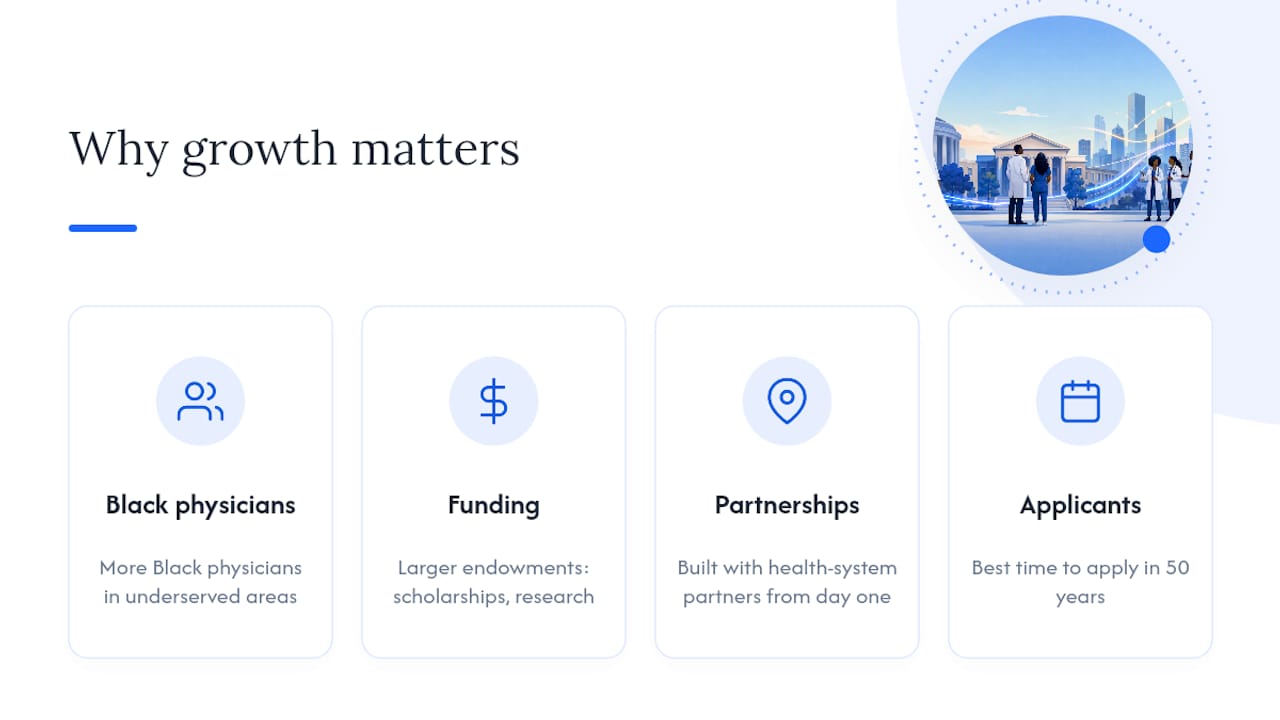
The expansion from four to potentially six HBCU medical schools is not just an institutional milestone. Research and reporting consistently show that Black physicians are significantly more likely to practice in underserved communities and to serve Black patients. Every additional HBCU medical school graduate represents a downstream effect on community health outcomes in areas that have been chronically under-doctored.
Recent philanthropic investments, particularly through Bloomberg Philanthropies’ Greenwood Initiative, are changing the financial calculus for these schools in ways that matter for applicants: larger endowments mean more institutional scholarships, more research funding, and more competitive faculty recruitment. The two new schools, XOCOM and Morgan State, are being built with health system partnerships from day one, which is a structurally smarter model than the underfunded standalone approach that caused so many early Black medical schools to close after the Flexner era.
For applicants, the practical implication is straightforward: this is a better time to apply to HBCU medical schools than at any point in the past 50 years. The schools are better resourced, the pipeline is expanding, and the national conversation around health equity has created institutional and philanthropic momentum that is unlikely to reverse.
Medschoolpilot helps you track every step of your HBCU application
Applying to HBCU medical schools means managing multiple deadlines, pipeline program applications, hour logs, and school-specific secondary essays simultaneously. Medschoolpilot is built for exactly that complexity.
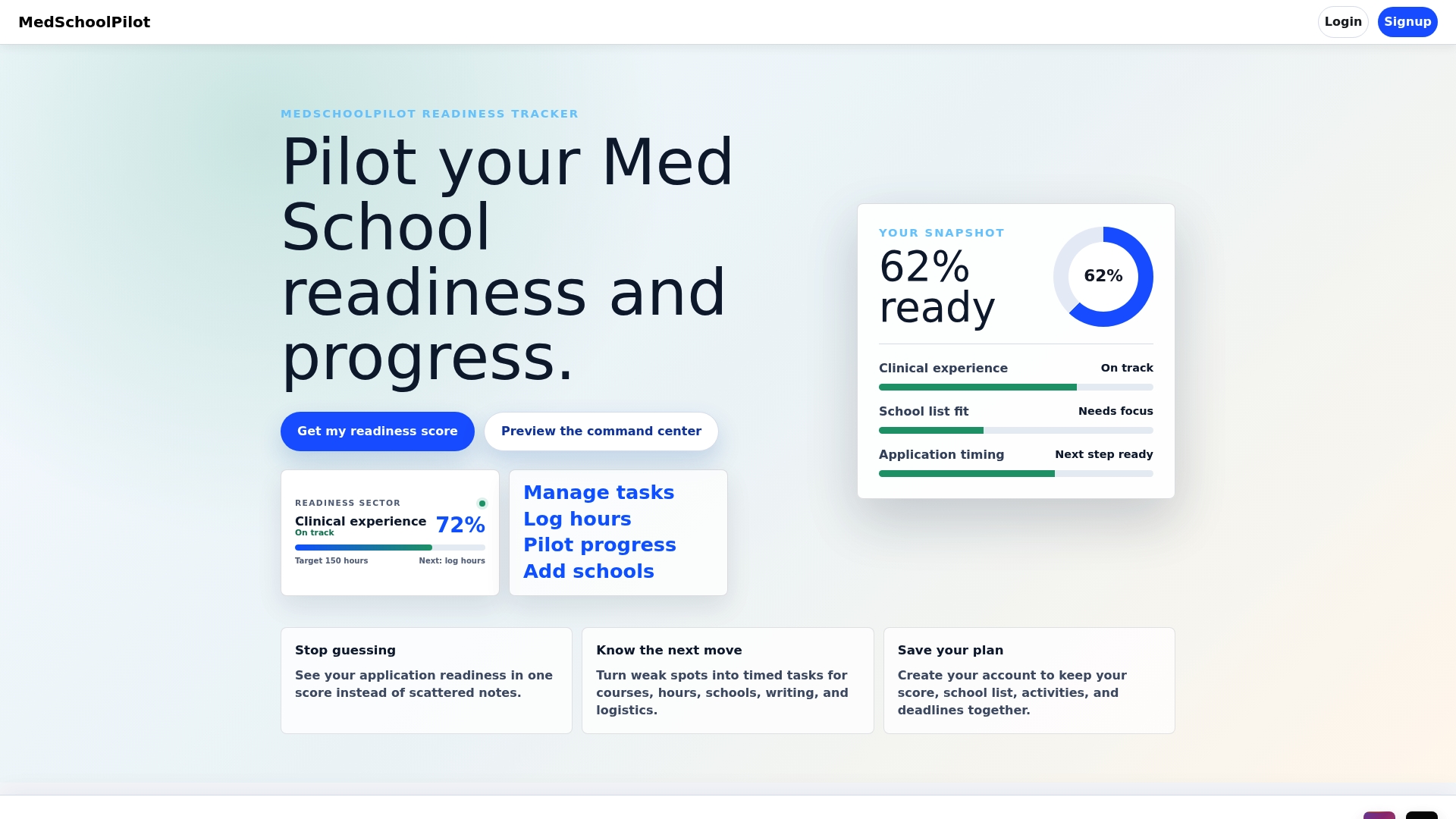
The platform gives you a customizable readiness tracker that scores your application progress across clinical hours, academic targets, school list research, and document completion. You can log hours with supervisor details, set milestone deadlines for each school, and see your overall readiness score update in real time. For applicants tracking both established HBCU schools and the developing XOCOM and Morgan State programs, having everything in one dashboard means you will not miss an announcement or a deadline.
Get free access to Medschoolpilot and start building your readiness tracker today. You can also see how the platform works before signing up.
Sources
Official school pages and accreditation records are the only reliable source for current tuition, class size, and application requirements. These numbers change annually, and third-party aggregators often lag by a year or more.
- Meharry Medical College
- About Charles R. Drew University | Charles R. Drew University of Medicine and Science
- Xavier Ochsner College of Medicine | Xavier University of Louisiana
- Homepage | Howard University College of Medicine
- Morehouse School of Medicine - MSM - Atlanta
Verify tuition and class-size figures directly on each school’s admissions or financial aid page before making application decisions. Press release details for XOCOM and Morgan State are the most current public record for those programs’ timelines.