
For most applicants, yes. A gap year premed strategy tends to strengthen an application when the time gets spent deliberately, and it’s now the majority path: 73% of entering medical students reported taking at least one gap year, leaving only 27% who matriculated straight through.
Statistic snapshot: Nearly three out of four matriculants gapped at least once, which means the question isn’t really “should I,” it’s “what do I do with it.”
Your first move isn’t picking an activity. It’s running a gap analysis: line up your current MCAT score, GPA, and clinical hours against your target schools’ medians, and work backward from the AMCAS timeline to see how much runway you actually have. From there, do two things this week. Lock either an MCAT study plan or a full-time clinical role, since half-measures on both tend to stall applicants. Then log the decision somewhere that turns it into dated milestones, whether that’s a spreadsheet or a platform like Medschoolpilot.
Key Takeaways
A gap year premed plan works best when it targets a specific application weakness and gets tracked against a firm 16-month AMCAS timeline rather than left open-ended.
| Point | Details |
|---|---|
| Gap years are the norm | 73% of matriculants took at least one, so the decision needs no special justification. |
| Run a gap analysis first | Compare current MCAT, GPA, and clinical hours to target school medians before choosing activities. |
| Pick a backbone activity | Full-time clinical work, research, or a post-bacc gives your year structure and a clear narrative. |
| Work backward from 16 months | Submit AMCAS about 16 months before matriculation, with MCAT and letters locked earlier. |
| Document everything monthly | A running log of hours and reflections becomes your AMCAS descriptions and interview stories. |
| Track readiness continuously | A tool like Medschoolpilot maps your gap-year plan into milestones and a live readiness score. |
Table of Contents
- Why Do Premeds Take a Gap Year?
- What Should You Actually Do During a Gap Year?
- How Does a Gap Year Fit Into the AMCAS Timeline?
- What Does the Data Say About Gap Years and Admissions?
- What Will a Gap Year Actually Cost You?
- How Do You Present Your Gap Year on Applications?
- Which Gap-Year Plan Fits Your Goals?
- Where Do You Find Gap-Year Programs and Roles?
- How Do You Decide If a Gap Year Is Right for You?
- What Mistakes Do Premeds Make During a Gap Year?
- How Do You Protect Your Mental Health During a Gap Year?
- How Do You Build a Network During Your Gap Year?
- What We’ve Learned About Planning a Gap Year
- Turn Your Gap Year Plan Into a Tracked Timeline
- Frequently Asked Questions
- Sources
Why Do Premeds Take a Gap Year?
A gap year premed plan usually solves a specific problem: a GPA that needs another semester to recover, an MCAT score that needs a real retake attempt, or an application that’s thin on clinical hours and research. Duke University’s pre-health advising office notes that the majority of its own applicants take at least one gap year, and the office pushes back on the term itself. It’s rarely a break. It’s an active year built around coursework, service, or a job that keeps you connected to medicine.
The motives cluster into a few categories:
- Academic repair: more coursework or a post-bacc to raise a low science GPA.
- Test performance: a dedicated MCAT study block without classes competing for attention.
- Clinical depth: full-time patient contact instead of a few hours a week squeezed around classes.
- Research output: enough time in a lab to actually finish a project, not just start one.
- Financial stability: paid work that funds application fees, MCAT prep, and travel to interviews.
Admissions committees generally reward consistency over novelty. They want to see sustained engagement in one or two lanes rather than a scattershot list of one-off volunteer days. The AMA reports that among matriculants with gap years, many took one to two years, some took three to four, and fewer took five or more years. Multi-year gaps are common enough that a single year rarely raises eyebrows, as long as the file shows why.
What Should You Actually Do During a Gap Year?
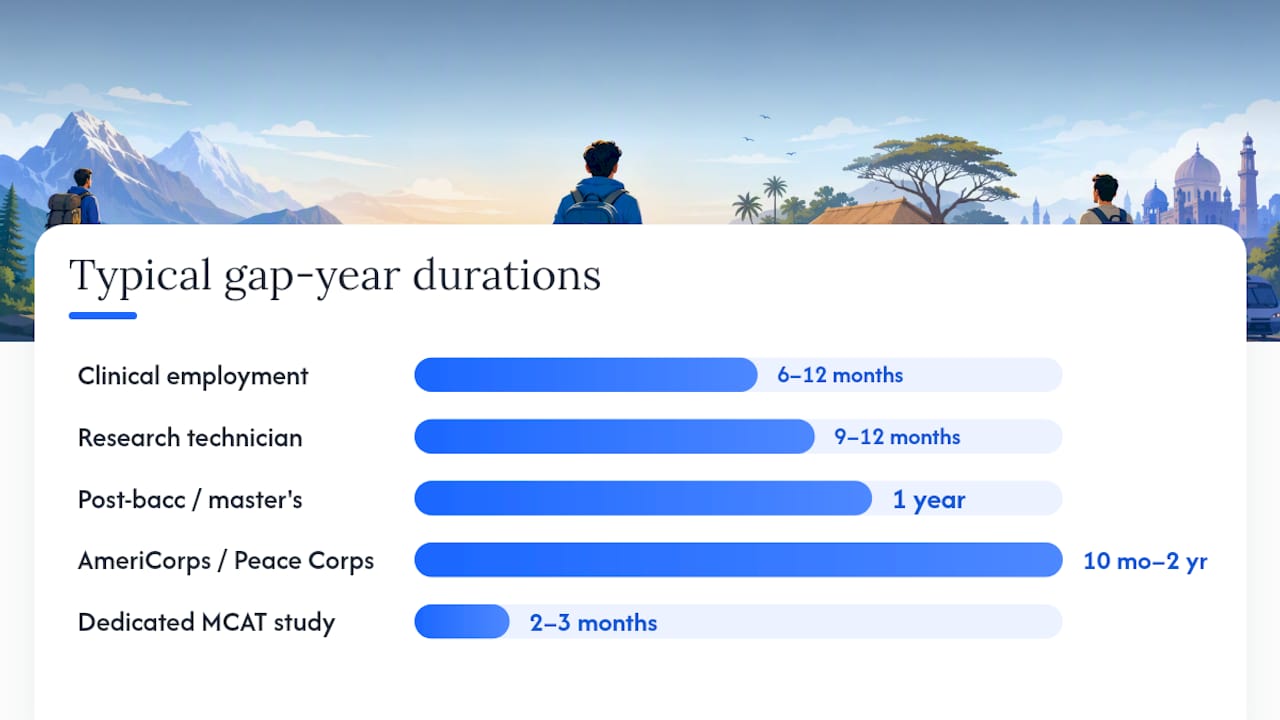
Not all gap-year activities carry equal weight with admissions committees, and time is the scarcest resource you have. Here’s how the major categories stack up.
Clinical employment (medical scribe, medical assistant, EMT) tends to deliver the strongest return per hour. You get sustained, often paid, patient contact that reads as far more credible than a volunteer shift log. The tradeoff is a steep initial learning curve and, for EMT work, a certification course before you even start.
Research technician roles matter most if you’re eyeing MD/PhD programs or research-heavy schools. A full year in a lab is usually enough to get your name on a poster or, with luck, a publication. It’s slower to show results than clinical work, and the output depends heavily on your principal investigator.
Post-baccalaureate or master’s programs work best for GPA repair or subject mastery. Columbia University’s Institute of Human Nutrition reports that its one-year master’s students see measurable MCAT score gains alongside real research output, since coursework directly reinforces the biochemistry and physiology tested on the exam. The catch is tuition, plus a compressed timeline to fold the credential into your application before deadlines close.
Service programs like AmeriCorps and Peace Corps give you a structured commitment with a built-in narrative. AmeriCorps positions often include a living allowance, and Peace Corps placements run from several months to two years with a defined public-health or community focus. Both signal long-term commitment better than short volunteer stints, but neither moves your MCAT score.
MCAT-focused blocks, shadowing, and unrelated paid work paired with medical volunteering round out the list. Shadowing alone rarely impresses committees anymore. Paired with something substantive, it fills gaps in specialty exposure cheaply.
| Activity | Typical time commitment | What it strengthens |
|---|---|---|
| Clinical employment (scribe, MA, EMT) | Full-time, 6-12 months | Patient contact hours, clinical maturity |
| Research technician | Full-time, 9-12 months | Research output, PhD-track fit |
| Post-bacc or master’s | 1 academic year | GPA repair, MCAT-relevant mastery |
| AmeriCorps or Peace Corps | 10 months to 2 years | Service narrative, cross-cultural exposure |
| Dedicated MCAT study block | 2-3 months | Test score improvement |
Pro Tip: Keep a monthly log of your hours, responsibilities, one measurable outcome, and a single line of reflection. Six months in, that log turns into ready-made AMCAS activity descriptions and interview stories, instead of a scramble to remember what you did in March.
How Does a Gap Year Fit Into the AMCAS Timeline?
Most applicants submit their primary application roughly 16 months before their intended matriculation date, according to timing guidance presented at Rice University’s pre-health advising office. If you graduate in May and want to matriculate the following fall, you’re applying in that same summer, not waiting a full year to start the process.
That 16-month window shapes everything else. MCAT scores need to post before you submit AMCAS, which means your test date should land no later than the spring before applying, and ideally earlier to leave room for a retake. Here’s how a gap year premed timeline typically breaks down:
- Months 1-3: Lock your backbone activity (clinical job, research position, or program start), and run diagnostic MCAT practice tests if you haven’t taken the exam yet.
- Months 4-6: Deepen your role, start requesting letters of recommendation, and finish MCAT prep if it’s not done already.
- Months 6-9: Sit for the MCAT if you haven’t, and begin drafting your AMCAS personal statement and activity descriptions.
- Month 9-10: Submit AMCAS as early in the application cycle as your file allows.
- Months 10-14: Turn around secondary essays quickly (many schools expect responses within two weeks), and prepare for interviews.
- Months 14-16: Interview season runs through the winter and into spring, with acceptances rolling in ahead of your target matriculation.
| Milestone | Target timing |
|---|---|
| MCAT test date | Spring before application year |
| AMCAS opens/submits | Late spring to early summer |
| Secondary turnaround | Within 1-2 weeks of receipt |
| Interview season | Fall through early spring |
Rolling admissions punishes delay. Two applicants with identical stats can get very different outcomes if one submits in June and the other in September, simply because seats fill as the cycle progresses. If your gap year includes an intensive MCAT block, plan it for months when you can cut work hours, not the same month you’re also trying to finish a research project.
What Does the Data Say About Gap Years and Admissions?
The numbers settle a debate that used to run mostly on anecdotes. With 73% of matriculants now taking at least one gap year, a gap year is the statistical norm, not the exception that needs defending in an interview.
Admissions committees generally look for two things in a gap-year file: consistent engagement over the full year, and activities that connect logically to a medical career even when they’re not strictly clinical. A finance job with weekend hospice volunteering reads better than twelve months of nothing documented. The AAMC’s own guidance frames coursework, clinical experience, research, MCAT prep, and service as the core recommended categories, and notes that financial-necessity gap years are respected when paired with deliberate engagement in medicine.
A few myths persist despite the evidence:
- “Gap years hurt momentum.” Data doesn’t support this. Most matriculants take at least one, and many take two to four, per AMA’s breakdown of MSQ figures.
- “You have to do something medicine-related every single day.” Committees care about the narrative arc, not a flawless daily log.
- “Working a non-clinical job looks bad.” It looks bad only when it’s disconnected from any effort to stay engaged with medicine.
What Will a Gap Year Actually Cost You?
Budget for the obvious line items first: rent, transportation, MCAT prep materials or a course, the exam fee itself, AMCAS and secondary application fees, and, if you’re pursuing a post-bacc or master’s, tuition that can run into five figures depending on the program. Application costs alone can climb into the low thousands once you factor in secondaries across a dozen or more schools.
Funding sources vary by path. A full-time clinical role or research technician position usually pays a modest salary. AmeriCorps positions typically include a living allowance plus an education award at the end of service, and Peace Corps volunteers receive a living stipend abroad along with a readjustment allowance when their term ends. Post-bacc and master’s programs sometimes offer partial scholarships or assistantships, worth investigating before you commit to full sticker price.
Logistics matter as much as money. Before you accept a clinical job, check what background screening and credentialing it requires, since EMT certification or hospital badge access can take weeks to process. Confirm your health insurance coverage if you’re leaving a school-sponsored plan. If you’re taking coursework, make sure transcripts will be ready in time for AMCAS submission, since a delayed transcript can push your whole file back a cycle.
How Do You Present Your Gap Year on Applications?
The gap year itself isn’t the risk. A vague description of it is. Admissions readers can tell within two sentences whether an applicant treated the year as a growth period or a placeholder.
Do this:
- Name specific responsibilities and hours, not just a job title.
- Include a measurable outcome: patients you helped triage, a poster you presented, a certification you earned.
- Connect the experience explicitly to why you’re pursuing medicine, even for jobs that seem unrelated on the surface.
Avoid this:
- Describing the year in vague terms like “took time to figure things out” with no specifics.
- Framing paid work as purely financial without mentioning any continued engagement with medicine or service.
A model AMCAS activity description, at roughly 55 words: “Worked full-time as an emergency department scribe, documenting over 2,000 patient encounters across trauma, cardiac, and pediatric cases. Collaborated with attending physicians to refine chart accuracy and observed the diagnostic reasoning behind rapid triage decisions. This experience clarified my interest in emergency medicine and reinforced the importance of clear communication under pressure.”
Pro Tip: Keep a “reflection bank,” one or two sentences per month, capturing a specific moment and what it taught you. Nine months later, that bank becomes your fastest source of secondary essay material and interview anecdotes, since you won’t be reconstructing memories from scratch under deadline pressure.
Which Gap-Year Plan Fits Your Goals?
Four templates cover most applicant situations. Pick the one that matches your weakest application component.
- Research-intensive: Months 1-3, join a lab and learn techniques. Mid-year, aim for a conference abstract or manuscript draft. Final three months, finalize authorship credit, sit for the MCAT if not done, and draft AMCAS.
- Clinical immersion: Months 1-3, start a full-time patient-contact role (scribe, MA, EMT) and hit a rhythm. Mid-year, take on more responsibility, request letters from supervising physicians. Final three months, MCAT date, AMCAS draft, letters locked.
- Master’s or post-bacc: Months 1-3, front-load coursework and join a small research project if the program allows it. Mid-year, sit for the MCAT once coursework reinforces your content knowledge. Final three months, finish the degree, submit AMCAS with the credential in hand or in progress.
- Work, volunteer, and MCAT: Months 1-3, secure paid work and a consistent weekly volunteer commitment. Mid-year, shift into a dedicated MCAT study block. Final three months, sit for the exam, draft AMCAS, and finalize letters.
Every template should target the same measurable goals by month 12: an MCAT score that moves you into your target schools’ range, clinical hours in the mid three digits or higher, at least one research output if that’s your focus, and three to four strong letters locked in advance. A tool like Medschoolpilot can map any of these four templates directly onto a milestone tracker, converting vague year-long goals into monthly checkpoints and a readiness score you can watch move.
Where Do You Find Gap-Year Programs and Roles?
Start with sources that are already vetted for premeds rather than generic job boards. AmeriCorps fits service-oriented applicants who want structured commitments with a living allowance. Peace Corps suits those building a global-health or community-service narrative over a longer placement. The AAMC’s gap-year guidance lists recommended activity categories directly. Columbia’s Institute of Human Nutrition is a concrete example of an academic-degree route for MCAT and research gains. University advising pages, including Duke’s and Brown’s Health Careers Advising office, curate role examples worth reviewing this month if you haven’t started applications yet.
How Do You Decide If a Gap Year Is Right for You?
Run through four questions honestly before you commit either direction.
Is your MCAT score where it needs to be? If you’re more than a couple of points below your target schools’ median, a dedicated study block usually beats squeezing prep around a full course load.
Does your file have enough clinical hours to support your personal statement? A handful of shadowing hours won’t back up claims about understanding patient care. If your hours are thin, that’s your answer.
Can you afford another year of tuition-adjacent costs (rent, application fees, possibly a post-bacc) without derailing your finances? Financial necessity is a valid reason to work full-time for a year, as long as you stay connected to medicine somehow.
Are you applying because you’re ready, or because it’s the expected next step? Momentum isn’t a strategy. An application submitted before your file is competitive usually costs you an entire extra cycle when it gets rejected, which is a slower path than a single deliberate gap year.
If two or more of these point toward “not ready,” a gap year is probably the stronger move. If your MCAT, GPA, and hours already clear your target range, applying straight through can make sense, and a gap year premed detour might just delay an already-strong file.
What Mistakes Do Premeds Make During a Gap Year?
The most common failure isn’t a bad activity choice. It’s drift: starting the year with vague intentions and no calendar, then realizing in month nine that the MCAT still isn’t scheduled.
A second frequent mistake is picking an activity for its resume value rather than its substance. Shadowing forty hours across a dozen specialties with no depth reads as checkbox behavior to admissions readers, compared to sustained months in one clinical role.
Financial mismanagement causes real damage too. Underestimating application costs, secondary fees, and MCAT retake expenses can force students into a rushed, underfunded application cycle. Build the budget before the year starts, not halfway through it.
Letters of recommendation get neglected as well. If your gap-year supervisor doesn’t know you’re planning to ask for a letter until month eleven, you’re asking someone to write about you from a fading memory. Flag the request early, ideally within the first few months of working together, so they have a full year of observations to draw from.
Finally, some applicants isolate from their premed network entirely during the gap year, assuming they’ll reconnect once applications start. That disconnection makes it harder to get advice on secondaries, interview prep, or school selection when you need it most. Staying loosely connected to advisors and peers throughout the year costs little and pays off during application season.
How Do You Protect Your Mental Health During a Gap Year?
A gap year premed plan can quietly become isolating, especially for applicants who leave a college campus and its built-in peer group behind. Full-time clinical or research jobs don’t come with the same social structure as a dorm or a lab section full of fellow premeds.

Burnout shows up differently in a gap year than in undergrad. There’s no semester break to reset, and the pressure to “make the year count” can turn every weekend into unpaid extra work. Build in actual downtime, not just time between MCAT study sessions.
Uncertainty compounds the stress. You’re waiting on an application outcome that won’t resolve for over a year, often while watching former classmates already sitting in medical school lecture halls. That comparison trap is real, and it helps to remember that a well-used gap year routinely produces a stronger, more specific application than an early submission would have.
If you’re managing this alone, set a recurring check-in, whether that’s a weekly call with a premed friend, a standing meeting with a mentor, or simply blocking time to reassess your plan monthly instead of only at the end of the year. Small, regular course corrections beat one panicked reassessment in month ten.
How Do You Build a Network During Your Gap Year?
The people you work alongside during a gap year often become your strongest letter writers and your most useful sources of specialty-specific insight, but only if you treat the relationships as ongoing rather than transactional.
Physicians and supervisors you shadow or scribe for see your work ethic firsthand, which makes their letters more specific than a professor who only knew you from a lecture hall of 200 students. Ask early, stay in touch after the position ends, and update them when you get interview invitations.
Research mentors offer a different kind of value: they can speak to your intellectual curiosity and your ability to handle ambiguity, both of which admissions committees weigh heavily for research-focused schools. A single well-timed conversation with a principal investigator about your career goals can shape how they frame your letter months later.
Peer networks matter too. Premeds who gapped a year ahead of you, or alongside you, tend to have the freshest knowledge of secondary prompts, interview formats, and school-specific quirks. Communities like r/premed surface these details constantly, though they’re best used to compare notes rather than as a source of anxiety about what everyone else is doing.
Don’t overlook your undergraduate pre-health advising office during your gap year. Many advisors continue supporting alumni through the application cycle, and they’ve usually seen enough cycles to flag a weak component in your file before an admissions committee does.
What We’ve Learned About Planning a Gap Year
The biggest planning failure we see isn’t a bad activity choice. It’s treating the gap year as an open-ended period instead of a project with a deadline. Students who succeed tend to set a target matriculation date on day one and work backward from it.
Readiness isn’t a feeling. It’s a set of numbers: MCAT score, clinical hours, research output, GPA trend. When students convert those into a dashboard instead of a vague sense of “I think I’m ready,” the gaps in their file become obvious months earlier, while there’s still time to fix them.
Pro Tip: Convert your MCAT practice scores and logged hours into a single readiness view. Watching the number move month over month does more for motivation, and for honest self-assessment, than any single conversation with an advisor.
Turn Your Gap Year Plan Into a Tracked Timeline
Reading about a 16-month application rhythm is one thing. Actually tracking your MCAT prep, clinical hours, and research milestones against it without losing the thread by month six is another problem entirely.
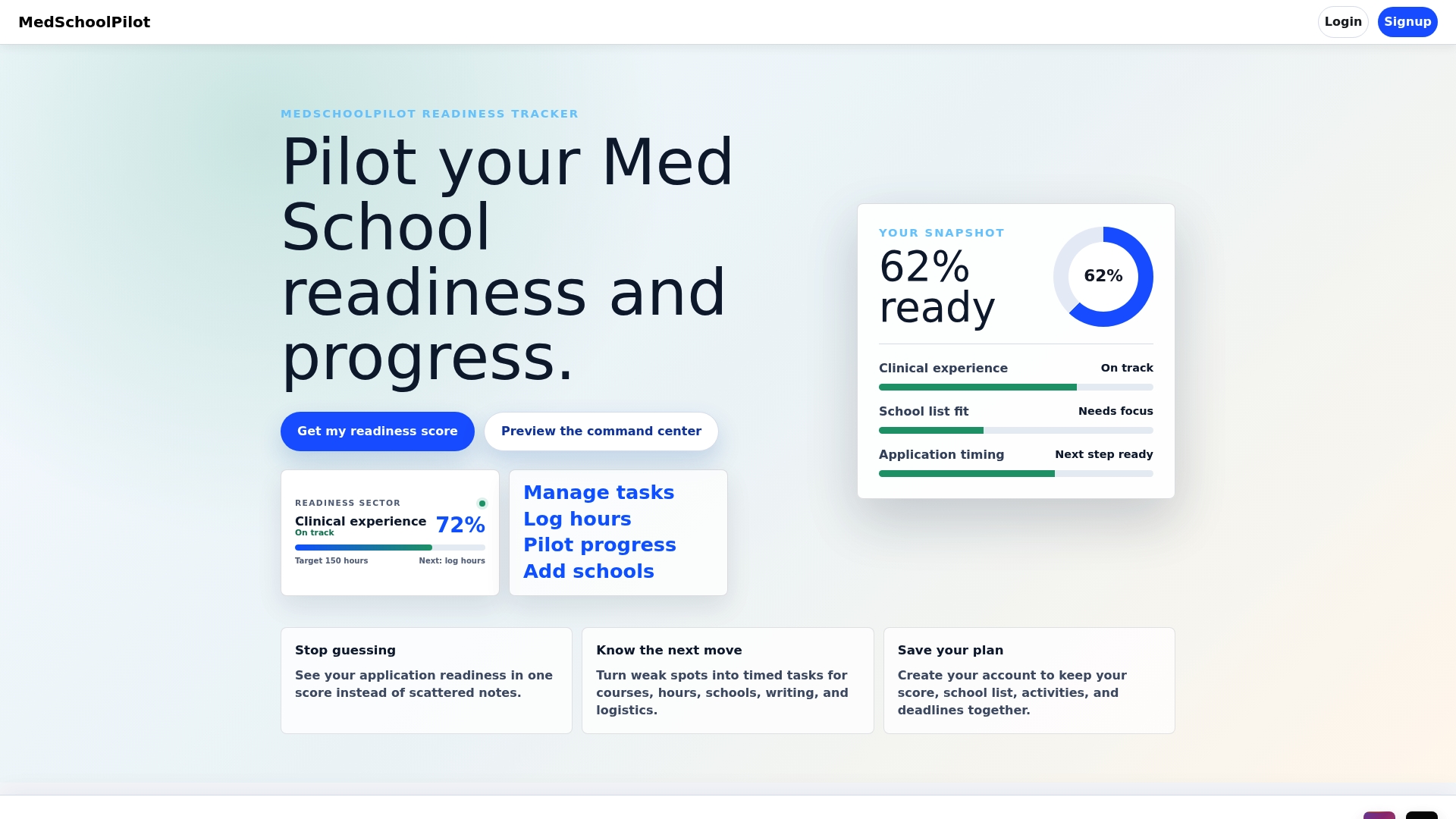
Medschoolpilot’s readiness tracker takes the four gap-year templates above and turns them into dated milestones, so your clinical hours, MCAT practice scores, and application tasks live in one dashboard instead of scattered spreadsheets and sticky notes. The platform’s scoring system flags weak areas early, whether that’s a clinical-hours shortfall in month four or an MCAT gap that needs another two months of study before your target test date. If you want to see how the milestone mapping works before committing, watch a quick walkthrough of the platform. If you’re ready to map your own gap year now, get instant free access to Medschoolpilot and start converting your plan into a tracked timeline today.
Frequently Asked Questions
Is it bad to take a gap year before medical school? No. It’s now the majority path, with 73% of entering medical students reporting at least one gap year. What matters to admissions committees is how you used the time, not whether you took it.
How many gap years is too many for premed? There’s no hard cutoff. AMA’s breakdown of AAMC data shows 43.9% of gapped matriculants took one to two years, 13.4% took three to four, and 7.9% took five or more. Longer gaps just need a clearer narrative connecting the years to your decision to pursue medicine.
What is the best activity for a premed gap year? It depends on your weakest application component. Full-time clinical work strengthens patient-contact hours, research builds toward publication for research-focused schools, and a post-bacc or master’s directly reinforces MCAT-relevant content.
Should I take the MCAT before or during my gap year? Either can work, but sitting for it early in your gap year, once you’ve had a real dedicated study block, gives you time for a retake if needed and keeps you on track for the 16-month application window.
How do I explain a gap year in a medical school interview? Be specific: name your role, your hours, a measurable outcome, and how it clarified your interest in medicine. Vague answers about “figuring things out” raise more questions than they answer.
Sources
- To Gap or Not to Gap – Pre-Health Advising - Vassar Office of Pre-Health Advising
- Planning for a Gap Year - Duke University - Advising
- 6 reasons to take a gap year before applying to medical school | Columbia University IHN
- Timing your gap year and application cycle - Rice University (NAAHP presentation)