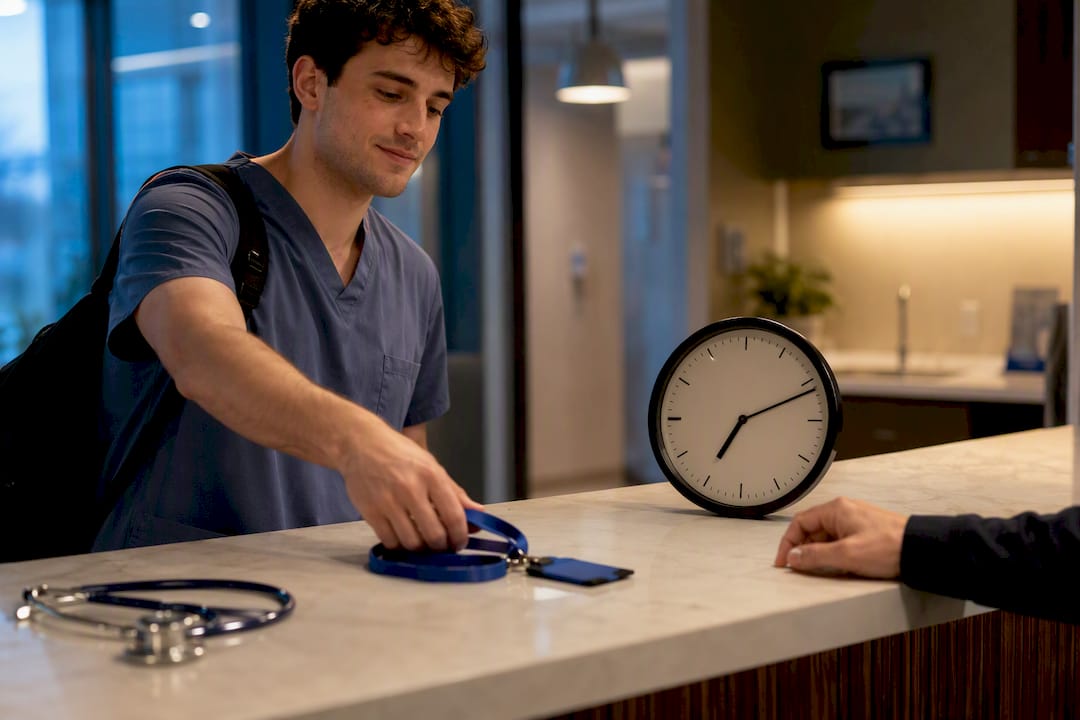
Most U.S. medical schools rely on your integrity and only perform selective checks. AMCAS, AACOMAS, and TMDSAS collect your activity dates, hours, and contact information but rarely audit every entry line by line. The real requirement isn’t a perfect hour count. It’s contactable supervisors and contemporaneous records you can produce if someone asks. Start now: log every activity with full details, secure a supervisor contact or attestation while you’re still on-site, and back it up with an email, pay stub, or badge log.
TL;DR:
- Admissions officers scrutinize high weekly hours, overlapping dates, and vague descriptions to identify potential misrepresentations or inflated logs.
- Tracking clinical hours immediately after shifts with detailed descriptions, supervisor contacts, and backup proof significantly reduces verification risks.
- Direct patient contact roles like nurses, EMTs, and scribes clearly qualify as clinical experience, while shadowing and administrative work must be logged separately.
- Consistent documentation, including signed attestations, pay stubs, badge logs, and timely emails, creates a reliable record for verification when needed.
- Honest reflection combined with detailed, contemporaneous logs demonstrates understanding and integrity, which matter more than just reaching a target hour count.
Table of Contents
- How Do You Verify Clinical Hours for Med School?
- What Counts as Clinical Experience, Shadowing, or Research?
- Recordkeeping That Actually Holds Up: A Step-by-Step Guide
- Which Tracking Method Actually Works Week to Week?
- What Triggers a Med School to Investigate Your Hours?
- What If You Can’t Prove Some of Your Clinical Hours?
- Your Clinical Hours Documentation Checklist and Templates
- Why Honesty and Reflection Matter More Than Your Hour Count
- How MedSchoolPilot Keeps Your Hours and Contacts Organized
- Where to Go for Official Verification Guidance
- Sources
How Do You Verify Clinical Hours for Med School?
AMCAS, AACOMAS, and TMDSAS all ask for the same basic inputs: activity category, start and end dates, total hours, a short description of your duties, and a contact name with phone number or email for a supervisor. None of the three services independently confirms every hour submitted. They’re built on an honor system, and applicants sign an integrity statement affirming that what they’ve entered is accurate, according to Princeton’s Health Professions Advising office.
That doesn’t mean nobody checks. Admissions committees run spot checks, and certain entries draw more scrutiny than others. A cumulative hour count that seems physically impossible, dates that overlap with a full course load, or a listed contact whose information doesn’t match the organization on file will get a second look. The AMCAS application overview from AAMC confirms that the service collects contact details specifically so schools retain the ability to verify entries when something looks off.
What actually gets scrutinized:
- Entries with unusually high weekly hours relative to a full-time school or work schedule
- Vague duty descriptions that could describe almost any role (“helped patients,” “worked at clinic”)
- Missing or unreachable supervisor contact information
- Clinical hours that appear suddenly, concentrated in the weeks before an application deadline
- Activities where the organization name doesn’t match publicly available records
Here’s what most applicants miss: admissions offices care less about your raw total than whether your experience shows sustained, responsible engagement. A committee reading 200 hours logged over 18 months at one clinic reads differently than 200 hours crammed into a single spring break. AAMC’s own guidance on gaining clinical experience stresses quality and depth over volume, and recommends contacting individual schools directly if you’re unsure how a specific role will be classified. The MSAR database, which lists school-specific requirements, reinforces this same emphasis: schools want evidence you understand what clinical work actually involves, not just a number on a page.
What Counts as Clinical Experience, Shadowing, or Research?
Direct patient care is the category that carries the most weight, and it has a fairly clear definition: you’re interacting with patients, often touching them, and your actions affect their care in the moment. Certified nursing assistants, EMTs, medical scribes, medical assistants, phlebotomists, and hospice volunteers who work directly with patients all fall under clinical experience. So do paid roles like patient care technician or home health aide.
Duties that typically qualify as clinical experience:
- Taking vital signs, drawing blood, or assisting with wound care
- Transporting, positioning, or directly assisting patients
- Recording patient histories or documenting encounters as a scribe
- Administering basic care under supervision (feeding, bathing, mobility support)
- Working a hospital or clinic shift where you’re responsible for patient contact, not just paperwork
Shadowing is fundamentally different, and mixing the two categories is one of the most common application mistakes. When you shadow, you observe a physician without providing care yourself. It still matters. It just belongs in its own AMCAS entry, logged separately with its own hours and description. Advising sources commonly recommend somewhere around 40 to 60 hours of shadowing as a reasonable benchmark, paired with a much larger block of direct clinical experience, according to guidance from ResidencyAdvisor on clinical hour benchmarks.
Clinical hour benchmark: Advisors commonly point to 100 to 300+ hours of direct clinical experience as a competitive range for most applicants, with reapplicants often needing more. A steady 3 to 8 hours a week sustained over several months tends to read better to committees than the same total hours compressed into one intense month.
Research and administrative roles occupy a third category, and this is where classification gets genuinely tricky. Working in a lab, even a clinical research lab studying patient outcomes, is research, not clinical experience, unless you have direct patient contact as part of the role. A research coordinator who recruits patients, obtains consent in person, and collects data through direct interviews arguably has a partial clinical component worth describing carefully in the activity description. Front-desk or administrative work at a clinic, without patient contact, belongs under a different category entirely, even though it happens inside a hospital.
Recordkeeping That Actually Holds Up: A Step-by-Step Guide
The strongest defense against any verification question is a habit, not a scramble. Build the habit from your very first shift.
- Log immediately after every shift or activity. Waiting a month to “fill it all in later” is how details get fuzzy and hours get rounded generously in your favor without you noticing.
- Record the full set of fields every time: date, exact hours (start and end time, not just a total), organization name and address, supervisor’s full name and title, direct phone or email, a concrete description of your duties, and one or two sentences of contemporaneous reflection on what you observed or learned.
- Ask your supervisor, early, whether you can list them as a contact. Most people say yes if you ask before your last shift, not after.
- Request a signed attestation when the role allows it. A one-page form listing your name, dates, total hours, role, and a supervisor signature is a model borrowed from clinical certification boards, where supervisor verification forms with explicit hour ranges and a signature line are standard practice.
- Save every secondary proof point as you go: pay stubs or wage statements, institutional scheduling emails, badge-in or timeclock records, and any training or orientation certificates tied to your start date.
- Store everything in one place with a consistent file name (organization, role, date range) and back it up to cloud storage monthly, not just once at the end.
Pro Tip: Send yourself a confirmation email after every shift with the date, hours, and supervisor name in the subject line. Even if you never build a formal log, that email trail alone can substantiate months of hours if you’re ever asked to explain a gap.
Which Tracking Method Actually Works Week to Week?
A paper logbook works if you’re disciplined, but it’s the easiest system to lose or forget to update. A shared Google Sheets template solves the loss problem and lets you sort by organization or date, though it still depends on you remembering to open it after a long shift. Generic time-tracking apps built for hourly work can log hours accurately but usually have nowhere to store supervisor contacts or duty descriptions, which means you’ll still need a second system for the details AMCAS actually asks for.
A minimal tracking template needs only five columns to work: date, hours, organization and supervisor, duties, and a one-line reflection. The weekly routine that keeps it alive: log within 24 hours of the shift, save the confirmation email the same day, and do a five-minute monthly backup of everything to cloud storage.
- Paper logbook: cheap, portable, easy to lose or damage
- Spreadsheet template: flexible and searchable, but only as good as your habit of updating it
- Generic time-tracking apps: accurate on hours, weak on contact and duty detail
- Institutional records: strong evidence but slow to request and not always retained long-term
- A dedicated premed planner: built specifically to combine hours, contacts, and dates in one export-ready format
This is where a centralized system earns its place. MedSchoolPilot’s clinical hours tracking guide walks through a workflow where every entry captures the date, supervisor contact, and duty description in one record, so by the time you open your AMCAS application, your activity section is close to a copy-paste job instead of a memory exercise. The readiness tracker also flags when your clinical hours look thin relative to your target schools, before a committee ever gets the chance to notice first.
What Triggers a Med School to Investigate Your Hours?
Certain patterns draw attention almost automatically, and most of them are avoidable with better habits, not better excuses. A cumulative hour count that would require working impossible daily totals is the fastest way to get flagged. So is a supervisor contact whose email bounces or whose title doesn’t match public information about the organization.
Common red flags admissions staff watch for:
- Hours that spike sharply in the months right before the application opens, with almost nothing logged before that
- Overlapping date ranges across two demanding activities that would require being in two places at once
- Contact information that’s unreachable or clearly informal (a personal cell number with no organizational tie)
- Duty descriptions copied nearly word for word across multiple unrelated entries
- Round numbers everywhere (exactly 100, 200, 300 hours) with no supporting detail
Avoiding flags is mostly about consistency, not perfection. Round your hours honestly to the nearest reasonable increment rather than always rounding up. Keep more than one type of evidence for your biggest activities, not just a supervisor’s name. Write your contemporaneous reflections as you go so your description in the application matches what you actually remember, not a polished summary written six months later.
Pro Tip: If a school does flag an entry, respond fast and lead with whatever proof you already have, even if it’s incomplete. A partial pay stub and a supervisor email carry more weight than a long explanation with no documents attached.
If you’re contacted about a specific entry, don’t panic and don’t over-explain. Provide the evidence you have, and if part of your hour count relied on honest estimation because you didn’t clock in and out precisely, say so directly and explain your estimation method.
What If You Can’t Prove Some of Your Clinical Hours?
Missing documentation is fixable more often than students assume, especially if you act before you actually need the proof.
- Contact the organization’s HR or volunteer office, not just your direct supervisor, and ask whether they retain records of your service dates and hours. Many hospitals and clinics keep volunteer logs for years.
- Request a late attestation letter using simple, direct wording: state your name, the dates you believe you worked, your role, and ask the supervisor to confirm or correct the range before signing.
- Gather secondary evidence if a signature isn’t available: old pay stubs, a training completion certificate with a date, a badge access log from security, or an old shift schedule saved in your email.
- Decide whether to disclose proactively. If a gap or estimate is minor, wait and provide documentation only if asked. If a gap is significant, address it briefly in a secondary essay or an application update rather than letting a committee discover it first.
Your Clinical Hours Documentation Checklist and Templates
Keep this list next to your log, not buried in a folder you forget about.
- Organization name, address, and supervisor’s full name and title
- Direct phone number or email for that supervisor
- Start and end dates, plus total hours (not estimated at the end)
- A specific duty description, not a generic summary
- One proof type beyond your own memory: attestation, pay stub, badge log, or email confirmation
Supervisor attestation template: “I confirm that [Applicant Name] volunteered/worked at [Organization] from [start date] to [end date], completing approximately [X] hours in the role of [Role Title]. Duties included [brief description]. Signed: [Supervisor Name, Title, Date].”
Script for requesting attestation: “Hi [Name], I’m finalizing my medical school application and wanted to confirm my hours and role with you in writing. Would you be willing to sign a short statement confirming my dates and approximate hours? I can send a simple template if that’s easier.”
| Proof Type | Best For | How Fast You Can Get It |
|---|---|---|
| Supervisor attestation | Direct patient care roles | Days to a few weeks |
| Pay stub or wage record | Paid clinical positions | Immediate if saved |
| Badge or timeclock log | Hospital or institutional roles | Weeks, requires HR request |
| Email confirmation | Any activity | Immediate if sent same day |
Why Honesty and Reflection Matter More Than Your Hour Count
Admissions committees aren’t scoring you against a spreadsheet. They’re trying to understand whether you know what medicine actually looks like day to day, and whether you’ll be honest about it when it’s inconvenient. An inflated hour count doesn’t just risk a verification flag. It signals, quietly, that you’re comfortable rounding the truth when it benefits you, and that’s a far worse impression than a modest but well-documented total.
The habit of logging contemporaneously does double duty. It protects you if a school ever asks for proof, and it hands you the raw material for your personal statement and interview stories months before you need them. The detail you’d otherwise forget, the patient conversation, the moment a procedure didn’t go as planned, becomes usable narrative instead of a vague memory. Treat your log as a notebook for the application you’ll eventually write, not just a defensive file.
— MedSchoolPilot
How MedSchoolPilot Keeps Your Hours and Contacts Organized
A centralized platform can help turn scattered shifts, supervisor names, and half-remembered dates into an activity record you can trust when it’s time to apply. Instead of juggling a spreadsheet, a folder of emails, and a mental list of who supervised you last spring, a centralized system can organize your clinical, research, and volunteering hours in one dated log with supervisor contact fields built in.
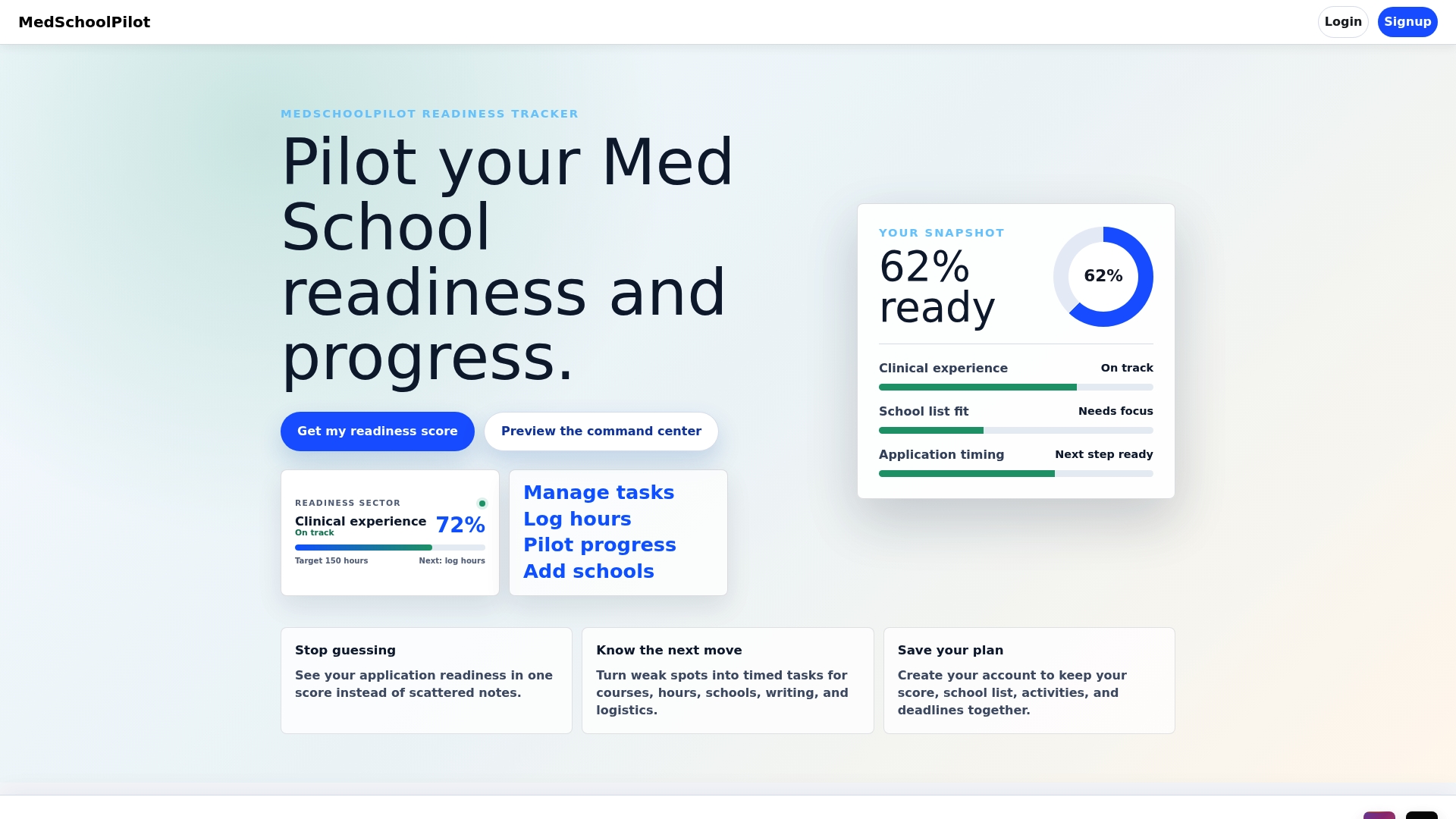
A readiness tracker may score your activity mix against typical competitive applicants, helping identify a thin clinical section or an overrepresented shadowing entry before an admissions committee does. Entries can be date-stamped and export-ready, allowing AMCAS activity descriptions to come from records maintained over time rather than a rushed reconstruction the week before submission.
If you’re weighing specific schools while you build out your experience, MedSchoolPilot’s school-specific admissions pages show how your readiness stacks up against real program requirements. Start by trying the tracker and logging this week’s activity before it slips out of memory.
Where to Go for Official Verification Guidance
- AMCAS application overview from AAMC for how activity data is collected
- AAMC’s guide to gaining clinical experience for what counts beyond shadowing
- Princeton HPA’s clinical experience FAQ for integrity statement expectations
- PNCB supervisor attestation form as a model for requesting sign-off
- MedSchoolPilot’s clinical hours tracking guide for downloadable logging templates
- MedSchoolPilot’s AMCAS vs AACOMAS comparison for how each service treats activity reporting
Sources
- Five ways to gain experience without shadowing | Students & Residents (AAMC)
- Clinical experience FAQ | Health Professions Advising (Princeton HPA)
- Verification of clinical practice hours | Pediatric Nursing Certification Board (PNCB)