
TMDSAS calculates six distinct GPA figures for your application: Overall, Overall BCPM (biology, chemistry, physics, and math), Overall Non-BCPM, Undergraduate, Graduate (when applicable), and Last 45 credit hours. Unlike your university transcript GPA, the TMDSAS GPA calculation includes every grade you have ever earned at a regionally accredited U.S. institution, which means your application GPA is often lower than what your school reports, especially if early semesters were rough.
Here is what TMDSAS counts and what it skips, at a glance:
- Included: Every letter grade (A, B, C, D, F) on an official U.S. regionally accredited transcript, including repeated courses (both attempts), Withdrawn Fail (WF), and No Credit (NC)
- Excluded: Credit by examination (CR), Withdrawn (W), Withdrawn Passing (WP), Incomplete (I or X), and Pass when the grading system is Pass/Fail
- Failures count: An F, WF, or NC earns zero grade points but still consumes credit hours in the denominator, pulling your GPA down
That last point surprises many applicants. A failed course you retook and aced still drags your TMDSAS GPA because TMDSAS carries both attempts, unlike AMCAS (which also includes both) and AACOMAS (which replaces the earlier grade). For a side-by-side breakdown of how the three services differ, see this AMCAS vs AACOMAS comparison.
Key Takeaways
TMDSAS GPA calculation includes every grade on every official U.S. transcript, uses a flat 4.0 scale with no plus/minus, and reports six distinct GPA figures that admissions committees evaluate separately.
| Point | Details |
|---|---|
| Every grade counts | TMDSAS includes all letter grades, WF, and NC — no forgiveness, no replacement for retakes. |
| Six GPA buckets reported | Overall, BCPM, Non-BCPM, Undergraduate, Graduate, and Last 45 all appear on your application. |
| Last 45 can help you | The most recent 45 credit hours form a separate GPA that highlights upward academic trends. |
| Portal entry accuracy matters | Enter grades exactly as shown on the transcript; a wrong credit-hour or grade entry shifts your calculated GPA. |
| Medschoolpilot tracks it all | Medschoolpilot’s coursework module applies TMDSAS rules across all GPA buckets and saves dated snapshots for your audit trail. |
Table of Contents
- What does TMDSAS include and exclude from your GPA?
- What GPA types does TMDSAS report on your application?
- How do you calculate your TMDSAS GPA step by step?
- How does TMDSAS handle repeats, pass/fail, and foreign coursework?
- How do you enter coursework and transcripts in the TMDSAS portal?
- Which calculators and tools help you estimate your TMDSAS GPA?
- A Medschoolpilot workflow for tracking your TMDSAS GPA over time
- Why do TMDSAS GPA breakdowns matter to admissions committees?
- What applicants consistently get wrong about TMDSAS GPA
- Medschoolpilot keeps your TMDSAS GPA calculation organized
- Sources
What does TMDSAS include and exclude from your GPA?
TMDSAS follows Texas Higher Education Coordinating Board (THECB) rules: every course on an official transcript from a regionally accredited U.S. institution that carries an assigned grade and credit hours enters the calculation. The institution’s own GPA policy is irrelevant. If your school excluded a failed retake from its internal GPA, TMDSAS still counts it.
Courses that are included
- All letter-graded courses (A through F) at regionally accredited U.S. colleges and universities
- Repeated courses: every attempt, every time
- WF (Withdrawn Fail) and NC (No Credit): treated as F-equivalent, zero grade points, full credit hours counted
- High school courses taken for college credit that appear on a college transcript with an assigned grade
- Summer courses, online courses, and community college courses that appear on an official transcript
Courses that are excluded
- CR / Credit by Examination: no grade assigned, so excluded
- W (Withdrawn): no grade, excluded
- WP (Withdrawn Passing): no grade, excluded
- I or X (Incomplete): excluded unless later resolved to a letter grade on the transcript
- Pass in a Pass/Fail system: excluded; however, a Fail in a Pass/Fail system counts as an F
- Audited courses: no grade or credit, excluded
- Narrative evaluations: no numeric grade, excluded
- Foreign coursework: excluded from the TMDSAS-calculated GPA entirely; individual schools may evaluate it separately
Transcript-entry checklist
Before you start entering courses in the TMDSAS portal, run through this list:
- [ ] Pull official transcripts from every U.S. regionally accredited institution you attended
- [ ] Identify every course with a letter grade (A, B, C, D, F) — these all go in
- [ ] Flag any W, WP, CR, or I entries — these are excluded
- [ ] Flag any Pass/Fail courses — Pass is excluded; Fail goes in as zero grade points
- [ ] Note any repeated courses — enter both attempts separately
- [ ] Confirm foreign transcripts are on hand for school-level review (not entered in TMDSAS GPA)
Pro Tip: If a course appears on your transcript with a grade and credit hours, TMDSAS counts it — even if your university wiped it from your school GPA after a grade forgiveness policy. There is no forgiveness in the TMDSAS system.
What GPA types does TMDSAS report on your application?
TMDSAS defines and reports the following GPA categories, and admissions committees see all of them:
| GPA Type | What It Covers |
|---|---|
| Overall GPA | Every included course across all institutions and levels |
| Overall BCPM GPA | Biology, chemistry, physics, and math courses only, all levels |
| Overall Non-BCPM GPA | Every included course that is not BCPM, all levels |
| Undergraduate GPA | All included courses taken at the undergraduate level |
| Undergraduate BCPM GPA | BCPM courses taken at the undergraduate level |
| Undergraduate Non-BCPM GPA | Non-BCPM courses taken at the undergraduate level |
| Graduate GPA | All included courses taken at the graduate level (if applicable) |
| Graduate BCPM GPA | BCPM courses at the graduate level (if applicable) |
| Graduate Non-BCPM GPA | Non-BCPM courses at the graduate level (if applicable) |
| Last 45 Hour GPA | The final 45 credit hours of coursework (undergrad + grad combined, chronological) |
What counts as BCPM?
BCPM stands for biology, chemistry, physics, and mathematics. The category is broader than many applicants expect:
- Biology: general biology, cell biology, genetics, microbiology, biochemistry, anatomy, physiology, neuroscience
- Chemistry: general chemistry, organic chemistry, analytical chemistry, physical chemistry, biochemistry (often dual-tagged)
- Physics: general physics, modern physics, biophysics
- Math: calculus, statistics, linear algebra, differential equations
If you are unsure whether a course qualifies as BCPM, the course title and department are the primary signals. For a deeper look at how the science GPA is computed and why it matters, see this guide on calculating your science GPA.
The Last 45 hour GPA
The Last 45 is calculated from the most recent 45 credit hours of coursework on your transcript, combining undergraduate and graduate courses in chronological order. If you took 15 hours of graduate coursework after finishing your undergraduate degree, those 15 hours are the most recent and count first toward the 45. This GPA type gives admissions committees a snapshot of your recent academic performance, which is why it matters so much when your early transcript is weak.
How do you calculate your TMDSAS GPA step by step?
The formula is straightforward. TMDSAS uses a flat 4.0 scale with no plus or minus adjustments:
The formula:
GPA = (Sum of [Grade Points × Credit Hours]) ÷ (Sum of Credit Hours)
TMDSAS rounds the result to the hundredth place (two decimal points), per THECB rules. A 3.456 becomes a 3.46.
Step-by-step: computing your Overall GPA
- List every included course from every official U.S. transcript.
- Assign grade points using the scale above (flatten any A- to 4.0, B+ to 3.0, and so on — TMDSAS ignores plus/minus).
- Multiply each course’s grade points by its credit hours to get quality points.
- Sum all quality points.
- Sum all credit hours.
- Divide total quality points by total credit hours.
- Round to the hundredth place.
Worked example: Overall GPA
GPA = 70.0 ÷ 21 = 3.33
Step-by-step: computing your Last 45 GPA
- Sort all included courses chronologically by term (earliest to latest).
- Starting from the most recent term and working backward, accumulate credit hours until you reach 45.
- If a single term pushes you past 45, include all courses from that term (TMDSAS does not split a term mid-way).
- Apply the same formula to only those courses.
Pro Tip: Quarter-unit courses need conversion before entry. TMDSAS uses semester hours, so divide quarter hours by 1.5 (e.g., a 5-quarter-unit course becomes 3.33 semester hours, entered as 3.3). Getting this wrong inflates or deflates your credit-hour count and shifts which courses fall inside your Last 45.
How does TMDSAS handle repeats, pass/fail, and foreign coursework?
These are the situations that most commonly produce a surprise when applicants see their TMDSAS GPA for the first time.
Repeated courses: no grade replacement
TMDSAS includes every attempt at a course. If you took General Chemistry I three times and earned a D, a C, and an A, all three attempts enter the calculation. Your school may show only the A; TMDSAS shows all three. This is one of the main reasons a TMDSAS GPA can land meaningfully below a university GPA.
Pass/Fail courses
- Pass: excluded from the GPA calculation entirely (no grade points, no credit hours in the denominator)
- Fail in a Pass/Fail system: counted as an F, zero grade points, full credit hours included
Withdrawals
- W (Withdrawn): excluded, no effect on GPA
- WP (Withdrawn Passing): excluded, no effect on GPA
- WF (Withdrawn Fail): counted as an F, zero grade points, full credit hours included
Incomplete grades
An Incomplete (I or X) is excluded at the time of application. If it later resolves to a letter grade on your transcript, you may need to update your application. Contact TMDSAS directly if an Incomplete resolves after you submit.
Transfer coursework
Transfer credit that appears on an accepted U.S. regionally accredited transcript is included in the TMDSAS GPA calculation. The key is whether the receiving institution’s transcript shows the course with a grade and credit hours. If your home institution only shows “TR” with no grade, TMDSAS cannot include it and you may need to submit the original institution’s transcript separately.
Foreign coursework
Foreign coursework is excluded from the TMDSAS-calculated GPA. Individual Texas medical schools may request a foreign transcript evaluation (through services like WES or ECE) and compute their own internal assessment, but that evaluation does not appear in your TMDSAS GPA figures.
High school courses on a college transcript
If your college transcript lists a dual-enrollment or early-college high school course with a letter grade and credit hours, TMDSAS includes it. The course’s origin does not matter; its presence on the official college transcript does.
How do you enter coursework and transcripts in the TMDSAS portal?
Errors in the portal are the most preventable source of GPA miscalculation. The TMDSAS Application Handbook is explicit: enter the grade exactly as it appears on your transcript. Do not add a plus or minus unless the transcript itself shows one. Do not round or interpret.
Portal entry rules
- Enter the grade symbol verbatim from the transcript (A, B, C, D, F, W, WF, CR, P, etc.)
- Enter credit hours to one decimal place in the unit type shown on the transcript (semester or quarter)
- Select the correct term type (semester vs. quarter) — this affects Last 45 sequencing
- Tag each course as BCPM or Non-BCPM based on subject matter
- Tag each course as undergraduate or graduate based on the level shown on the transcript
- Enter repeated courses as separate entries, one per attempt
Which transcripts to submit
Submit official transcripts from every regionally accredited U.S. institution where you completed coursework, regardless of whether you think the grades help or hurt. TMDSAS requires all of them. Foreign transcripts are submitted separately for school-level review and do not feed the TMDSAS GPA.
Transcript-entry checklist
- [ ] One official transcript ordered from every U.S. institution attended
- [ ] Each course entered with the exact grade symbol from that transcript
- [ ] Credit hours entered to one decimal (e.g., 3.0, not 3)
- [ ] Semester vs. quarter correctly selected for each institution
- [ ] BCPM/Non-BCPM tag applied to every course
- [ ] Undergraduate/graduate level correctly assigned
- [ ] Repeated courses entered as separate line items
Pro Tip: Before you finalize your coursework entries, sort them chronologically and count backward from your most recent term to identify which courses fall in your Last 45. A miscoded term type (semester entered as quarter) shifts the credit-hour count and can pull the wrong courses into that window.
Which calculators and tools help you estimate your TMDSAS GPA?
No third-party calculator is official. TMDSAS computes your GPA from the entries you submit in the portal, and the only way to know your exact TMDSAS GPA is to submit accurate entries and let the system calculate. That said, a well-built spreadsheet or a rules-compliant calculator gets you close enough to plan your application strategy.
What to check in any calculator
- Does it flatten plus/minus grades to the base letter (A- = 4.0, B+ = 3.0)?
- Does it include failed attempts and WF entries?
- Does it separate BCPM from Non-BCPM?
- Does it separate undergraduate from graduate?
- Does it have Last 45 logic (chronological ordering, not just the 45 highest-credit courses)?
- Does it disclose its rules and exclusions?
If a calculator does not answer yes to all of those, its output is unreliable for TMDSAS planning.
Building a spreadsheet that mirrors TMDSAS rules
A Google Sheets or Excel spreadsheet with the following columns replicates the TMDSAS formula exactly:
- Institution | Term | Year | Course Name | Credit Hours | Grade | Grade Points | Quality Points | BCPM (Y/N) | Level (UG/G)
Sort by Year and Term to establish chronological order for Last 45 selection. Add a running credit-hour total column to identify the Last 45 cutoff. Filter by BCPM tag to compute your science GPA separately.
A word of caution: Several free online TMDSAS calculators do not include WF or NC entries in their denominators, and some omit repeated-course logic entirely. If the calculator you are using does not explicitly state that it counts failed attempts and does not replace repeated grades, assume it is producing an optimistic estimate. Cross-check against your own spreadsheet before drawing conclusions about your competitiveness.
A Medschoolpilot workflow for tracking your TMDSAS GPA over time
Calculating your GPA once is useful. Tracking it as you complete additional coursework, catching entry errors before submission, and keeping a dated record for appeals is what actually protects you during the application cycle.
Here is a five-step workflow you can run inside Medschoolpilot:
- Import your coursework list. Enter every course from your official transcripts into Medschoolpilot’s coursework module, tagging each as BCPM or Non-BCPM and undergraduate or graduate. This mirrors the TMDSAS portal structure so your entries transfer cleanly.
- Sort chronologically and mark Last 45. Use Medschoolpilot’s term-ordering view to count backward from your most recent term and flag the courses that fall inside the Last 45 window. The platform’s Last 45 visualization updates automatically as you add new coursework.
- Run the GPA calculation. Medschoolpilot applies the TMDSAS formula (grade points × credit hours, summed and divided, rounded to the hundredth) across each GPA bucket: Overall, BCPM, Non-BCPM, and Last 45.
- Cross-check against your official transcripts. Compare each entry in Medschoolpilot against the physical transcript line by line. Flag any discrepancy in grade symbol, credit hours, or term type before you touch the TMDSAS portal.
- Save a dated snapshot. Export a PDF or spreadsheet of your calculation at each major milestone: before you start portal entry, after you complete entry, and after any post-submission transcript update. Dated snapshots are your audit trail if TMDSAS flags a discrepancy or a school questions your reported GPA.
You can pair this GPA workflow with Medschoolpilot’s clinical hours tracker to keep all your application components in one place, reducing the risk of overlooking a data-entry error under deadline pressure.
Pro Tip: Save a dated PDF of your TMDSAS GPA calculation before you submit. If a transcript arrives late or a grade posts after submission, you will have a timestamped baseline that shows exactly what changed and when.
Why do TMDSAS GPA breakdowns matter to admissions committees?
Texas medical schools see every GPA bucket TMDSAS reports, not just your Overall. The BCPM GPA carries particular weight because it signals whether you can handle the science-heavy first two years of medical school. A strong Overall GPA with a weak BCPM GPA raises a flag; a weaker Overall with a strong BCPM often reads more favorably than the reverse.
Analysis of matriculant data shows that most students who matriculated into Texas medical schools clustered in the top GPA ranges, with many matriculants showing overall GPAs of 3.91–4.00 and science/BCPM GPAs at or above 3.81. That concentration at the top end reflects how competitive the Texas applicant pool is, not a hard cutoff. Schools do admit applicants below those ranges, particularly when other application components are strong.
The Last 45 GPA is the figure that can most directly rehabilitate a weak early transcript. If your first two years of college were difficult and your last two years show consistent A’s and B’s in upper-division science courses, your Last 45 GPA will be noticeably higher than your Overall. Admissions committees recognize an upward trend as evidence of academic maturation, and the Last 45 makes that trend quantifiable rather than anecdotal.

TMDSAS publishes ten-year applicant and matriculant statistics through its stats dashboard, which lets you filter by entry year and applicant category. Checking where your GPA figures fall relative to the matriculant distribution for the schools on your list is one of the most concrete ways to calibrate your competitiveness before you apply. For school-level GPA and MCAT thresholds, the medical schools by MCAT guide provides additional admissions data.
If your GPA is below the typical matriculant range, a strong MCAT score and a compelling upward trend in your Last 45 are your primary levers. This low GPA, high MCAT playbook covers that strategy in detail.
What applicants consistently get wrong about TMDSAS GPA
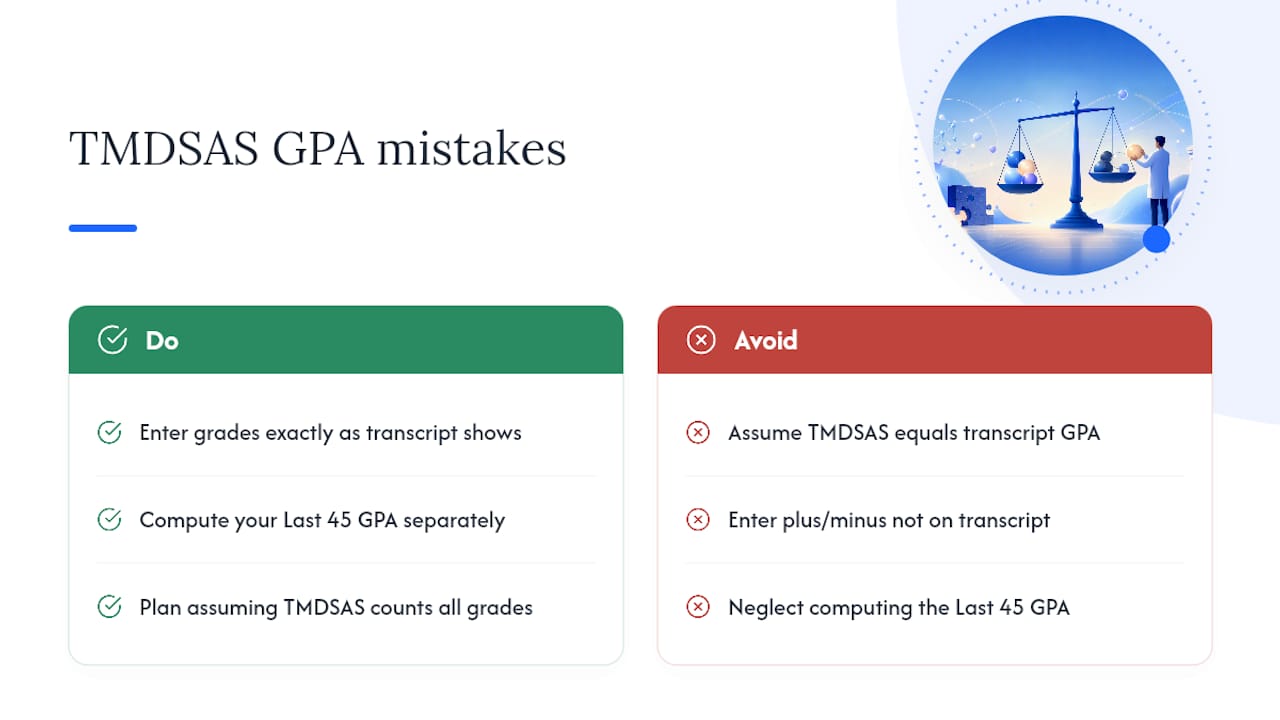
The most common mistake is assuming the TMDSAS GPA will match the GPA on a diploma or a school’s unofficial transcript. It almost never does, and the gap is almost always in the wrong direction. TMDSAS counts every grade, flattens every plus and minus, and ignores every institutional forgiveness policy. An applicant who retook five courses under a grade-replacement policy at their university and sees a 3.5 on their transcript may see a 3.1 on their TMDSAS application.
The second most common mistake is entering grades with plus/minus notation that does not appear on the official transcript. A student who received a B+ but whose transcript simply reads “B” should enter B, not B+. TMDSAS standardizes grades from portal entries, and a mismatch between what you enter and what the transcript shows can trigger a verification issue.
The third mistake is underestimating how much the Last 45 can shift the narrative. Applicants with strong recent records sometimes neglect to compute it separately and miss an opportunity to highlight their most competitive GPA figure in their school list strategy.
Medschoolpilot keeps your TMDSAS GPA calculation organized
Pulling transcripts from four institutions, tagging 80 courses as BCPM or Non-BCPM, sorting them chronologically for Last 45, and then entering every one of them correctly into the TMDSAS portal is genuinely tedious work. One wrong credit-hour entry or a missed WF can shift your reported GPA by a few hundredths of a point, which matters when the median matriculant GPA at your target school is 3.7.

Medschoolpilot’s coursework module is built around the TMDSAS structure: BCPM tagging, undergraduate/graduate splits, Last 45 visualization, and a formula that matches TMDSAS rounding to the hundredth place. You enter your courses once, and the platform shows you every GPA bucket simultaneously, so you can see how a current semester’s grades will move each figure before you submit. Dated exports give you a clean audit trail. The readiness tracker connects your GPA progress to the rest of your application, from clinical hours to school list selection, so nothing falls through the cracks.
Start tracking your TMDSAS GPA free, or see how the platform works before you commit.
Sources
These are the authoritative references to consult when a rule is unclear or you need to resolve a discrepancy:
- TMDSAS Policies
- Statistical analysis showing overall and science GPA distributions for matriculated students