
If you’re a career changer with no science prerequisites, a formal post-baccalaureate program is almost always your fastest route. If your prereqs are done but your science GPA is dragging your application, a record-enhancer post-bacc or a Special Master’s Program (SMP) is the real question to answer. And if your GPA is above 3.5 with a competitive MCAT, you likely need neither.
The 4-path decision framework maps this clearly: your prereq status and whether your undergraduate GPA is still repairable determine which of four paths makes sense. Most premeds waste money by skipping that diagnosis.
The core tradeoffs at a glance:
- A post-bacc raises your undergraduate BCPM/science GPA directly, which is what AMCAS and AACOMAS actually calculate for admissions. An SMP creates a separate graduate GPA that admissions committees read as a different signal.
- An SMP is high-stakes: outperform first-year medical students and it can override undergraduate concerns. Fall below a healthy SMP GPA threshold and it often confirms the committee’s doubts rather than erasing them.
- Cost and time differ sharply. A DIY post-bacc at a state school tends to be less expensive; a formal SMP often costs substantially more for one year.
| Path | Credential | GPA Effect | Typical Cost | Typical Time |
|---|---|---|---|---|
| Career-changer post-bacc | Certificate | Adds to UG GPA | $15K–$60K | 1–2 years |
| Record-enhancer post-bacc | Certificate | Raises UG BCPM GPA | $10K–$40K | 1–2 years |
| Special Master’s Program | Master’s degree | Separate grad GPA | $40K–$80K | 1 year |
| Research/MPH master’s | Master’s degree | Separate grad GPA | $30,000–$60,000 | 1–2 years |
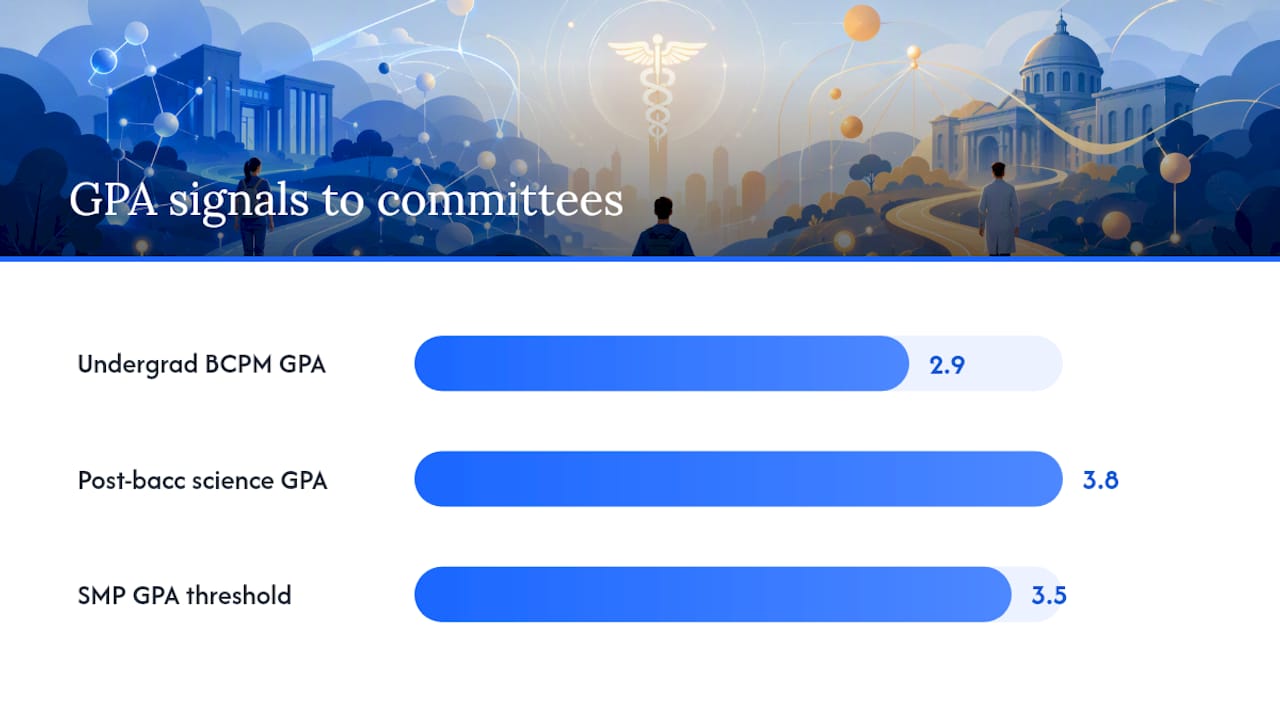
Pro Tip: Before committing to an SMP, confirm you can realistically score a 3.6 or higher in graduate-level medical school coursework. A sub-3.5 SMP GPA is widely read by admissions committees as a negative signal, not a neutral one. If you’re not confident about that threshold, a record-enhancer post-bacc is the lower-risk move.

Key Takeaways
The single most important rule: match your specific problem (missing prereqs, low BCPM GPA, or need for a graduate-level signal) to the program type designed to solve it, not the most expensive or prestigious option available.
| Point | Details |
|---|---|
| Post-bacc repairs UG GPA directly | Post-bacc credits fold into your BCPM GPA on AMCAS; graduate coursework does not. |
| SMP threshold is 3.5 or higher | A sub-3.5 SMP GPA is read as a negative signal by most admissions committees, not a neutral one. |
| Federal loans favor master’s programs | Certificate post-baccs usually don’t qualify for federal student loans; degree programs generally do. |
| Linkage requires written thresholds | A real linkage publishes specific GPA and MCAT numbers; vague “relationships” are marketing language. |
| Medschoolpilot tracks your readiness | Log your cGPA, sGPA, and MCAT progress in Medschoolpilot to model and compare both paths in real time. |
Table of Contents
- How do post-bacc and master’s programs compare for med school?
- What is a post-baccalaureate program?
- What master’s programs actually matter for premeds?
- How does each path affect your medical school application?
- What do these programs actually cost, and how long do they take?
- Which path is right for your specific situation?
- What questions should you ask before committing to any program?
- Representative U.S. programs worth knowing
- How to build a readiness tracker for this decision
- What should you do this week?
- Medschoolpilot helps you compare and track your path
- Sources
How do post-bacc and master’s programs compare for med school?
The table below maps the key decision dimensions side by side. The biggest practical difference: post-bacc coursework folds directly into your undergraduate GPA on AMCAS and AACOMAS, while graduate coursework sits in a separate GPA column that committees evaluate differently.
| Dimension | Post-Bacc (Certificate) | SMP / Master’s Degree |
|---|---|---|
| Primary purpose | Prereqs or UG GPA repair | Graduate-level academic signal |
| Credential | Certificate or transcript | Master’s degree |
| Duration | 1–2 years | 1–2 years |
| Cost range | $10K–$60K | $30K–$80K |
| Federal loan eligibility | Usually not eligible | Generally eligible |
| GPA impact on AMCAS | Raises undergraduate BCPM GPA | Separate graduate GPA |
| Linkage/conditional interviews | Rare | Available at select programs |
| MCAT advising | Varies by program | Varies; SMPs often include it |
AMCAS and AACOMAS treat these paths differently in a way that matters: post-bacc undergraduate coursework is recalculated into your cumulative and science GPA, giving you a direct shot at repairing the number committees see first. Graduate coursework does not touch that number.
What is a post-baccalaureate program?
A post-baccalaureate program is undergraduate-level coursework taken after you’ve already earned a bachelor’s degree. It does not award a graduate degree. Most programs issue a certificate or simply generate a new transcript that feeds into your AMCAS or AACOMAS GPA calculation. Johns Hopkins pre-professional advising distinguishes two main tracks and notes that program outcomes vary considerably, so the program name alone tells you very little.
The three main post-bacc tracks:
- Career-changer post-bacc: Designed for applicants who majored in a non-science field and need to complete all core prerequisites from scratch: general chemistry, organic chemistry, biology, physics, and biochemistry. These programs typically run one to two years and are structured around getting you prereq-ready for the MCAT and for application.
- Record-enhancer post-bacc: Built for applicants who already completed prerequisites but earned a low science GPA. The coursework is upper-level science, chosen to raise the BCPM GPA that AMCAS calculates. Some programs also offer structured MCAT prep and committee letters.
- URiM-focused post-bacc: Programs specifically designed to support underrepresented students in medicine, often with additional advising, mentorship, and outcomes tracking. Many are affiliated with medical schools and publish stronger matriculation data.
Most formal post-bacc programs include cohort advising, access to committee letters, and some form of MCAT guidance. The Johns Hopkins University Post-Baccalaureate Premedical Program is a well-known career-changer model: it covers core science prerequisites, provides structured advising, and is designed for applicants making a full pivot from a non-science background.
Pro Tip: A DIY post-bacc at a state university can cost a fraction of a formal program and still move your BCPM GPA. The tradeoff is that you lose the committee letter, cohort structure, and advising infrastructure. If your main barrier is cost, the DIY route is worth modeling before you commit to a $40,000 formal program.
What master’s programs actually matter for premeds?
A master’s degree creates a separate graduate GPA on your application. That’s the fundamental difference from a post-bacc. Whether that graduate GPA helps you depends entirely on how well you perform and what type of program you choose.
The main graduate options for premeds:
- Special Master’s Programs (SMPs): One-year graduate programs that place you in medical-school-level coursework, often alongside first-year medical students. The explicit purpose is to demonstrate you can handle the academic rigor of medical school. Some programs carry formal linkage agreements with affiliated medical schools.
- Research master’s (M.S.): A thesis or coursework-based degree in a science discipline. Adds research experience and a graduate GPA, but does not directly repair your undergraduate science GPA and may not include MCAT-relevant coursework.
- Master of Public Health (MPH): Builds skills in epidemiology, biostatistics, and health policy. Strong for applicants interested in population health or research careers, but an MPH does not help your BCPM GPA and is not a substitute for science coursework repair. The SMP vs MPH comparison often comes down to whether your barrier is academic credibility or experience breadth.
The Georgetown University Special Master’s Program in Physiology and Biophysics is one of the most cited SMP examples because of its explicit linkage structure. Students take courses alongside Georgetown’s first-year medical students, and the program advertises a guaranteed interview at Georgetown School of Medicine for students who achieve a 3.5 SMP GPA and a minimum MCAT score of 510. That threshold is not a suggestion; it’s the published bar.
Boston University’s SMP is another frequently referenced program. Like Georgetown, it places students in graduate-level biomedical science coursework and provides advising support. Both programs are examples of SMPs that offer structured pathways rather than just a degree credential.
How does each path affect your medical school application?
This is where the post bacc vs masters decision gets concrete. Admissions committees don’t just see a GPA; they see which GPA and how it was earned.
Post-bacc undergraduate coursework is recalculated directly into your cumulative GPA and BCPM science GPA on AMCAS and AACOMAS. If your undergraduate science GPA was a 2.9 and you complete 30 credits of upper-level science at a 3.8, that number moves. Committees see one unified science GPA that reflects your full undergraduate record. That’s a powerful repair mechanism, and it’s the main reason record-enhancer post-baccs exist.
Graduate coursework works differently. Your SMP GPA appears as a separate graduate GPA column. It does not touch your undergraduate BCPM GPA. What it does is send a signal: this applicant can handle medical school coursework. Admissions analyses show that outperforming M1-level peers can override undergraduate concerns, but a sub-3.5 SMP GPA tends to confirm committee doubts rather than resolve them.
What committees actually evaluate:
- Your undergraduate BCPM GPA (directly affected by post-bacc work, not by graduate work)
- Your graduate GPA, if applicable (SMP or other master’s)
- MCAT score and timing relative to your coursework
- Letters of recommendation, including committee letters from post-bacc programs
- Upward grade trends versus isolated strong semesters
Timing matters for the MCAT. A career-changer post-bacc typically positions you to take the MCAT after completing prerequisites, which is the natural sequence. An SMP is usually taken after the MCAT, or concurrently, since the program assumes you’ve already completed prereqs. If your MCAT score is also weak, an SMP alone won’t fix it.
Linkage agreements are the most misunderstood feature of SMPs. A formal linkage means the program has a documented, published pathway to a guaranteed interview or conditional acceptance at an affiliated medical school, contingent on hitting specific GPA and MCAT thresholds. Many programs use the word “linkage” loosely to mean an informal relationship. Ask for the written threshold, not the marketing language.
What do these programs actually cost, and how long do they take?
Money and time are often the deciding factors, and the financing rules are not intuitive.
Federal student loan eligibility generally applies to degree-granting graduate programs. An SMP or research master’s typically qualifies. Most post-bacc certificate programs do not qualify for federal loans, which means you’re financing them out of pocket, through private loans, or through employer assistance. That’s a material difference when you’re comparing a $50,000 SMP (potentially loan-eligible) to a $30,000 formal post-bacc (likely not).
Typical cost and timeline ranges:
- DIY post-bacc (state school): $5,000–$20,000 total, 1–2 years. No committee letter, no cohort advising, but maximum flexibility and lowest cost.
- Formal career-changer post-bacc: $25,000–$60,000, 1–2 years. Includes advising, committee letter, structured prereq sequence.
- Record-enhancer post-bacc: $15,000–$40,000, 1–2 years. Upper-level science focus, often with MCAT prep options.
- SMP: $40,000–$80,000, typically one academic year. Graduate degree, potential linkage, high-stakes performance environment.
The true cost of a failed SMP is not just the tuition. A sub-3.5 SMP GPA can actively damage an application that might otherwise have been competitive. That investment can be substantial and may worsen your situation if academic performance falls below a certain threshold. Before committing, model the scenario where you earn a 3.3 and ask yourself honestly whether you’d still apply.
Pro Tip: If you’re considering a DIY post-bacc, use upper-division science courses at a four-year university rather than community college courses. AMCAS includes community college credits, but admissions committees often discount them. Upper-division coursework at a university signals more clearly that you can handle rigorous science.
Which path is right for your specific situation?
The 4-path framework maps applicant profiles to recommended paths based on two variables: whether you’ve completed prerequisites and whether your undergraduate GPA is still repairable through additional coursework.
Profile-to-path matching:
- Non-science major, no prereqs completed: Career-changer post-bacc. You need the foundational coursework before anything else. An SMP assumes you’ve already done this.
- Prereqs done, cGPA below 3.0: Record-enhancer post-bacc. Your undergraduate GPA is still repairable, and post-bacc credits fold directly into your BCPM GPA. An SMP won’t touch that number.
- Prereqs done, cGPA 2.8–3.4, strong test readiness: SMP is worth considering, but only if you’re confident you can hit 3.6 or above in medical-school-level courses. If you’re not sure, the post-bacc is the safer path.
- Strong MCAT (515+), weak cGPA: Read the low GPA, high MCAT playbook before spending money on either program. Some applicants in this profile are better served by applying strategically to DO programs or lower-tier MD programs than by adding another year of coursework.
- Reapplicant with previous post-bacc work: An SMP may be the only remaining lever if you’ve already done significant post-bacc work and your undergraduate GPA is as high as it’s going to get.
- DO-focused applicant: AACOMAS calculates GPAs similarly to AMCAS for post-bacc work. The same logic applies, but DO programs often weigh upward trends more generously, which can make a record-enhancer post-bacc particularly effective.
Quick self-screen before choosing an SMP:
- Can you name at least three specific graduate-level courses you’ll take and explain why you’ll perform at the top of the class?
- Is your MCAT score already at or above the program’s published threshold?
- Have you spoken with alumni who completed the program and applied to medical school?
- Do you have a financial plan that doesn’t require the SMP to work on the first attempt?
If you answered no to any of these, reconsider before enrolling.
What questions should you ask before committing to any program?
Most program pages are marketing documents. The information that actually matters is usually one phone call or email away, and most applicants never ask for it.
Questions to ask every program:
- What is the exact GPA and MCAT threshold required to receive a guaranteed interview or conditional acceptance? Get this in writing.
- How many students enrolled in the last three years, and how many matriculated to medical school? Ask for the raw numbers, not a percentage.
- Who writes the committee letter, and what is the process for students who underperform?
- Are courses taken alongside medical students, or in separate sections?
- What MCAT advising or prep resources are included in the program fee?
- Can you share a sample syllabus for the core courses?
Red flags to watch for:
- Linkage language that says “relationship with” or “connection to” a medical school without publishing specific GPA/MCAT thresholds
- Acceptance rate statistics without denominators (e.g., “90% of our graduates get into medical school” with no mention of how many students started)
- Programs that emphasize cost comparisons or prestige without publishing outcome data
- No published matriculation statistics anywhere on the program website
A credible program publishes its thresholds, tracks its outcomes, and can connect you with alumni. Program pages and advising offices consistently warn that linkage or association does not guarantee admission. The programs worth your money are the ones that say the same thing and back it up with data.
Representative U.S. programs worth knowing
These three programs represent distinct models. Verify all details directly with each program, as costs and thresholds change.
Johns Hopkins University Post-Baccalaureate Premedical Program A career-changer model for applicants who did not major in science and need to complete core prerequisites. The program provides structured advising, access to committee letters, and a curriculum built around MCAT-relevant science. Best fit: applicants making a full career pivot who need both the coursework and the advising infrastructure to build a competitive application from scratch.
Georgetown University Special Master’s Program in Physiology and Biophysics One of the most structurally transparent SMPs in the country. Students take courses alongside Georgetown’s first-year medical students, and the program publishes a specific linkage threshold: a 3.5 SMP GPA and a minimum MCAT score of 510 earn a guaranteed interview at Georgetown School of Medicine. Best fit: applicants with prerequisites completed, a cGPA in the 2.8–3.4 range, and genuine confidence in their ability to perform at the top of a medical-school-level class.
Boston University Special Master’s Program A one-year graduate program in biomedical sciences with advising support and a curriculum designed to demonstrate medical school readiness. Like Georgetown, it places students in rigorous graduate-level science. Best fit: applicants who want an SMP with institutional support and are targeting a broad range of medical schools rather than a single linked program.
A note on all three: published statistics are conditional. Always ask for raw matriculation numbers and the specific performance thresholds that apply to any linkage or interview guarantee.
How to build a readiness tracker for this decision
A readiness tracker turns an abstract choice into a scored comparison. Here’s how to build one before you spend a dollar on applications or program fees.
- Record your baseline metrics. Write down your current cGPA, science GPA (BCPM), number of prereqs remaining, most recent MCAT practice score, and total clinical hours. These are your starting coordinates.
- Calculate your GPA repair ceiling. Use the science GPA calculator to model how much your BCPM GPA can move with 30, 45, or 60 additional credits at various grade levels. If your GPA can reach 3.2 with 30 credits at a 3.8, a post-bacc is likely sufficient. If it can’t move past 3.0 regardless of additional credits, you’re looking at a different problem.
- Score each path on four dimensions: cost (weight: 25%), time to application (weight: 25%), GPA impact (weight: 30%), and linkage/signal strength (weight: 20%). Assign a 1–5 score for each dimension based on your specific situation.
- Model the failure scenario. For the SMP path, score what happens if you earn a 3.2 instead of a 3.6. If that outcome makes your application weaker than it is today, the SMP is a high-risk choice.
- Set a decision deadline. Most post-bacc programs have rolling or spring deadlines; SMPs often have earlier cutoffs. Build a 12-month timeline that includes application deadlines, MCAT test dates, and program start dates.
- Contact three programs with your standardized question list from the vetting section above. Compare their answers directly.
Pro Tip: Medschoolpilot’s readiness tracker lets you log your cGPA, sGPA, clinical hours, and MCAT progress in one place and see a scored readiness assessment in real time. Running your post-bacc and SMP scenarios side by side in the tracker takes about 20 minutes and gives you a concrete comparison rather than a gut feeling.
What should you do this week?
The decision between a post-bacc and a master’s program is not one to make based on a single article or a program’s marketing page. Here’s what to do in the next seven days.
Immediate next steps:
- Pull your official transcript and calculate your current cGPA and BCPM science GPA. If you’re not sure how, the science GPA guide walks through the AMCAS method step by step.
- List every prerequisite you still need to complete and whether you’ve taken the MCAT.
- Contact three programs using the standardized question list from the vetting section. Write down their answers so you can compare them directly.
- Build a 12-month timeline that maps MCAT test dates, program application deadlines, and your target application cycle.
- Run a readiness-tracker scorecard using the step list above to score each path against your actual numbers.
One restatement of the core verdict: if your undergraduate science GPA is repairable and you haven’t finished prerequisites, start with a post-bacc. If your GPA is as high as it’s going to get and you need a graduate-level signal, an SMP is worth considering only if you can credibly target a 3.6 or above.
What premeds wish they’d known before choosing
The most common regret isn’t choosing the wrong program type. It’s choosing a program before validating that the program solves the actual problem.
Several applicants spend $60,000 on an SMP only to discover that their MCAT score, not their GPA, was the real barrier. Others complete a formal post-bacc and then learn that the committee letter from that program carries less weight at their target schools than they assumed. Both situations are avoidable with two weeks of research before enrollment.
The intensity of SMP coursework surprises most students. Taking graduate-level biochemistry and physiology alongside first-year medical students is not the same as taking upper-level undergraduate science. The pace is faster, the expectations are higher, and the grading curve is often unforgiving. Students who underestimate this and earn a 3.2 SMP GPA are in a worse position than if they’d never enrolled.
The most useful thing you can do before committing to any program is talk to three alumni who completed it and applied to medical school in the last two years. Ask them what their GPA was, where they applied, and where they got in. Marketing statistics are conditional; alumni outcomes are real.
Medschoolpilot helps you compare and track your path
Choosing between a post-bacc and a master’s program is a financial and strategic decision that deserves more than a spreadsheet. Medschoolpilot’s readiness tracker lets you log your current cGPA, science GPA, clinical hours, and MCAT progress, then see a scored readiness assessment that reflects your actual numbers rather than program averages.
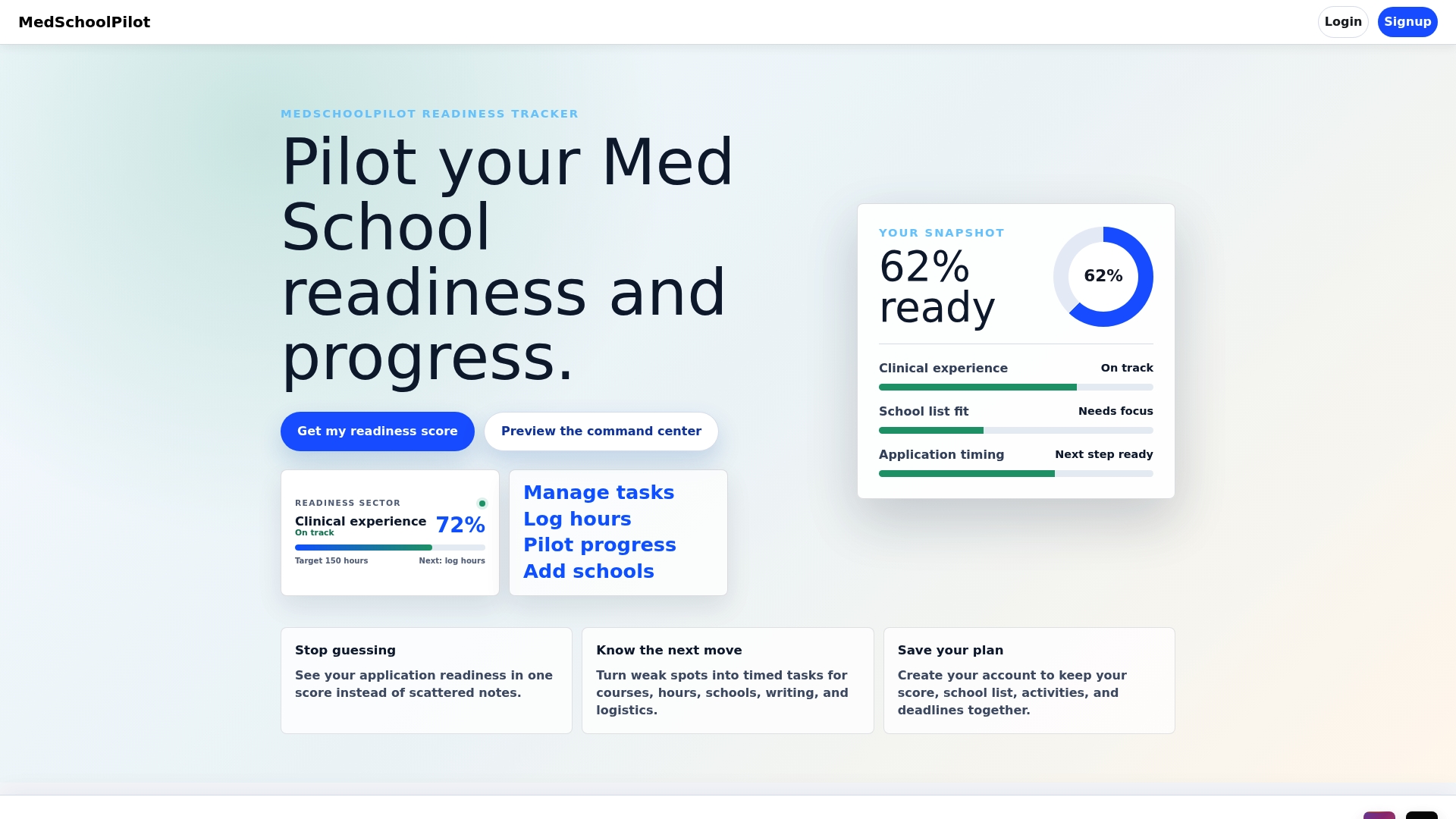
You can model both scenarios side by side: what your application looks like after a record-enhancer post-bacc versus after an SMP, with milestone timelines that account for program length, MCAT scheduling, and application cycle deadlines. The platform keeps every metric in one place so you’re not rebuilding your analysis from scratch every time a program sends you new information.
Start tracking your readiness today, or get free access to run your first scenario now.
Sources
Verify all program details directly with each institution. Published statistics change, and thresholds are updated without notice.
- Special Master’s Program in Physiology & Biophysics | Georgetown University
- Post-Bacc vs SMP: The 4-Path Decision Framework (2026) - GradPilot
- Masters and Post-Bac Programs | Pre-Professional Advising
- Studentaid
When reading any program’s published acceptance or matriculation statistics, always ask for the raw number of students who enrolled and the number who matriculated. A percentage without a denominator tells you almost nothing about your actual odds.