
AMCAS calculates a standardized, verified GPA from your official transcripts during verification; the verified result covers four separate GPA types: cumulative undergraduate, BCPM (Biology, Chemistry, Physics, Math), AO (All Other), and a separate graduate GPA when applicable. That verified number is what every medical school actually sees, and it will almost certainly differ from the GPA on your transcript because AMCAS standardizes grading across institutions rather than duplicating your school’s own calculation.
Before you estimate anything, lock in these facts:
- AMCAS computes your GPA during verification, not when you submit. The verified GPA appears on your printable application only after processing completes.
- AMCAS uses its own Grade Conversion Guide to assign numeric weights to letter grades. Your school’s scale does not carry over automatically.
- Every attempt at every course counts, including failed attempts and retakes, even if your school hides them under an academic forgiveness policy.
- Pass/Fail, Credit/No Credit, AP, and audited courses typically go to supplemental hours, not your GPA.
Start now: gather official transcripts from every institution you attended, download the AMCAS Grade Conversion Guide, and prepare to enter every single course attempt, not just the ones that look good.
Table of Contents
- Which grades AMCAS counts and which it skips
- What the four AMCAS GPA categories actually mean
- How AMCAS converts grades and computes your GPA
- Common transcript situations that change your AMCAS GPA
- When AMCAS calculates and posts your verified GPA
- How to estimate your AMCAS GPA before verification
- Key Takeaways
- What premed advisors actually prioritize
- Medschoolpilot helps you get course entry right the first time
- Useful sources and next-step reading
Which grades AMCAS counts and which it skips
The clearest way to avoid a verification return is to understand exactly what belongs in your GPA and what does not before you start entering coursework.
What AMCAS includes in your GPA:
- All courses with a letter grade and assigned credit hours, as recorded by the issuing institution
- Every attempt at a repeated course, both the original and the retake
- Failed attempts (F, WF, or equivalent), regardless of whether your school removed them from your transcript GPA
- Plus and minus grades, even when your institution does not use them in its own GPA calculation
- Institutional symbols like “IF” (incomplete failure), which AMCAS treats as an F
What AMCAS moves to supplemental hours instead:
- Pass/Fail, Credit/No Credit, CLEP, AP, audited (AU), and withdrawn (W) courses when no institutional alpha grade is assigned
- Narrative evaluations with no letter grade
- Coursework from non-degree-granting or vocational institutions (massage schools, some vocational programs), which AMCAS marks with a not-equal symbol and excludes from GPA
Two situations trip up a lot of applicants. First, AP credit: if your transcript shows “AP” with no letter grade, it goes to supplemental hours. If your institution posted an actual alpha grade (like a B+) for the AP course, that grade counts in your GPA. Second, academic forgiveness: if your school replaced an F with a replacement symbol, you still must enter the original failing grade. AMCAS will find it.
Pro Tip: Pull your institution’s transcript legend before entering coursework. Every symbol your registrar uses has a specific AMCAS equivalent, and guessing wrong is one of the top causes of verification delays.
What the four AMCAS GPA categories actually mean
AMCAS reports GPAs by academic status and by course type. The two that matter most to admissions committees are BCPM and cumulative.
Cumulative undergraduate GPA covers all undergraduate coursework with a letter grade, across every institution you attended. Graduate coursework is calculated separately and reported as a distinct graduate GPA when applicable.

BCPM GPA covers only courses classified as Biology, Chemistry, Physics, or Math. Admissions committees at research-heavy schools often weight BCPM heavily because it signals readiness for the basic science curriculum in Year 1.
AO (All Other) GPA covers every undergraduate course that is not BCPM: humanities, social sciences, language, writing, and so on.
Here is how common courses typically map:
| Course title | GPA category |
|---|---|
| General Biology I | BCPM |
| Organic Chemistry | BCPM |
| Calculus I | BCPM |
| English Literature | AO |
| Introduction to Psychology | AO |
| Biochemistry | BCPM |
| Sociology | AO |
You classify each course when you enter it in AMCAS, but AMCAS verifies your classifications against course descriptions and institutional catalogs. Misclassifying a course, say, putting Biochemistry in AO to protect your BCPM GPA, will be caught and corrected, and it will delay your application. For a deeper look at science GPA calculation, Medschoolpilot has a dedicated walkthrough.
How AMCAS converts grades and computes your GPA
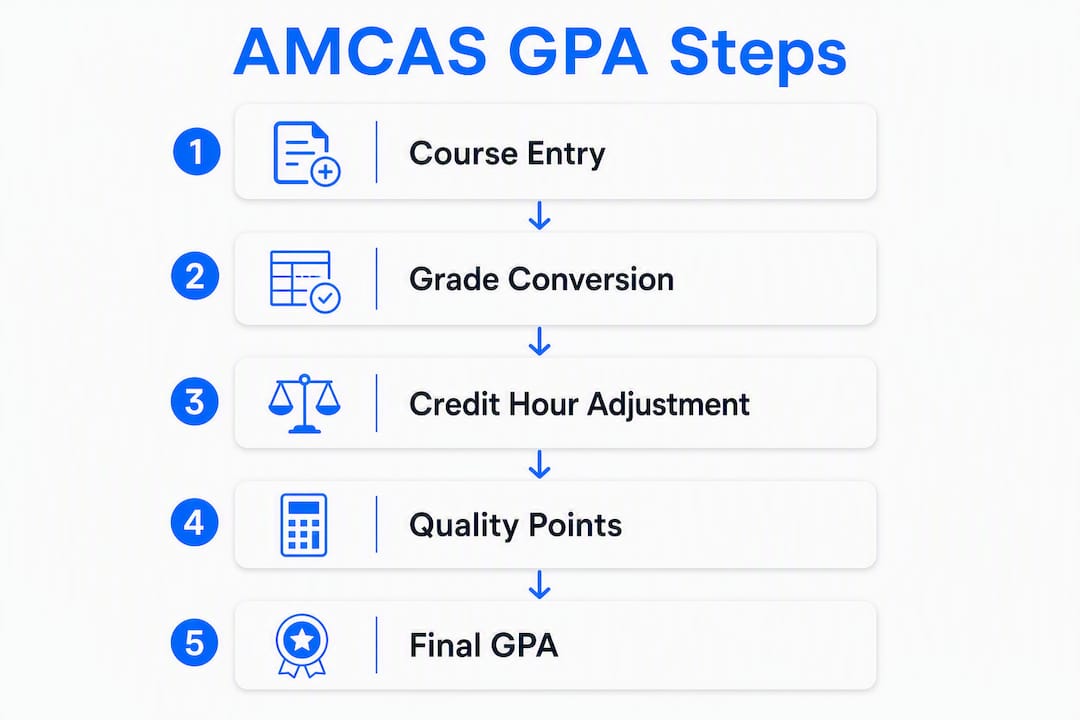
The formula is straightforward once you see it written out.
AMCAS GPA formula:
- Quality points = AMCAS grade weight × semester hours for that course
- GPA = Total quality points ÷ Total semester hours
AMCAS assigns grade weights using its Grade Conversion Guide. A key detail: A+ and A both map to 4.0. Your institution may give A+ a 4.3; AMCAS does not. Plus and minus grades are converted too, and the AMCAS mapping may differ from your school’s. A B+ at your institution might be 3.5; AMCAS may map it to 3.3 or 3.7 depending on the conversion table that matches your school’s system.
Quarter-to-semester conversion: If you attended a quarter-system school, AMCAS converts your quarter hours to semester-equivalent hours using its own conversion rules before computing quality points.
Worked example:
| Course | Grade | AMCAS weight | Semester hours | Quality points |
|---|---|---|---|---|
| General Biology | A | 4.0 | 4 | — |
| English Composition | B+ | 3.3 | 3 | — |
| Calculus I | B | — | 4 | — |
| Total | 11 | 37.9 |
GPA = 37.9 ÷ 11 = 3.45
Notice that the B+ maps to 3.3, not 3.5. That single conversion difference can move your AMCAS GPA a few hundredths of a point below your institutional GPA, which is exactly why the AAMC warns that the two numbers almost always differ.
Pro Tip: Download the AMCAS Grade Conversion Guide and find the conversion chart that most closely matches your school’s grading system. If your school uses a non-standard scale, pick the closest match and note any discrepancies before you submit.
Common transcript situations that change your AMCAS GPA
Several scenarios produce a verified GPA that surprises applicants. Here is what actually happens in each one.
Repeated courses: All attempts count. If you took BIO 101, earned an F, then retook it and earned an A, AMCAS includes both. Your AMCAS GPA reflects the F and the A; your institutional GPA may show only the A. Enter both attempts in AMCAS, each with its original grade and term.
Academic forgiveness: Many schools let students petition to have a grade replaced or removed. AMCAS does not honor these policies. If your transcript shows a replacement symbol where a grade used to be, you must enter the original grade. Omitting it is one of the most common causes of a verification return.
Failed courses: Every F counts, full stop. There is no mechanism in AMCAS to exclude a failed attempt, regardless of what your registrar’s office says about your institutional record.
Transfer credits: AMCAS factors transferred courses as assigned by the transcript-issuing institution. If your home school posted transfer credits with letter grades, those grades count. If the transfer credit shows only “TR” with no grade, it typically goes to supplemental hours.
Vocational and non-degree coursework: Credits from institutions that do not grant degrees, such as some vocational schools, are marked with a not-equal symbol during verification and excluded from GPA calculations.
Foreign coursework: Study-abroad credits posted on a U.S. institution’s transcript are treated like any other course from that institution. Credits on a foreign transcript require a credential evaluation.
The strategic retake is worth addressing directly. Retaking a course to replace a poor grade on your transcript does not remove the original attempt from AMCAS. Admissions committees will see both grades. A strong upward trend can help your narrative, but the math still includes the original attempt.
When AMCAS calculates and posts your verified GPA
AMCAS calculates GPAs during the verification step, and the verified GPA appears on your printable application only after processing is complete. You will not see a verified GPA the moment you submit.
AMCAS typically begins processing applications after the submission window opens each cycle. Verification timelines vary based on application volume and transcript receipt. The AAMC publishes processing time estimates on its website, and those estimates shift during peak submission periods.
Common causes of verification delays:
- Missing official transcripts (AMCAS cannot verify what it has not received)
- Course entries that do not match the transcript (wrong grade, wrong term, wrong credit hours)
- Missing original grades when academic forgiveness was applied, or unusual transcript symbols AMCAS cannot automatically map
- Institutional closures or registrar backlogs during peak periods
- Course classification disputes (BCPM vs. AO) that require manual review
Action checklist to reduce delays:
- Request official transcripts from every institution as early as possible, before you submit
- Double-check every course entry against your actual transcript, line by line
- Keep your registrar’s contact information accessible in case AMCAS needs clarification
- Use the Grade Conversion Guide to verify that the grade you entered matches the AMCAS-recognized symbol for your school
Pro Tip: Send transcripts before you submit your application. AMCAS can begin matching transcripts to your record as soon as they arrive, which shortens the gap between submission and verified GPA.
How to estimate your AMCAS GPA before verification
You can get a reliable estimate before AMCAS processes your application. Here is a practical method.
- Download the Grade Conversion Guide and identify the conversion chart that matches your school’s grading system.
- List every course you have taken with a letter grade: course title, term, credit hours (convert quarter hours to semester hours if needed), and the grade as printed on your transcript.
- Assign AMCAS weights to each grade using the conversion chart.
- Calculate quality points for each course (weight × semester hours).
- Separate BCPM courses from AO courses and compute each GPA independently using the same formula.
- Sum quality points and hours for each category, then divide.
A spreadsheet works well for this. Set up columns for course title, grade, AMCAS weight, credit hours, and quality points. A SUM formula at the bottom handles the rest.
Accuracy checklist for course entry:
- Exact course title as it appears on your transcript
- Term and year
- Credit hours in semester equivalents
- Grade exactly as printed (not your memory of it)
- Correct BCPM or AO classification, verified against the course catalog description
Medschoolpilot’s platform lets you organize your course list, track which transcripts have been sent and received, and run a GPA estimate in one place. The estimate helps you catch classification errors and missing entries before you submit to AMCAS. Note that any estimate, whether from a spreadsheet or a platform, is provisional. The AMCAS Grade Conversion Guide is the canonical source for grade weights, and AMCAS verification is the only authoritative result.
Cross-check your estimate using MSAR Advisor Reports, which show median BCPM and cumulative GPAs for admitted students at each school. That comparison tells you where you stand relative to each program’s typical admitted class, which is more useful than a raw number in isolation. For context on how BCPM and cumulative GPA factor into school selection, the Medschoolpilot guide on medical schools by MCAT pairs admissions data with GPA context.
Key Takeaways
AMCAS GPA calculation is a standardized process that counts every graded attempt, converts grades using its own scale, and produces a verified result that medical schools use to compare applicants across institutions.
| Point | Details |
|---|---|
| Verification produces the official GPA | AMCAS computes your GPA during verification; the number appears on your printable application after processing completes. |
| All attempts count | Failed courses and every repeat attempt are included, even if your school’s forgiveness policy removed them from your transcript GPA. |
| Use the Grade Conversion Guide | AMCAS assigns its own grade weights; A+ and A both equal 4.0, and plus/minus grades may map differently than your institution’s scale. |
| BCPM and AO are reported separately | Classify each course correctly before submission; misclassification is verified against course catalogs and causes delays. |
| Medschoolpilot supports pre-submission accuracy | The platform centralizes course lists, transcript tracking, and GPA estimates to reduce data-entry errors before AMCAS verification begins. |
What premed advisors actually prioritize
Most students fixate on the final GPA number. The advisors behind Medschoolpilot see a different pattern: the students who run into trouble are usually not the ones with a lower GPA. They are the ones who entered coursework carelessly, missed a failed attempt from five years ago, or assumed their school’s forgiveness policy would carry over.
Three things worth doing before you touch the AMCAS course entry screen:
First, map every course to BCPM or AO using the actual course catalog description, not your memory of what the class covered. A course called “Biochemistry and Molecular Biology” is BCPM. A course called “Nutrition Science” might be AO depending on how your institution classifies it. Get it right the first time.
Second, never assume a prior failing grade is gone. Pull every transcript you have ever received, including ones from community college summers and study-abroad programs, and look for anything that could be an F, a WF, or an institutional equivalent. AMCAS will find it during verification. You should find it first.
Third, send transcripts early. Verification cannot start until AMCAS has your transcripts in hand. Every week of delay at the transcript stage is a week of delay in the cycle, and medical school admissions is rolling.
One honest note: any GPA estimate you run before verification, whether in a spreadsheet or a platform, is a working number. It helps you plan and catch errors. The verified AMCAS GPA is the only number that matters to admissions committees.
Medschoolpilot helps you get course entry right the first time
Entering 40 or 60 courses accurately, with correct grades, credit hours, terms, and BCPM/AO classifications, is where most verification delays actually start. Medschoolpilot gives you a structured workspace to organize every course before it goes into AMCAS, track which official transcripts have been sent and received, and run a GPA estimate that flags potential classification issues early.

The platform’s readiness dashboard keeps your entire application in one place, from coursework and GPA estimates to clinical hours and school list progress. You can see exactly where your application stands and what still needs attention before you submit.
A quick note: Medschoolpilot’s GPA estimates are a planning tool. AMCAS verification is the authoritative result, and the verified GPA is what schools receive.
Start organizing your coursework on Medschoolpilot before your next submission window opens.
Useful sources and next-step reading
The sources below are the authoritative references for AMCAS GPA policy. Use them for final verification and any policy questions.
- AAMC Grades and GPA Calculations: The official AAMC page explaining when and how AMCAS computes verified GPAs
- Grades Factored Into AMCAS GPA Calculations: Covers which grades count, how repeats and failed attempts are handled, and how institutional symbols are treated
- Grades Included in AMCAS GPAs: Specifies which transcript notations go to supplemental hours rather than GPA
- AMCAS GPA Reports to Medical Schools: Explains how AMCAS reports GPAs by academic status to medical schools
- Medschoolpilot: How to Calculate Science GPA: Step-by-step BCPM GPA calculation walkthrough for premed applicants.
- Medschoolpilot: AMCAS vs AACOMAS: Comparison of GPA rules across centralized application services.
For all policy questions, the AAMC official pages and the Applicant Guide are the definitive sources. Medschoolpilot resources are planning tools that complement, not replace, AMCAS verification.