
Premed isn’t a major. It’s an advising track built around required coursework, a competitive GPA, a strong MCAT score, and documented clinical and research experience. Staying on it means tracking five things every semester: your core science prerequisites and labs, your BCPM GPA, your MCAT prep timeline, your clinical and volunteer hours, and regular check-ins with a pre-health advisor.
TL;DR:
- Maintaining a strong GPA in science courses and understanding school-specific prerequisites is essential, especially for organic chemistry and biochemistry requirements.
- Tracking clinical hours, research, and extracurricular activities with detailed verification ensures a credible and verified application profile.
- Scheduling the MCAT early and preparing with focused study sessions, including practice exams, increases the chance of scoring within the competitive range.
- Applying early through rolling admissions improves chances, with primary applications submitted once all materials, including letters and transcripts, are ready.
- Building a comprehensive, semester-by-semester tracking system reduces last-minute errors and helps identify application gaps well before deadlines.
Table of Contents
- Premed Track Basics: Major Flexibility and Advising Support
- What Courses and Labs Does the Premed Track Require?
- How Competitive Does Your GPA Need to Be?
- What Does the MCAT Actually Test, and When Should You Take It?
- Which Nonacademic Experiences Do Admissions Committees Actually Weigh?
- How Do You Track Everything Without Losing the Plot?
- Advising, AP Credit, and When a Post-Bacc Makes Sense
- When Should You Submit Your Application, and in What Order?
- What Mistakes Derail Premed Students Most Often?
- Protecting Your Mental Health on the Premed Track
- What Does the Premed Track Actually Cost?
- The Real Gap in Premed Planning Advice
- Turn Your Premed Checklist Into a Readiness Score
- Sources
Premed Track Basics: Major Flexibility and Advising Support
You can major in biology, English, or engineering and still be premed, because medical schools care about prerequisite completion and GPA, not your degree title. Premed simply describes the set of requirements and experiences layered on top of whatever major you choose.
Most universities organize this through a pre-health advising office rather than an academic department. That distinction matters because it means the support structure is separate from your major, and you have to opt in.
Common resources include:
- Dedicated pre-health advisors who run degree audits against medical school requirements
- Premed student clubs that share shadowing and research contacts
- Committee letter programs that package your recommendations into one packet
- Online degree-audit tools that flag missing prerequisites before senior year
Declare your intent to your advising office as early as freshman orientation, even informally. Advisors can only catch a scheduling problem, like a chemistry sequence that won’t finish before your MCAT date, if they know your timeline in advance. Waiting until junior year to introduce yourself to advising is one of the more common, and most avoidable, planning errors.
What Courses and Labs Does the Premed Track Require?
The prerequisite list is fairly consistent across schools, though exact lab hours and accepted substitutions vary by institution. Core coursework typically includes:
- Biology: one year, including lab
- General chemistry: one year, including lab
- Organic chemistry: at least one semester, including lab
- Biochemistry: at least one semester
- Physics: one year, including lab
- Statistics: at least one course (biostatistics is increasingly favored over pure calculus)
- English composition: one year or the equivalent writing credit
Lab hours are non-negotiable at most schools, and a course without an attached lab section usually won’t satisfy the requirement even if the lecture content overlaps. Some schools accept an upper level course, like genetics or cell biology, in place of the introductory sequence, but that substitution is school specific. UT Austin’s course guidance is a useful model, but you still need to check each target school’s own prerequisite page, since requirements do shift, particularly around biostatistics emphasis.
A typical four-year sequence front-loads biology and general chemistry freshman year, moves into organic chemistry and physics sophomore and junior year, and saves biochemistry and statistics for junior or senior year so they align with MCAT prep. Late starters and post-bacc students usually compress this into two years by taking chemistry and biology simultaneously across summer and fall terms.
Pro Tip: Before you register for organic chemistry, check whether your target schools require it as a full year or accept one semester. That single detail changes your entire junior-year schedule.

How Competitive Does Your GPA Need to Be?
Medical schools track two numbers separately: your cumulative GPA and your BCPM GPA, which covers only biology, chemistry, physics, and math coursework. A strong cumulative GPA can mask a weak BCPM GPA, and admissions committees notice the gap.
Competitive applicants generally target a cumulative and BCPM GPA in the 3.6 to 3.8 range, and many entering classes report mean GPAs around 3.7 to 3.8. That’s an average, not a floor, but it tells you where the middle of the applicant pool sits.
A few tactics protect your GPA without gutting your science exposure:
- Balance your course load at roughly 14 to 16 credit hours per semester, with 6 to 9 of those hours in science rather than stacking every hard science class into one term.
- Understand your school’s grade replacement or retake policy before you need it, not after a rough exam.
- Choose electives that genuinely interest you in tough semesters, since a strong non-science grade still lifts your cumulative GPA.
Running your own science GPA calculation each term, rather than guessing at year’s end, catches a slipping BCPM average while you still have time to adjust your next semester’s course load.
What Does the MCAT Actually Test, and When Should You Take It?
The MCAT has four sections: Biological and Biochemical Foundations, Chemical and Physical Foundations, Psychological and Social Foundations of Behavior, and Critical Analysis and Reasoning Skills. Your biology, biochemistry, and organic chemistry courses feed the first section; general chemistry and physics feed the second.
The section most premeds underestimate: psychology and sociology content makes up a full quarter of the exam, yet many students never take an intro psych or soc course before test day. That gap shows up on practice scores.
Plan on three to six months of concentrated study once your coursework foundation is in place, with weekly full-length practice exams in the final stretch. Most applicants schedule the MCAT in the spring or early summer of the year before they apply, giving scores time to post before submitting AMCAS or AACOMAS.
Which Nonacademic Experiences Do Admissions Committees Actually Weigh?
Grades and MCAT scores get you into the applicant pool. Clinical hours, research, and leadership are what separate you inside it. Admissions committees sort experiences into a handful of categories, and they read each one differently.
- Clinical patient contact: direct interaction with patients, whether shadowing, scribing, EMT work, or hospital volunteering.
- Research: lab work, clinical research assistance, or a senior thesis, ideally with a poster or publication credit.
- Community service, nonclinical: volunteering unrelated to health care, which shows sustained commitment rather than resume padding.
- Leadership: an officer role, a team captaincy, or running a student organization.
Depth beats breadth here. A committee would rather see 200 hours at one free clinic over two years than five different one-week stints. Aim for meaningful minimums, roughly 100+ clinical hours and sustained research involvement of at least a semester, before you consider an entry “credible.”
Log hours the week they happen, with a supervisor’s name and contact information attached, because AMCAS verification requests months later are nearly impossible to satisfy from memory. When you write your activity description, name a specific moment or patient interaction rather than summarizing duties. Turning routine nonclinical volunteering into a strong AMCAS entry usually comes down to that one concrete detail.
Pro Tip: Ask your supervisor for a verification signature or letter the same month you finish an activity, not the month you start filling out AMCAS.
How Do You Track Everything Without Losing the Plot?
Most premed students fail at logistics, not chemistry. Somewhere around junior year, the spreadsheet gets messy, an hours log goes missing, or nobody remembers which schools require a full year of biochemistry. A workable operational framework has three layers: yearly milestones (finish prerequisites, take the MCAT, submit applications), semester checkpoints (run a degree audit, recalculate BCPM GPA), and weekly tasks (log hours, update your activities draft).
An effective tracker needs specific fields, not vague notes:
- Course name, term, and grade, split by BCPM subcalculation
- Lab completion status and verification
- Experience category, hours logged, timestamp, and supervisor verifier
- MCAT test date and full-length practice scores
- Letter of recommendation status for each writer
- Target school list with prerequisite match
Reconstructing a hour log from memory a year later is one of the most common failure points in the whole process, and it’s entirely avoidable with a system started in year one.
A useful tracking schema includes fields for course grades split by BCPM subcalculation, lab verification, experience category with timestamps and verifiers, LOR status, MCAT dates and practice scores, and an overall readiness score, audited every semester to catch gaps early.
A readiness score can be built directly from those fields, so instead of scattered spreadsheets and sticky notes, you get one dashboard showing where your application is strong and where it’s thin. The MedSchoolPilot iOS app adds milestone analytics on the go. Start a tracker in your first year, audit it every semester, and let your readiness score tell you whether to add a shadowing shift or pull back on a science-heavy course load.
Advising, AP Credit, and When a Post-Bacc Makes Sense
Meet with your pre-health advisor at least once a semester and request a degree audit every year, not just before you apply. AP and IB credit is where students most often trip up: many selective programs, including Harvard Medical School’s own guidance, still expect in-college coursework for core sciences even when you scored a 5 on the AP exam. Confirm this school by school before you skip a class.
- Choose a major based on genuine interest, since a non-science major with a strong GPA competes just fine against a biology major.
- Verify AP and transfer credit policy for every target school individually.
- Consider a post-baccalaureate program if you switched into premed late or need to rebuild a weak science GPA.
- Use a gap year to finish prerequisites, retake the MCAT, or add clinical hours without rushing.
When Should You Submit Your Application, and in What Order?
Both major application services run on roughly the same calendar. AMCAS serves allopathic (MD) schools; AACOMAS serves osteopathic (DO) schools. Submission opens roughly a year before your intended matriculation, and because most schools use rolling admissions, applying near the opening date, rather than the deadline, meaningfully improves your odds.
- Take the MCAT by spring of the application year at the latest, ideally earlier.
- Request transcripts and secure letters of recommendation months before you submit.
- Submit your primary application the day verification opens, not the day it’s due.
- Draft secondary application responses in advance for your most likely schools, since many arrive within days of your primary being verified.
- Prepare interview logistics, including travel and updated activity descriptions, once invitations start arriving in late summer or fall.
Early submission matters more than perfect polish. A detailed AMCAS submission checklist built around the eight weeks before verification opens can keep your primary from slipping past the ideal window.
What Mistakes Derail Premed Students Most Often?
- Overreliance on AP credit: confirm every school’s policy before assuming a course is satisfied.
- Taking the MCAT too late: a summer-before-application test date leaves no room for a retake.
- Losing track of hours: unverified activities get cut or shrunk during application review.
- Overloading science semesters: a 19-credit organic chemistry and physics term tanks your BCPM GPA.
- Ignoring school-specific prerequisites: MSAR and individual school pages list variations that generic checklists miss.
Run a semester audit with your advisor before these become senior-year emergencies. Nearly all of them are fixed by better documentation and earlier planning, not by working harder.
Protecting Your Mental Health on the Premed Track
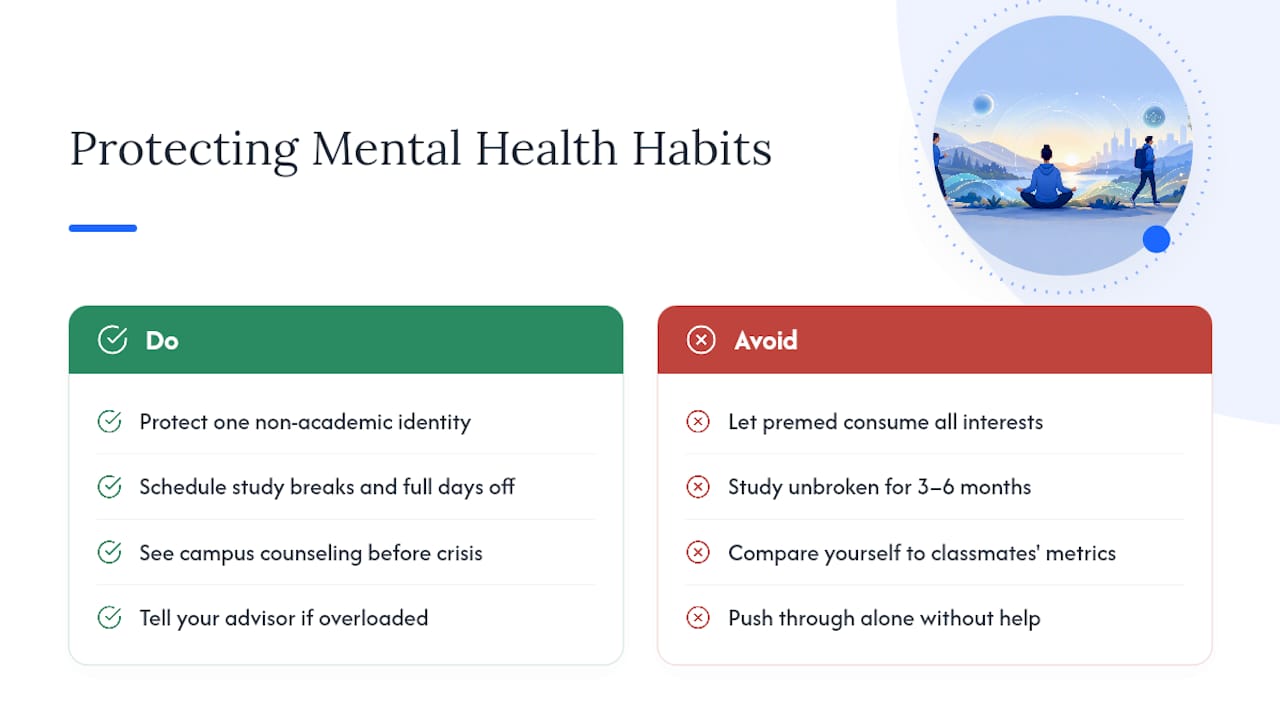
The premed track runs on deferred gratification, and that structure takes a toll if you never build in relief. Chronic comparison, whether it’s GPA, MCAT scores, or how many research posters a classmate has, is one of the most corrosive habits premed students develop, and it rarely reflects your actual competitiveness.
Build recovery into your calendar the same way you build in exam dates. A few practices that hold up across a four-year track:
Protect one non-academic identity, whether that’s a sport, a creative hobby, or a friend group unrelated to your major. Losing every outside interest to premed obligations tends to precede burnout, not prevent it. Schedule study breaks and full days off during MCAT prep specifically, since three to six months of unbroken studying produces diminishing returns past a certain point.
Talk to your campus counseling center before a crisis, not during one. Most universities offer free sessions to enrolled students, and a single conversation with a counselor about workload anxiety is far cheaper, in time and stress, than trying to push through a semester alone. If you’re carrying research, clinical hours, coursework, and a job simultaneously, say so to your advisor. A good pre-health advisor would rather help you sequence a lighter semester than watch your GPA and your well-being both slip at once.
What Does the Premed Track Actually Cost?
Premed preparation carries real costs beyond tuition, and they show up gradually enough that many students don’t budget for them until an expense is already due. MCAT prep materials, whether a self-study question bank or a structured course, commonly run several hundred to well over a thousand dollars depending on the format. The MCAT registration fee itself, plus any rescheduling fees if your first attempt doesn’t go as planned, adds another line item.
AMCAS charges a primary application fee plus a per-school fee for every additional program on your list, and AACOMAS follows a similar structure. Secondary application fees stack on top of that, typically per school, and a broad list of 15 to 20 schools turns into a meaningful total fast. Interview travel, including flights, hotels, and lost work or class time, is often the least anticipated cost of the entire cycle.
The AAMC’s Fee Assistance Program can reduce MCAT and AMCAS costs substantially for applicants who qualify based on financial need, and it’s worth checking eligibility well before your application year rather than after fees are already due. Budgeting across all four years, not just application year, gives you room to spread prep-course costs, shadowing-related travel, and application fees instead of absorbing them all in one expensive senior year.
The Real Gap in Premed Planning Advice
Most premed guidance treats checklists as the finish line: complete these courses, hit this GPA, log these hours, submit. The checklist isn’t wrong, but it’s incomplete. The actual failure point for most applicants isn’t knowing what to do. It’s tracking whether they’ve done it consistently enough, across four years, without a single missed verification or forgotten prerequisite.
Conventional advice underweights documentation almost entirely, treating it as an afterthought instead of the skill that determines whether a strong junior year actually shows up correctly on your AMCAS application. A student with excellent grades and thin, poorly documented activities loses to a student with solid grades and airtight, verified experience logs more often than most advisors admit.
Prioritize building your tracking system in year one, before you have anything complicated to track. It’s far easier to log a shadowing shift the week it happens than to reconstruct a semester of volunteering from memory during application season. The premed track rewards consistency far more than intensity, and consistency is a documentation problem before it’s ever an academic one.
— MedSchoolPilot
Turn Your Premed Checklist Into a Readiness Score
Sticky notes and five different spreadsheets get you through a semester. They don’t survive four years of coursework, clinical hours, research, and a shifting school list. Some platforms replace that patchwork with one workspace that tracks your BCPM GPA, MCAT prep, clinical and volunteer hours, letters, and school selections in a single dashboard, then convert all of it into a readiness score you can actually act on.
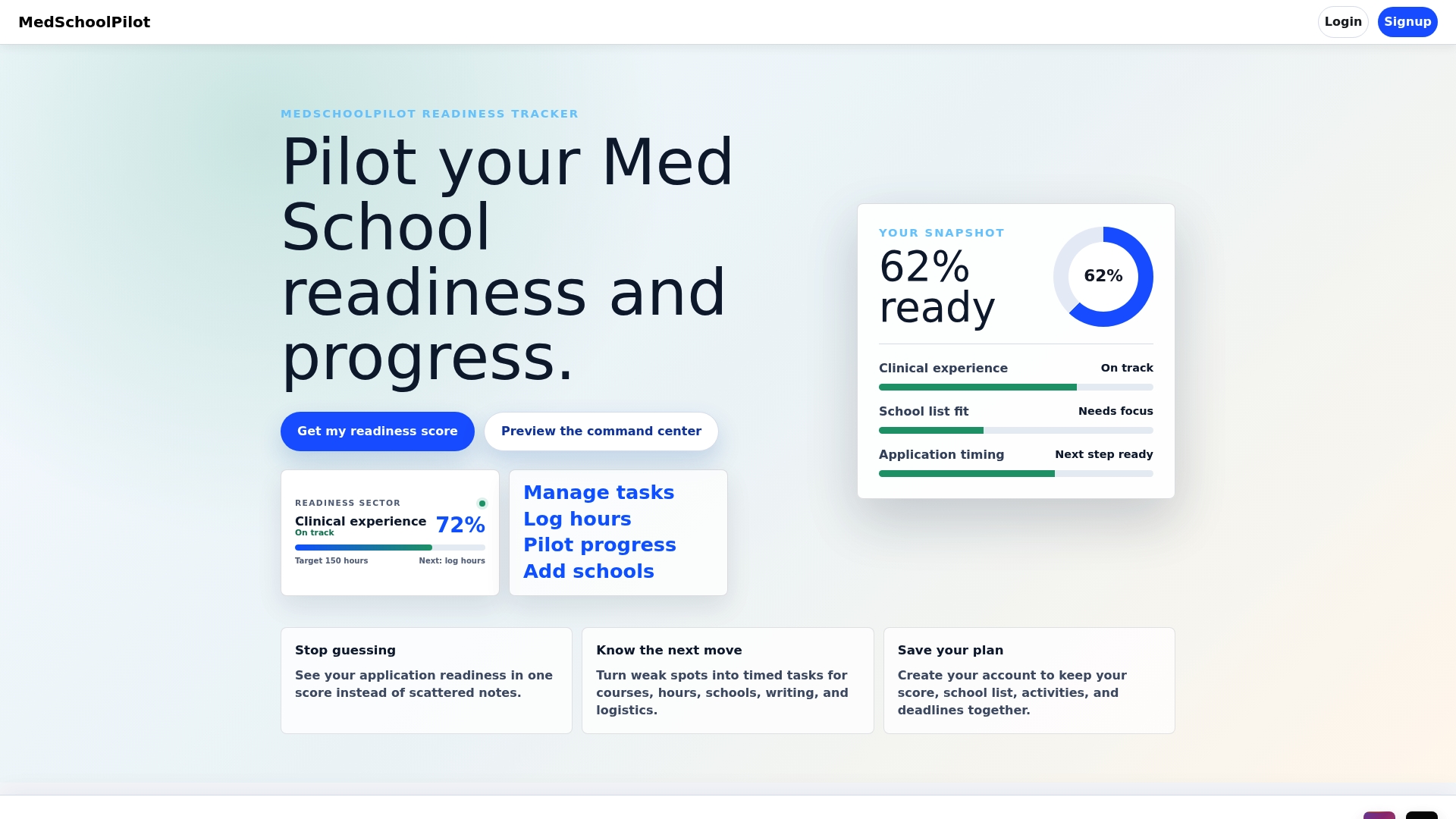
If you’re the student who’s been meaning to start tracking “soon,” this is the moment to stop meaning to. Pull up your target school list, check specific requirements like the Medical University of South Carolina’s admissions data or University of Michigan Medical School’s prerequisites, and log your first semester’s courses and hours into MedSchoolPilot today. Your readiness score will tell you exactly where the gaps are while you still have time to close them.
Sources
- Pre-Med Course Requirements | Health Professions Office
- MCAT sections | The Princeton Review
- Pre-Medicine Guide | University of Iowa