
You must disclose any institutional action on AMCAS unless your school officially deleted or expunged it from your record. There’s no middle ground here: the AAMC treats an undisclosed IA as an integrity violation, and verification often catches it anyway. Pull your transcript and conduct record today, confirm exactly what’s documented, then draft a factual AMCAS entry. Disclosure paired with real remediation evidence keeps you competitive.
TL;DR:
- Disclose any institutional actions unless they have been formally expunged in writing, as unreported actions are treated as serious integrity violations.
- Many conduct findings are stored separately from transcripts and only appear during background checks, making verification essential.
- When updating your AMCAS disclosure, include specific facts, sanctions, remediation, and verified evidence, avoiding explanations or excuses.
- Post-submission, you must notify medical schools of any new institutional actions within 10 business days, supported by documented evidence.
- Organize all related documentation early, including transcripts, conduct letters, and timelines, to ensure accurate and efficient disclosure during application review.
Table of Contents
- What counts as an institutional action on AMCAS?
- The AMCAS disclosure requirement and what happens if you skip it
- How AMCAS verification and post-submission reporting actually work
- Writing the 1,325-character AMCAS institutional action entry
- What admissions committees actually look for in an IA disclosure
- Talking about an IA in secondaries and interviews
- If your record was deleted or expunged, confirm it before you answer “No”
- Reapplying after an institutional action: what actually needs to change
- Using MedSchoolPilot to organize your IA documentation and evidence
- An advisor’s checklist for students with an institutional action
- Get organized before you write a single word of your IA entry
- Where to verify the rules yourself
- Sources
What counts as an institutional action on AMCAS?
The AAMC defines an institutional action as any formal action a college or medical school takes against you for unacceptable academic performance or a conduct violation. That’s a broad net, and it splits into two categories that AMCAS treats the same way on the application.
Academic actions cover things like academic probation, suspension for failing grades, or dismissal for repeated coursework problems. Conduct actions cover honor council findings (plagiarism, cheating on an exam, fabricating data), residence-hall violations serious enough to trigger a formal hearing, Title IX findings, and mandated interventions like an ethics course or a substance-use program ordered by a dean’s office. If a university committee heard your case and issued a written sanction, it almost certainly qualifies.
Here’s where students get tripped up: an IA doesn’t have to appear on your official transcript to count. Many conduct findings live in a separate disciplinary file that a registrar or dean of students maintains, invisible on the document you’d send to a job or a bank, but fully discoverable when a medical school’s background check or verification request reaches that office.
The one exception is genuine deletion or expungement. If your institution has a formal process for removing an action from your record after a set period or successful appeal, and it actually completed that process in writing, you may answer “No” on AMCAS. Anything less than documented removal means you answer “Yes.”
Before you assume either way, verify:
- Contact your registrar for a full, current academic transcript.
- Contact the dean of students or student conduct office and request a written summary of any disciplinary record, even informal ones.
- Ask specifically whether any past action was expunged, and get that confirmation in writing, not a verbal assurance from a staffer.
- Check your undergraduate and any graduate or post-bacc institutions separately. AMCAS wants your full history, not just your most recent school.
The AMCAS disclosure requirement and what happens if you skip it
AMCAS asks a direct question about institutional actions, and the 2026 AMCAS Applicant Guide is unambiguous about the standard: you answer “No” only if the action was deleted, expunged, or otherwise formally removed by the institution. Everything else gets a “Yes,” regardless of how minor it felt at the time or how long ago it happened.
Here’s how verification actually works. AMCAS cross-checks the transcripts you request from every institution you’ve attended against what you report. If a school’s transcript carries a disciplinary notation, or if a medical school later contacts your undergraduate registrar during secondary review, any mismatch between your answer and the record surfaces fast.
Reality check: advisors and admissions forums consistently report that failing to disclose an institutional action is treated as a more serious integrity breach than the underlying incident itself. A single semester of academic probation is often survivable. Getting caught concealing it is a different conversation entirely.
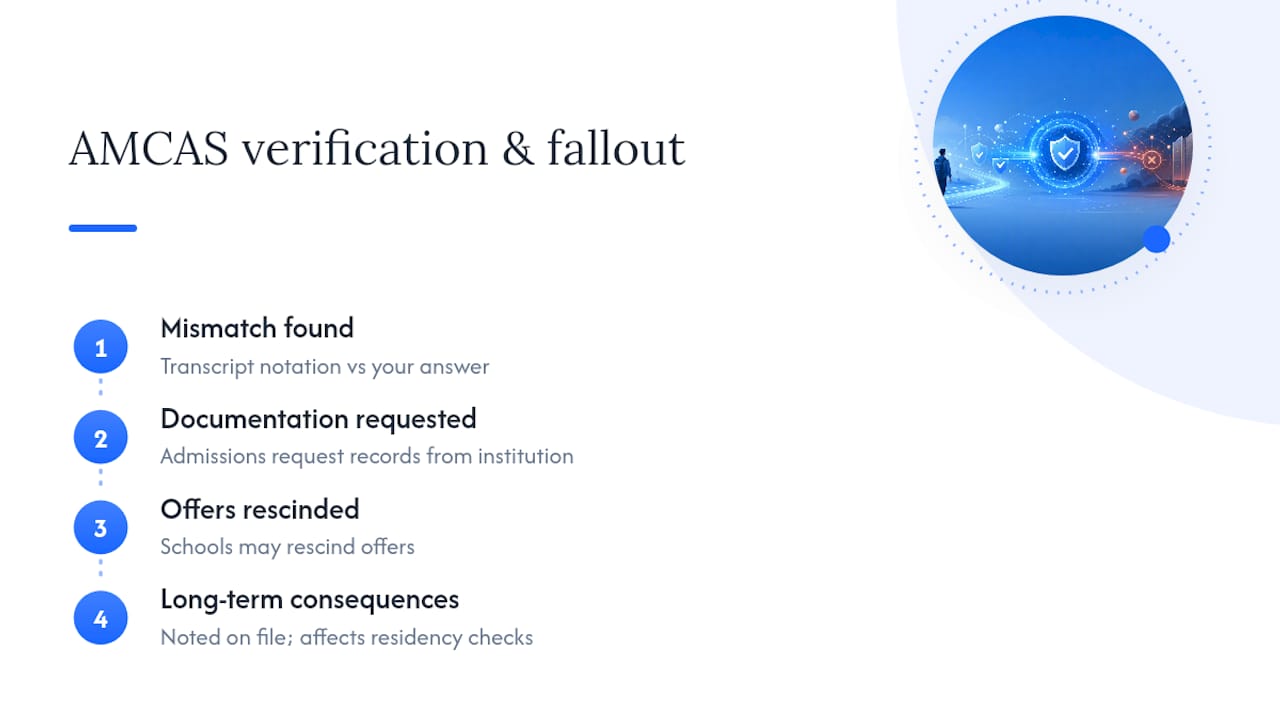
What actually happens when nondisclosure surfaces:
The school flags your application for an integrity review, often pausing your file mid-cycle while it investigates. 2. Admissions staff request documentation directly from your institution to establish the timeline and your original answer. 3. If you’re already enrolled or holding an acceptance, some schools rescind offers outright once a nondisclosure is confirmed. 4. Even schools that don’t rescind immediately will note the pattern, which follows you into residency background checks years later.
The fix is procedural, not clever. Order your transcripts and written conduct summaries from every school before you certify your AMCAS application, not after. If there’s any ambiguity about whether something qualifies as an IA, disclose it. A borderline disclosure that turns out to be unnecessary costs you nothing. A borderline omission that turns out to be necessary can cost you the cycle.
How AMCAS verification and post-submission reporting actually work
AMCAS verification isn’t a rubber stamp. Staff compare your self-reported coursework, dates, and IA disclosures against the official transcripts every listed institution sends directly to AMCAS. Discrepancies, including an unreported disciplinary notation, trigger a manual review that can add weeks to your processing time or, worse, flag your file for the integrity committee.
The part most applicants miss entirely: disclosure obligations don’t end at submission. If an institutional action occurs after you’ve submitted your AMCAS application but before you matriculate, the 2026 AMCAS Applicant Guide requires you to notify every medical school you’ve designated within 10 business days of the action. That’s a hard deadline, not a suggestion, and it applies whether the new IA is academic or conduct-related.
Practical steps to stay ahead of this:
- Save PDF copies of every transcript and conduct letter the moment you receive them, not months later when you need them under deadline pressure.
- Request a written statement from your registrar or conduct office confirming the exact date an action was issued and, if applicable, the date any sanction ended.
- If you’re a reapplicant, know that schools you applied to previously may already have your prior disclosures on file, so consistency across cycles matters as much as accuracy.
- Build a simple folder system, physical or digital, that separates “confirmed clean” records from “pending confirmation” ones so nothing slips through during a busy application season.
Pro Tip: Request your conduct-office letter in the same week you request your transcript. Registrars and deans of students often take two to three weeks to respond during peak academic periods, and you don’t want that document arriving the night before your AMCAS certification deadline.
Writing the 1,325-character AMCAS institutional action entry
AMCAS gives you 1,325 characters, roughly 200 to 230 words, to explain an institutional action. That’s not much room, which is exactly why a loose, apologetic narrative fails and a tight, evidence-first structure works.
The most effective approach follows a five-part sequence:
- The fact — what happened and when, stated plainly. No throat-clearing, no scene-setting.
- The sanction — the exact consequence the institution imposed, named specifically (probation, suspension, a required course).
- Brief context — one sentence, factual, with zero excuse-making. This is where students most often sabotage themselves by over-explaining.
- Remediation steps — what you actually did afterward: courses completed, terms of probation fulfilled, counseling attended.
- Measurable evidence — grades since the incident, roles that required trust, anything a reader can verify independently.
Notice what’s absent from that list: justification. Admissions readers have seen every version of “I was overwhelmed with my course load” or “my lab partner was actually responsible.” None of it moves the needle. What moves the needle is proof that you changed.
Tone rules that matter more than people think:
- Write in plain declarative sentences. Avoid passive constructions that dodge responsibility (“mistakes were made”).
- Never minimize the sanction’s severity, even if it feels embarrassing to state it directly.
- Skip adjectives that editorialize your own growth (“I’ve truly grown”). Let the evidence make that claim instead.
- End on the forward-looking fact, not a promise. “Since spring 2024, I have maintained a 3.7 GPA and served as a peer tutor” beats “I promise this will never happen again.”
Here’s how that plays out for two different severity tiers.
Minor case (single-course academic integrity violation, resolved with a grade sanction): “In October 2023, I received a zero on a chemistry lab report after using an unauthorized solution manual, resulting in a permanent notation and a mandatory academic integrity workshop. I completed the workshop in November 2023 and have since served as a course tutor for that same department, maintaining a 3.8 GPA across four subsequent semesters.”
Major case (semester-long suspension following an honor council finding): “In spring 2023, my university’s honor council found me responsible for plagiarism on a term paper, resulting in a one-semester suspension. I completed a required ethics course and returned in fall 2023, earning a 3.9 GPA over four semesters since, including two upper-level courses in the same department where the violation occurred, and I now mentor first-year students on academic integrity policy.”
Both examples run under 400 characters, which leaves room to add a second piece of evidence if space allows. That’s the goal: use every character on something a committee could theoretically verify, and cut anything that’s just narrative padding.
What admissions committees actually look for in an IA disclosure
Admissions officers describe their evaluation lens as safety with power and proximity, meaning they’re assessing whether you can be trusted with patients, colleagues, and the authority a physician holds. An apology doesn’t answer that question. Sustained, verifiable behavior change does.
The evidence that actually moves a committee, ranked roughly by weight:
- Time since the incident. A violation from your freshman year carries far less weight by senior year or a gap year than one from six months before you apply.
- Academic recovery. Semester-by-semester GPA trends after the incident, especially in rigorous coursework, tell a concrete story.
- Positions of trust. Serving as a teaching assistant, resident advisor, or lab manager after an IA signals that other institutions and supervisors have already vouched for you.
- Integrity-specific engagement. Volunteering with an honor council, completing an ethics fellowship, or mentoring students on academic conduct shows you engaged with the issue rather than just serving a sentence.
- Completed remediation. Finished courses, closed probation periods, and documented program completions, not “in progress” claims.
Whether an IA is disqualifying or remediable usually comes down to pattern and recency rather than the label of the violation itself. A single, older academic integrity finding with years of clean performance afterward is a very different file than a recent conduct violation involving dishonesty toward a patient, colleague, or authority figure, or a pattern of repeated actions across multiple terms.
If you can secure a letter from a supervisor, professor, or program director who worked with you after the incident and can speak to your reliability, that letter often carries more weight in committee discussion than anything you write about yourself.
Talking about an IA in secondaries and interviews
Your AMCAS entry is the compressed version. Secondaries and interviews are where you get to expand it, and the expansion should still follow the same discipline: fact, accountability, evidence, forward motion.
A workable structure for a verbal or written follow-up:
- Restate the fact in one sentence, matching exactly what’s on your AMCAS entry and your institutional record.
- Name the sanction and confirm it’s resolved.
- Spend the bulk of your answer on what changed, specific courses, roles, or habits, not general reflection.
- Close with a concrete marker of the person you are now versus then.
A model interview answer might sound like this: “During my sophomore year, I was placed on academic probation after failing two courses in one semester. I completed a mandatory study-skills program and met weekly with an academic advisor for the following year. Since then, I’ve earned a 3.8 GPA, including in upper-level biochemistry, and I now work as a peer tutor helping other students avoid the same mistakes.” Interviewers will often probe with “what would you do differently” or “how do you know this won’t happen again.” Answer both with specifics, not sentiment.
Pro Tip: Record yourself answering the IA question out loud before any real interview. Most applicants discover on playback that they either over-apologize or ramble past the point where the answer was already convincing.
Avoid three tone traps: blaming a professor, roommate, or circumstance; minimizing the sanction’s severity; and offering more detail than the question asked for, which tends to reopen doubts you’d already closed.
If your record was deleted or expunged, confirm it before you answer “No”
“Deleted” or “expunged” has a specific meaning here: your institution formally removed the action from your record through its own documented process, not that enough time simply passed or you assume it’s forgotten.
Before answering “No” on AMCAS, confirm the removal in writing:
- Request a letter from your registrar or conduct office explicitly stating the action was expunged and the effective date.
- Keep that letter permanently. You may need to produce it years later if a school’s background check surfaces the original record despite the expungement.
- If you’re reapplying and previously disclosed an IA that has since been expunged, update your answer for the new cycle, but be ready to explain the change if asked.
- When your institution’s policy on removal is unclear or contested, talk to a pre-health advisor or, for complicated disputes, an education attorney before you certify your application.
Reapplying after an institutional action: what actually needs to change
If you’re a reapplicant with an IA in your file, schools that saw your previous application will remember the disclosure. The goal this cycle isn’t a different story. It’s a stronger evidence file.
What to prioritize before you reapply:
- More time and a longer clean record. A second cycle with another full year of strong grades and no repeat issues does more for your case than any rewritten essay.
- A leadership or trust role you didn’t have last cycle, whether that’s a supervisory job, a teaching position, or a formal committee seat.
- Completed remediation with documentation, not just “enrolled in” but “successfully finished,” backed by a certificate or letter.
- A letter writer who can speak to change over time, ideally someone who knew you both before and after the incident.
If the IA was recent or severe, waiting an additional cycle to build that record usually beats reapplying immediately with the same thin evidence. Update your secondary and interview answers to reflect the new evidence rather than repeating the prior cycle’s script verbatim; committees notice when an answer sounds rehearsed from a previous year instead of genuinely current.
Using MedSchoolPilot to organize your IA documentation and evidence
Collecting the right paperwork under deadline pressure is where most applicants lose ground, not in the writing itself. MedSchoolPilot’s readiness tracker gives you a structured place to log every document, date, and remediation milestone tied to an institutional action, so nothing gets recreated from memory the night before certification.

A practical workflow looks like this: collect your transcript and conduct letters, log the exact dates of the action and sanction into a custom timeline, track remediation milestones (course completions, GPA recovery by term, new leadership roles) as they happen rather than reconstructing them later, then export a clean evidence list when you’re drafting your AMCAS entry or a secondary response.
The platform’s task timelines double as an interview-prep tool, keeping your talking points aligned with the actual documented dates instead of a fuzzier recollection. It also gives you one place to store contact information for the registrar, conduct office staff, and letter writers you’ll need again for secondaries or a future reapplication. For students working through an IA, that kind of centralized, dated record is often the difference between a rushed disclosure and a well-supported one.
An advisor’s checklist for students with an institutional action
Here’s the sequence I walk students through every time an IA comes up, in order, no shortcuts:
- Verify your full record first. Get transcripts and written conduct summaries from every school you’ve attended.
- Confirm whether anything was formally expunged, in writing, before you assume you can answer “No.”
- Draft your AMCAS entry using the fact, sanction, context, remediation, evidence structure, not a defense.
- Gather specific evidence: grades by term, new roles, completed programs, and a letter writer who saw the change firsthand.
- Write and practice your interview answer out loud, then get honest feedback from someone who isn’t your parent.
- Have a pre-health advisor review your entry before you certify your application.
- If anything happens after submission, report it within 10 business days. Don’t wait to see if it matters.
- Keep every document. You may need it again next cycle, or during residency background checks years from now.
Honesty is, plainly, the least risky path available to you. It’s also the one that lets you stop managing a secret and start building the record that actually gets you in.
— MedSchoolPilot
Get organized before you write a single word of your IA entry
There are other ways to manage this: a spreadsheet, a folder of scanned PDFs, a notes app full of half-remembered dates. All of them work until the week before your AMCAS deadline, when you’re trying to remember whether your probation ended in December or January and your registrar’s office takes three business days to respond to email.
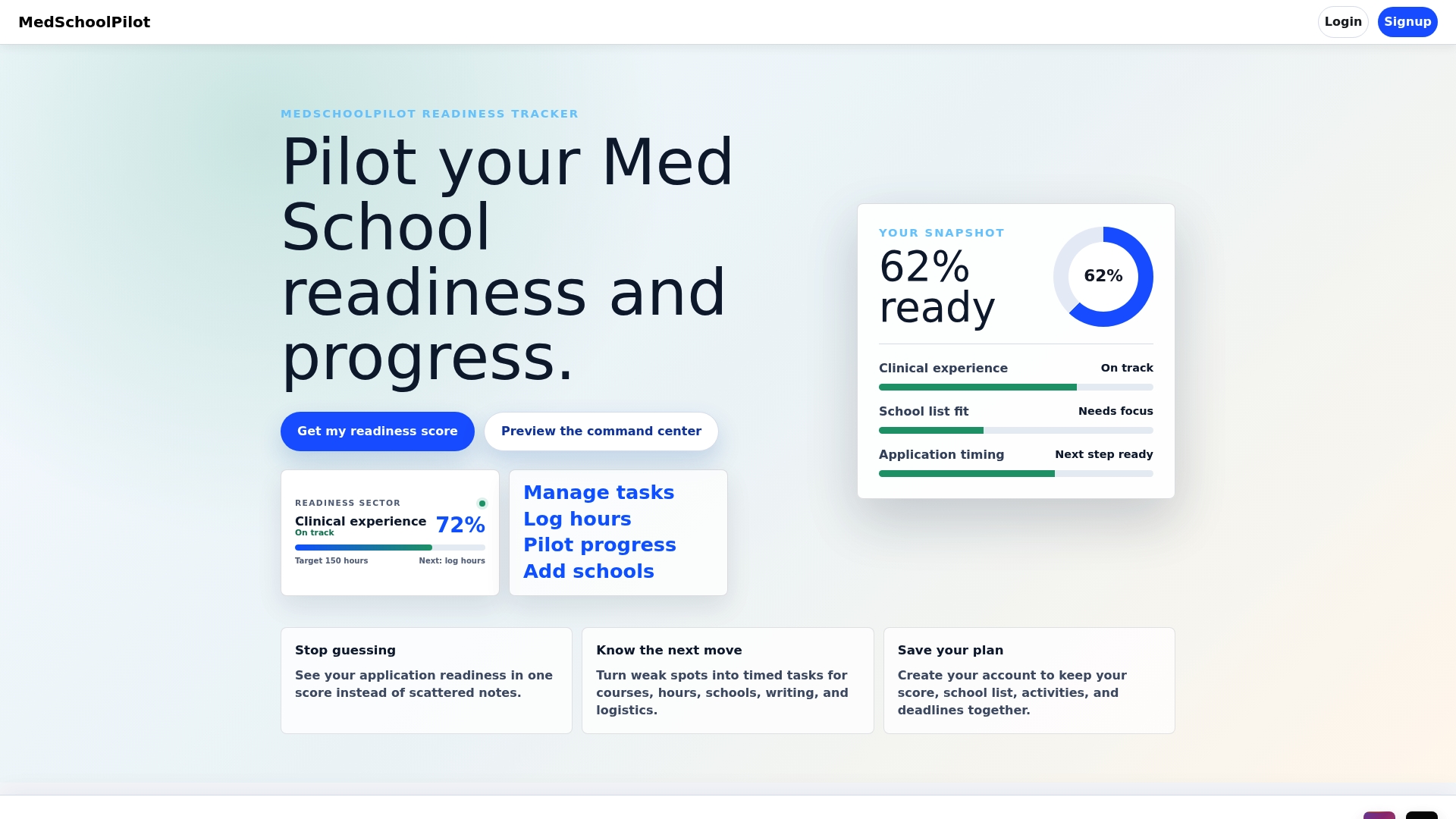
MedSchoolPilot’s readiness tracker gives you one workspace for the parts of your application that carry the most risk if they’re disorganized, including institutional action documentation. Log the incident, the sanction, and every remediation milestone as they happen, then track your GPA recovery and clinical or leadership hours in the same dashboard you’re already using to manage deadlines. When it’s time to draft your AMCAS entry or a secondary response, your evidence is already dated, sourced, and ready to cite instead of scattered across old emails.
If you’re also mapping out where to apply, MedSchoolPilot’s school-specific profiles, like the one for the University of Michigan Medical School, help you build a realistic list alongside your IA strategy rather than as a separate project. Start a free readiness assessment at MedSchoolPilot and get your documentation timeline built before your next deadline, not after.
Where to verify the rules yourself
Don’t take secondhand summaries as the final word here. Read the AAMC’s own Institutional Action page for the definition and disclosure standard, and check the 2026 AMCAS Applicant Guide for the exact reporting timeline and application instructions.
For essay structure, Gradpilot’s breakdown of the institutional action entry offers a useful sentence-level model. For real-world consequences of nondisclosure, the discussion at Student Doctor Network is worth reading in full before you finalize your answer.
Sources
- Institutional Action | Students & Residents
- 2026 AMCAS Applicant Guide
- The AMCAS Institutional Action Essay: How to Write About Academic Dishonesty Without Destroying Your Application
- Reporting an Institutional Action