
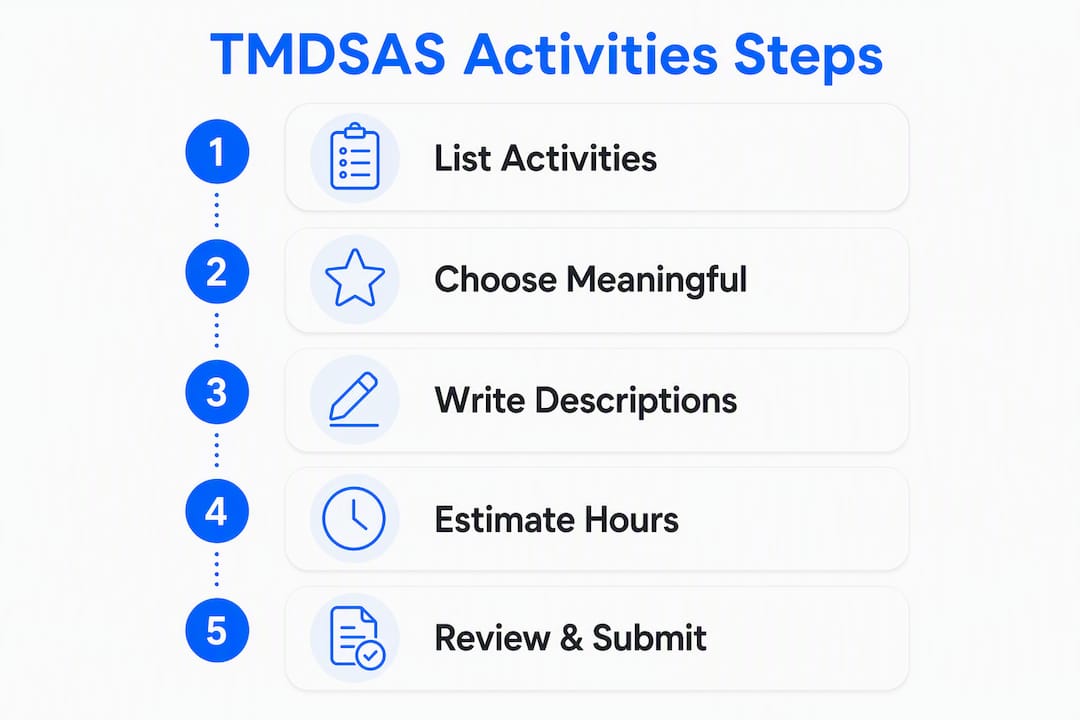
List every activity since high school graduation, pick up to three “Most Meaningful” entries for expanded reflection, and write each description using a role → action → outcome structure. The TMDSAS activities section has no cap on entries, but most descriptions are limited to 300 characters — so every word has to earn its place. Three designated “Most Meaningful” slots each allow an additional 500 characters for reflection, which is where you make the case for medicine.
Before you type a single character into the live form, know this: activities cannot be changed after submission under any circumstances. That constraint shapes everything below.
Quick-start checklist before you open the form:
- Cover all time periods from high school graduation through the application deadline, with no gaps longer than three months
- Select the correct category for each entry (Employment, Healthcare, Research, Leadership, Community Engagement, Extracurricular, Academic Recognition, Non-Academic Recognition)
- Respect the 300-character limit per description; use the 500-character expansion only for your three Most Meaningful picks
- Mark activities as current, planned, or completed accurately — planned entries lock at submission
- Never paste from Microsoft Word or Google Docs; hidden formatting characters can corrupt entries permanently
Pro Tip: Type descriptions directly into the TMDSAS fields or draft them first in Notepad (Windows) or TextEdit in plain-text mode (Mac). Pasting from a formatted word processor introduces invisible characters that break the form and cannot be fixed after you submit.
Table of Contents
- How is the TMDSAS activities section structured?
- What counts as an activity, and which category does it belong in?
- How do you write a strong activity description in 300 characters?
- How do you choose and write your three “Most Meaningful” activities?
- How do you handle planned, ongoing, and completed activities?
- What mistakes do applicants most often make in this section?
- Sample activity descriptions you can adapt
- A practical workflow to prepare your TMDSAS activities before you open the form
- Key Takeaways
- What admissions reviewers actually look for in your activities
- Medschoolpilot keeps your TMDSAS activities organized from day one
- Useful sources to read next
How is the TMDSAS activities section structured?
Every activity entry in the TMDSAS application asks for the same core set of fields. Understanding what each field does — and its limits — prevents the kind of last-minute scrambling that leads to permanent errors.

Fields you will fill out for each entry
| Field | What to enter | Key limit or rule |
|---|---|---|
| Role/Position Title | Your specific title (e.g., Medical Scribe, Lab Research Assistant) | Appears in the Chronology summary |
| Organization Name | Full name of the employer, clinic, lab, or group | Use the official name |
| Start Date / End Date | Month and year; leave end date blank if ongoing | Must be accurate; no edits post-submit |
| Total Hours | Cumulative hours completed to date | Estimate future hours separately |
| Category | One of the official TMDSAS categories | See list below |
| Short Description | Your narrative of role, actions, and outcomes | 300 characters max |
| Most Meaningful flag | Designate up to three entries | Unlocks 500 extra characters for reflection |
| Planned Activity flag | For activities after the submission deadline | Locked at submission |
Official TMDSAS activity categories
TMDSAS uses ten categories: Academic Recognition, Non-Academic Recognition, Leadership, Employment, Research Activities, Healthcare Activities, Community Engagement, Extracurricular Activities, Top Meaningful Activities (the designation, not a separate entry), and Planned Activities. Most entries fall under Employment, Healthcare, Research, Community Engagement, or Extracurricular.
The 50-character rule reviewers rarely mention
The Chronology of Activities that TMDSAS generates shows only the first 50 characters of each description. That summary goes to every school you apply to. If your first 50 characters read “Assisted with various tasks in a clinical setting,” you have already lost the reviewer’s attention before they open the full entry. Start with your role title and the sharpest outcome or action — not a warm-up sentence.
Statistic callout: Three “Most Meaningful” entries each receive an additional 500 characters for reflection — on top of the standard 300-character description — giving you roughly 800 characters total per top entry to make your case.
What counts as an activity, and which category does it belong in?
The honest answer: almost any structured, recurring commitment since high school graduation qualifies. The harder question is which category fits, and what to do when one experience could reasonably sit in two places.
Category mapping for common premed experiences
Employment: Any paid role, regardless of field. A summer job at a restaurant counts. A paid tutoring gig counts. The category is about compensation, not clinical relevance.

Healthcare Activities: Direct patient contact, clinical observation, scribing, EMT work, CNA roles, medical interpreting, and similar experiences. The key word is clinical — you were in a healthcare environment interacting with patients or providers.
Research Activities: Wet-lab work, data analysis, clinical research coordination, public health studies, and any faculty-supervised investigation. Undergraduate thesis research belongs here.
Community Engagement: Unpaid service that benefits a community, including tutoring programs, food banks, health fairs, and mission trips. If you were not paid and the primary beneficiary was the community, this is your category.
Leadership: Elected or appointed roles where you directed others, organized initiatives, or held formal responsibility. President of a pre-med club, team captain, committee chair.
Extracurricular: Clubs, sports, hobbies, and creative pursuits that do not fit the above. Playing in a university orchestra or competing in intramural soccer lives here.
When one activity belongs in two categories
TMDSAS expects paid healthcare roles to appear in both Employment and Healthcare Activities so that both the employment record and the clinical hours count are preserved for reviewers. A medical scribe who earns an hourly wage should enter the role twice: once under Employment (emphasizing workplace reliability, scheduling, and professional conduct) and once under Healthcare Activities (emphasizing clinical exposure, physician interaction, and patient documentation). The descriptions should not be identical — each entry should highlight different competencies.
Pro Tip: When you duplicate an entry across Employment and Healthcare, treat them as two separate stories about the same experience. The Employment entry answers “What kind of worker are you?” The Healthcare entry answers “What did you learn about medicine?”
Borderline cases worth knowing
Internships that are unpaid and research-adjacent often fit Research Activities better than Employment. Episodic volunteering — a one-day health fair, a weekend mission trip — can be grouped under a single Community Engagement entry if the organization is the same; do not create separate entries for each event. Seasonal jobs with gaps are fine to list as a single entry with accurate start and end dates; just note the seasonal nature in the description if the gap would otherwise look like an unexplained break. For applicants documenting supervised clinical experiences, the preceptor’s name and role are useful details to keep in your personal records even if the form does not require them.
How do you write a strong activity description in 300 characters?
Three hundred characters is roughly two sentences. That is not much room for a task list, which is exactly why task lists fail here. The formula that works: role → specific action(s) → measurable outcome or learned skill.
The do list
- Open with your role title in the first few words — those first 50 characters appear in the Chronology summary, so lead with the most important identifier
- Quantify when you can: patients seen per shift, funds raised, students tutored, samples processed, hours supervised
- Name the outcome or the skill: what changed because of your work, or what you now understand that you did not before
- Tailor language to the category: a Healthcare entry should use clinical vocabulary; a Leadership entry should reference the team or initiative you directed
- Use active verbs: documented, coordinated, supervised, analyzed, recruited, presented
The don’t list
- Do not open with “I was responsible for…” — it wastes characters and signals passivity
- Do not copy the same description into multiple categories; reviewers notice, and it reads as filler
- Do not list duties without outcomes (“answered phones, filed charts, greeted patients”)
- Do not use vague soft language without context (“gained valuable experience,” “developed communication skills”)
- Do not exceed the character limit and assume the system will warn you in time — paste into a character counter first
Focused, quantifiable descriptions consistently outperform long lists of generic responsibilities in admissions review. Outcomes and metrics — patients seen, funds raised, hours supervised — are what reviewers remember.
How do you choose and write your three “Most Meaningful” activities?
Most applicants default to their highest-hour activities. That is usually the wrong criterion. The three Most Meaningful entries should be the experiences that most clearly explain why you are pursuing medicine and what you have learned about yourself in the process.
Selection criteria
- Depth over duration: An experience where you held real responsibility and saw genuine outcomes matters more than one where you logged passive hours
- Demonstrable impact: You can point to something that changed — a patient outcome, a community served, a skill built — because of your specific contribution
- Unique insight into your motivation: The experience gave you a perspective on medicine, illness, or service that you could not have gotten elsewhere
- Evidence of growth or leadership: You took on more responsibility over time, or you navigated a challenge that required resilience
Structure for the expanded 500-character entry
Use the extra space for reflection, not repetition. The short 300-character description already covered what you did. The 500-character expansion should answer: Why did this matter to you, and how did it shape your goals?
A reliable structure:
- Context (1–2 sentences): What was the situation, and what was your specific role within it?
- Specific contributions: What did you do that went beyond the baseline expectation?
- Observable outcomes: What changed, and how do you know?
- Reflection: How did this experience connect to your decision to pursue medicine?
What not to do: do not rewrite the short description in slightly different words. Reviewers read both. If the expanded entry just restates the role with synonyms, it signals that you did not think carefully about the experience.
How do you handle planned, ongoing, and completed activities?
This is where applicants make the most permanent mistakes. TMDSAS distinguishes between three timeline states, and the rules for each are specific.
| Status | Definition | Key rules |
|---|---|---|
| Completed | Activity ended before the application deadline | Enter exact start and end dates; total hours are final |
| Current / Ongoing | Activity is active at the time of submission | Leave end date blank or mark as ongoing; estimate hours through the deadline |
| Planned | Activity will begin or continue after the submission deadline, through matriculation | Cannot be edited after submission; only list definite plans |
Estimating hours for ongoing and planned activities
TMDSAS provides guidance on estimating hours through specific dates — typically through September 30th for activities ending before matriculation, or through your expected matriculation month for longer commitments. Be honest. If you volunteer four hours per week and you have 12 weeks left before the deadline, enter 48 estimated hours — not 200 because it sounds more impressive. Reviewers cross-reference hours with dates, and inflated numbers are a red flag.
For an activity that spans the submission deadline — say, a research position you started last year and plan to continue through graduation — enter it as both current (hours through the deadline) and as a planned continuation. The two entries together give reviewers the complete picture.
The no-edit rule and what to do when plans change
Planned activities are locked the moment you submit. If your plans change after submission — the volunteer program closes, the research lab loses funding, the clinical hours fall through — you cannot update the form. Keep a private, dated log of any changes. If a school asks about a planned activity during an interview, you can explain the change clearly and honestly. That is far better than having an unexplained discrepancy between your application and your actual experience.
What mistakes do applicants most often make in this section?
The errors that hurt applications the most are not typos. They are structural problems that make an otherwise strong applicant look careless or dishonest.
Audit checklist — run this before you submit:
- Verify dates and hours: Do your start/end dates match what your supervisor or organization would confirm? Are your estimated future hours realistic given your actual schedule?
- Check the first 50 characters of every entry: Does each description open with your role title or the most important outcome? Or does it open with filler?
- Remove duplicate wording across entries: If your Healthcare entry and your Employment entry for the same job use the same sentences, rewrite one of them to highlight different competencies
- Confirm category logic: Is every entry in the most accurate category? A paid tutoring job is Employment, not Community Engagement, even if it felt like service
- Check for inflated hours: Hours that do not match the date range and frequency are the most common red flag reviewers flag for follow-up
- Plain-text check: Did you paste from a formatted document? If so, retype or re-paste from a plain-text editor before submitting
How inconsistencies look to reviewers
When an applicant lists 500 hours of clinical experience in Healthcare Activities but only 200 hours in Employment for the same paid scribing role, reviewers notice. The discrepancy suggests either careless math or an attempt to inflate one category. The fix is simple: use the same total hours in both entries, and let the descriptions do the differentiating work. One entry emphasizes clinical learning; the other emphasizes professional reliability. Same hours, different story.
Sample activity descriptions you can adapt
These examples follow the role → action → outcome structure and stay within character limits. Adapt the specifics to your own experience.
Short descriptions (300 characters)
Employment (Restaurant Server): Server, Tex-Mex Bistro. Managed 6-table sections during peak shifts, trained 3 new hires on POS system and service standards. Developed composure under pressure and customer communication skills applied directly to patient-facing clinical roles.
Healthcare Activities (Medical Scribe): Medical Scribe, UT Health Emergency Dept. Documented 20+ patient encounters per shift in Epic EHR. Observed triage, diagnosis, and discharge workflows across trauma and general medicine cases, building fluency in clinical decision-making.
Research Activities (Undergraduate Lab): Research Assistant, TAMU Biochemistry Lab. Conducted PCR assays and Western blots for a protein-folding study. Contributed to data set used in a published conference abstract; learned to troubleshoot protocols independently.
Community Engagement (Free Clinic): Volunteer Interpreter, Austin Free Clinic. Provided Spanish-English interpretation for 15+ patients per session. Facilitated accurate diagnosis and treatment adherence for underserved patients with limited English proficiency.
Leadership (Pre-Med Club): President, Pre-Medical Society, 120-member chapter. Organized 8 speaker events and a hospital shadow program serving 40 students. Increased membership 30% by restructuring recruitment outreach.
Expanded “Most Meaningful” examples (500-character reflection)
Healthcare Activities (Scribe) — reflection: Working in a high-volume emergency department showed me medicine’s intersection of urgency and uncertainty. Documenting encounters where physicians made rapid decisions with incomplete information clarified what I want from a career: the responsibility of being the person in the room who synthesizes complexity into a plan. That clarity, earned shift by shift, is the reason I am applying.
Research Activities — reflection: When our assay failed for the sixth consecutive week, my PI asked me to redesign the protocol rather than repeat it. That moment — being trusted to problem-solve rather than just execute — changed how I understand scientific work. Medicine requires the same disposition: comfort with uncertainty, methodical troubleshooting, and the ability to hold a hypothesis loosely.
Pro Tip: In the expanded Most Meaningful entry, the word “I” should appear in the context of a decision, a realization, or a turning point — not just a task. Reviewers are looking for evidence that you processed the experience, not just completed it.
A practical workflow to prepare your TMDSAS activities before you open the form
Opening the live TMDSAS form without a complete draft is how applicants end up submitting entries they immediately regret. Build everything offline first.
Step-by-step preparation
- Inventory: Pull your resume or CV and list every activity since high school graduation. Add anything not on your resume — informal volunteering, short-term jobs, awards.
- Timestamp verification: For each activity, confirm the start and end dates with pay stubs, offer letters, volunteer logs, or emails. Do not rely on memory for dates.
- Categorize: Assign each activity to its TMDSAS category. Flag any that belong in two categories (paid healthcare roles).
- Draft short descriptions: Write each 300-character description in a plain-text editor. Use a character counter (wordcounter.net works fine) to verify length before you copy.
- Draft expanded reflections: For your three Most Meaningful picks, write the 500-character reflection separately. Read it aloud — if it sounds like a task list, rewrite it as a reflection.
- Final review: Run the audit checklist from the Common Mistakes section above.
- Paste into the form: Copy from plain text only. Submit only when every entry is verified.
Spreadsheet template for tracking activities
| Column | What to enter |
|---|---|
| Category | TMDSAS category name |
| Role Title | Your exact title |
| Organization | Full official name |
| Start Date | Month/Year |
| End Date | Month/Year or “Ongoing” |
| Total Hours | Completed + estimated future |
| Status | Completed / Current / Planned |
| Short Description (draft) | 300-char draft |
| Most Meaningful? | Yes / No |
| Expanded Reflection (draft) | 500-char draft |
| Supervisor Contact | Name, email, phone |
Keep this spreadsheet backed up in two places. Share it with your pre-health advisor before you submit — a second set of eyes on dates and hours catches errors you have stopped seeing.
For applicants planning or verifying clinical hours, especially for preceptor-supervised experiences, keeping a documented record of your supervisor’s contact information is worth the extra step. Schools occasionally ask for verification.
Pro Tip: Screenshot every completed entry in the live TMDSAS form before you move to the next one. After submission, you cannot retrieve the exact text you entered. Screenshots give you a record for interview prep and for catching discrepancies if a school asks.
Key Takeaways
The TMDSAS activities section rewards specificity, honest classification, and careful preparation — applicants who draft offline, verify every date, and write to outcomes rather than duties consistently produce stronger entries.
| Point | Details |
|---|---|
| No cap, but cover all time | List every activity since high school graduation; avoid gaps longer than three months. |
| 300 / 500 character limits | Standard descriptions cap at 300 characters; three Most Meaningful entries each allow 500 additional characters for reflection. |
| Planned entries lock at submit | Planned activities cannot be edited after submission; keep a private log of any changes for interviews. |
| First 50 characters matter | The Chronology summary shows only the first 50 characters — open with your role title or sharpest outcome. |
| Medschoolpilot tracks it all | Medschoolpilot’s activity logging and category tagging help you organize entries, estimate hours, and store draft descriptions before you touch the live form. |
What admissions reviewers actually look for in your activities
Here is the thing most applicants miss: the Activities section is not a résumé. Reviewers are not counting categories or tallying hours to see if you hit some threshold. They are reading for evidence of a person who has genuinely engaged with the world, taken on real responsibility, and thought carefully about what those experiences mean.
Sustained commitment matters more than breadth. An applicant who spent three years as a medical scribe, took on a training role in year two, and can articulate what changed in their understanding of clinical medicine will outperform an applicant with twelve one-semester commitments spread across every category. Admissions committees at Texas medical schools — including programs at Baylor College of Medicine, UT Health San Antonio, and Texas A&M College of Medicine — evaluate Activities alongside GPA, MCAT scores, and personal statements to build a holistic picture. The Activities section is where the picture gets texture.
Honesty in classification and hours is not just an ethical requirement — it is a strategic one. Misclassifying an experience to check a box, or inflating hours to look more competitive, creates inconsistencies that reviewers notice and that interviewers will probe. The applicants who come across as credible are the ones whose entries are specific, whose hours match their dates, and whose descriptions sound like they were written by someone who was actually there.
The AAMC core competencies — teamwork, resilience, cultural competence, ethical responsibility — do not need to be named in your descriptions. They need to be demonstrated through what you did and what you learned. “Supervised a team of four volunteers” shows leadership. “Navigated a language barrier to explain a diagnosis” shows cultural competence. Let the actions speak; do not label them.
Medschoolpilot keeps your TMDSAS activities organized from day one
Tracking activities across years of premed coursework — dates, hours, categories, supervisor contacts, draft descriptions — is exactly the kind of multi-variable problem that falls apart in a spreadsheet when deadlines stack up.
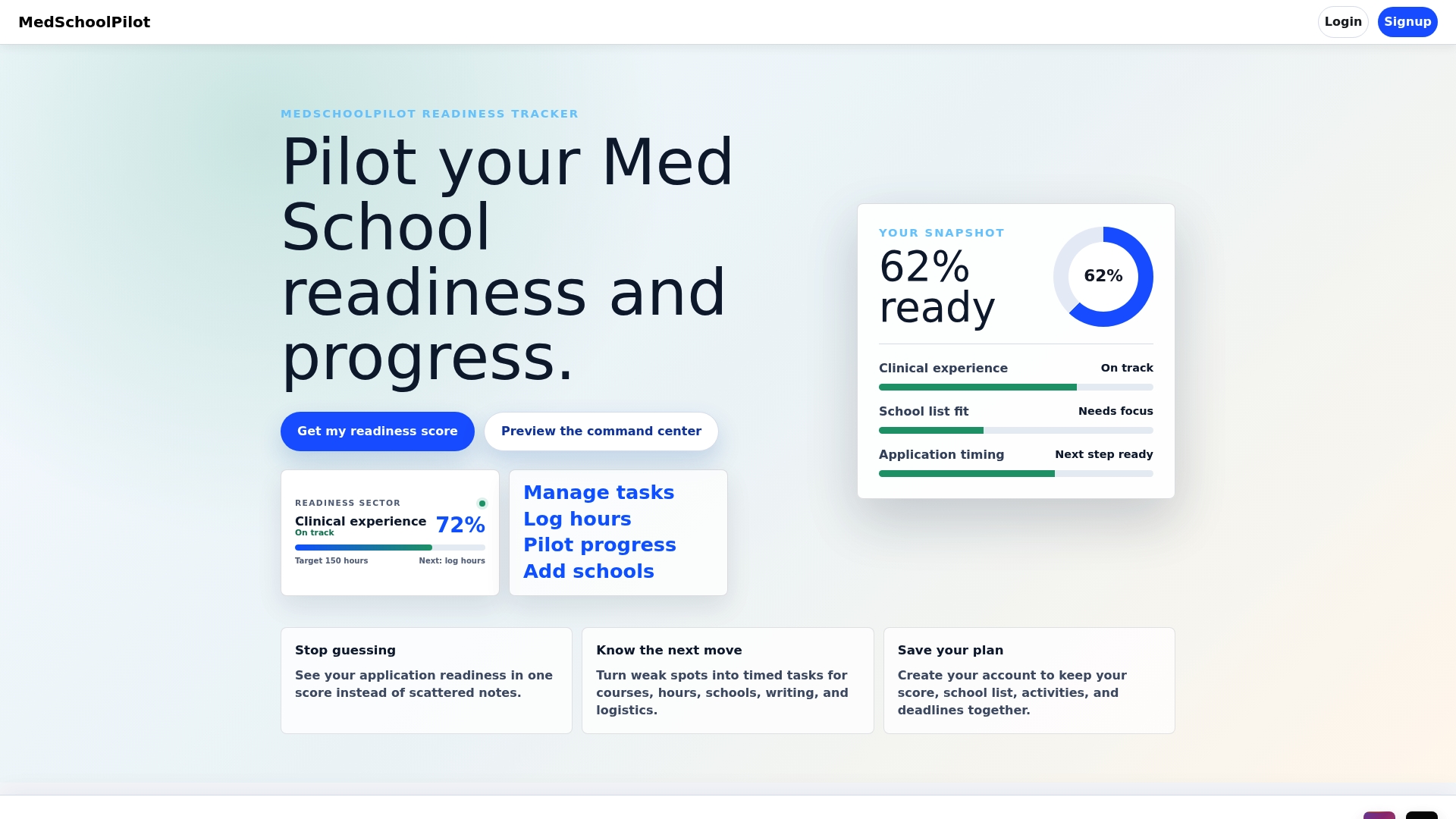
Medschoolpilot is built for this. The platform’s activity logging lets you tag each entry by TMDSAS category, record hours as you go (rather than reconstructing them from memory in May), and store both your 300-character draft and your Most Meaningful reflection in one place. Deadline-aware planned-activity tracking flags entries that will lock at submission so you review them before it is too late. When you are ready to share your draft with a pre-health advisor, the export is clean and readable.
The workflow described in this guide — inventory, verify, categorize, draft, review, paste — maps directly to how Medschoolpilot structures your application progress. You spend less time hunting for an old email to confirm a start date and more time writing descriptions that actually reflect what you did. Start tracking your activities before the 2026–27 cycle opens, and you will enter the form with everything already verified.
Useful sources to read next
- TMDSAS Personal Biography & Activities guide — The primary authoritative source for all rules: timeline requirements, category definitions, the no-edit policy, and hour-estimation guidance. Read this before anything else.
- TMDSAS Essays guide — Official guidance on formatting and submission; the plain-text paste warning applies to activity descriptions as well as essays.
- Accepted blog: TMDSAS Activities section tips — Practical breakdown of character limits, the Most Meaningful designation, and duplication rules for paid healthcare roles; good for examples and category logic.
- BeMo Academic Consulting: TMDSAS Activities section examples — Concrete sample descriptions and the 50-character Chronology rule explained with examples; use for style and structure, not policy.
Always confirm current rules with the official TMDSAS application guide. Policies can change between cycles, and the official source supersedes any third-party summary, including this one.