
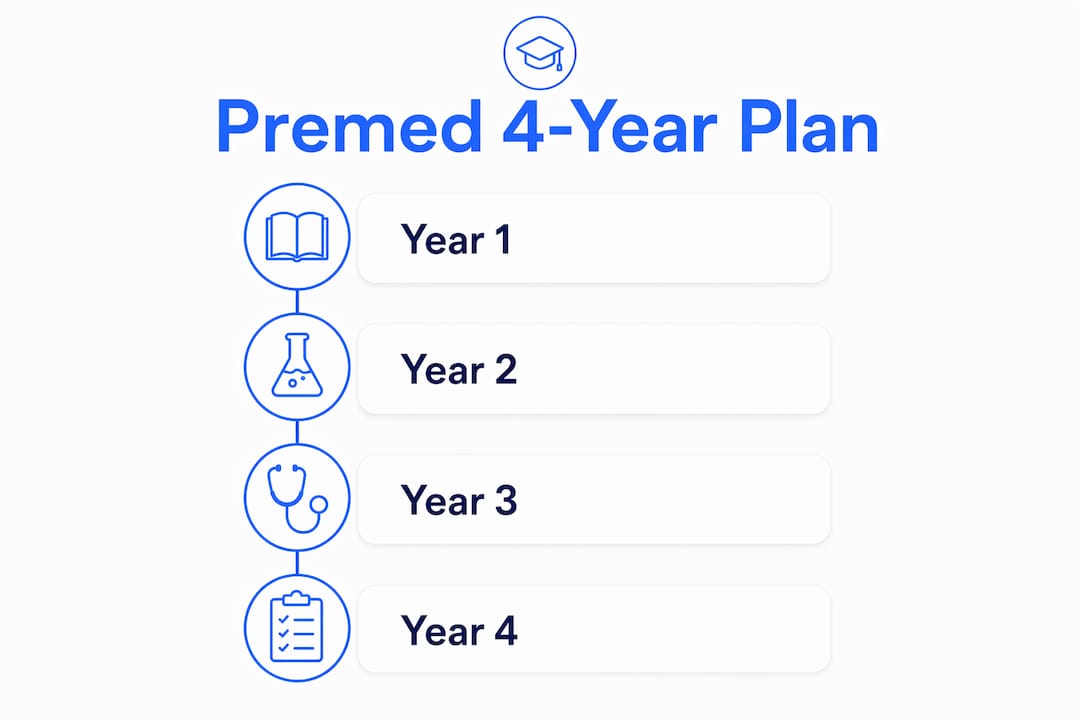
The most effective premed 4 year plan finishes your core prerequisites and MCAT by the end of junior year so you can submit your primary application early in the summer of Year 4. Here is the one-line version: Year 1 lays your science foundation (general chemistry, intro biology, English/statistics); Year 2 adds organic chemistry, physics, and early upper-level biology; Year 3 completes biochemistry and advanced coursework, then you sit the MCAT in spring/summer and begin application prep; Year 4 wraps major requirements and moves through secondaries, interviews, and decisions. Everything below expands that skeleton into a semester-level roadmap you can actually use.
Start here — your immediate next steps:
- Pull up your target schools’ prerequisite lists and compare them against your current transcript.
- Confirm your major requirements with your registrar and map them against the premed prerequisites below.
- Schedule a meeting with your prehealth advisor before the end of your first semester.
- Open a progress tracker (Medschoolpilot works well for this) and enter your completed courses, hours, and MCAT target window.
Quick-reference framework:
- AAMC publishes 17 premedical competencies your extracurriculars and experiences should map to.
- AMCAS (MD schools), AACOMAS (DO schools), and TMDSAS (Texas public schools) each have distinct submission windows; know which you are targeting before Year 3.
- Medschoolpilot’s readiness tracker lets you score your application readiness and flag gaps before they become problems.
Table of Contents
- What does a semester-by-semester premed schedule actually look like?
- Which courses do you actually need, and in what order?
- How do you balance your major with premed requirements?
- How should you build extracurriculars across four years?
- When should you take the MCAT, and how do you prepare?
- What is the AMCAS/AACOMAS/TMDSAS timeline, and when do you request letters?
- Should you take a gap year or apply straight through?
- How do AP, IB, and transfer credits affect your prerequisites?
- What GPA and metrics do medical schools actually look for?
- How does Medschoolpilot help you execute this plan?
- Key Takeaways
- The trade-offs nobody tells you about until it’s too late
- Medschoolpilot turns this plan into tracked progress
- Useful sources and next reads
What does a semester-by-semester premed schedule actually look like?
No single schedule fits every student, but the framework below reflects what university advising offices recommend as a starting template. Treat it as a map, not a contract.
Sample 4-year schedule
| Year | Fall Semester | Spring Semester | Summer |
|---|---|---|---|
| 1 | Gen Chem I + lab, Bio I + lab, English Comp, Elective | Gen Chem II + lab, Bio II + lab, Statistics, Elective | Volunteer/shadow; optional light course |
| 2 | Orgo I + lab, Physics I + lab, Major course, Elective | Orgo II + lab, Physics II + lab, Major course, Psychology/Sociology | Research or clinical internship; begin MCAT content review |
| 3 | Biochemistry, Upper-level Bio, Major course, MCAT prep (part-time) | Advanced Bio elective, Major course, MCAT (March–May target) | Finalize MCAT if needed; begin AMCAS personal statement draft |
| 4 | Major capstone, Elective, Secondary applications, Interviews | Major requirements, Elective, Decision/waitlist management | Post-acceptance transition or gap-year launch |
How summers fit in
Summers are not rest periods in a premed curriculum guide — they are strategic assets. A student who takes one lighter course in summer (say, statistics or psychology) can drop a credit from a brutal fall semester and protect their GPA during organic chemistry. Research internships and full-time clinical roles also fit most naturally into summers, when you can commit 20–40 hours per week without competing with coursework.

The University of Iowa’s pre-medicine advising guide notes that sample plans vary for students who begin in general chemistry versus a principles-level course, and that engineering majors typically need an adjusted sequence to fit their math-heavy requirements alongside premed prerequisites. If you are in a STEM-intensive major, map your major’s required sequence first, then slot prerequisites around it rather than the reverse.
Pro Tip: If you are taking organic chemistry in the fall, consider moving statistics or psychology to that same semester instead of a second lab science. Two lab courses in one term is manageable; three is where GPAs slip.
Advising check-ins matter more than most students realize. Meeting with your prehealth advisor at least once per semester keeps your sequence on track and, at many schools, is a prerequisite for accessing the Health Professions Recommendation Committee by fall of Year 3.
Which courses do you actually need, and in what order?
Most U.S. medical schools share a core set of prerequisites, though exact requirements vary. The list below covers what the overwhelming majority of programs expect.
Core prerequisites (with lab where noted):
- General Chemistry I and II (with lab)
- Organic Chemistry I and II (with lab)
- Biology I and II (with lab)
- Physics I and II (with lab)
- Biochemistry (one semester minimum; some schools want two)
- Statistics or Biostatistics (one semester)
- English Composition or Writing (one to two semesters)
- Psychology and Sociology (one semester each; MCAT-tested content)
Some programs also recommend or require Genetics, Cell Biology, Molecular Biology, or Calculus. Check the UT Austin Health Professions course requirements page as a representative benchmark, then verify against each target school’s MSAR entry.
Sequencing the prerequisites across three years
| Semester | Courses | Credit Hours (approx.) |
|---|---|---|
| Fall, Year 1 | Gen Chem I + lab, Bio I + lab, English Comp | 14 |
| Spring, Year 1 | Gen Chem II + lab, Bio II + lab, Statistics | 14 |
| Fall, Year 2 | Orgo I + lab, Physics I + lab, Major course | 14–15 |
| Spring, Year 2 | Orgo II + lab, Physics II + lab, Psychology | 14–15 |
| Fall, Year 3 | Biochemistry, Upper-level Bio, Major course | 14–16 |
| Spring, Year 3 | Advanced Bio elective, Sociology, Major course | 14–15 |
A 14–16 credit hour load per semester is the range most campus advisors recommend for premed students. Going above 16 hours while carrying two lab sciences is where grades tend to slip. The courses most heavily tested on the MCAT — biochemistry, organic chemistry, physics, psychology, and sociology — should all be completed before you begin serious MCAT prep, ideally by the fall of Year 3 at the latest.
How do you balance your major with premed requirements?
Medical schools value diverse majors alongside strong science performance. Premed is a set of prerequisites, not a standalone major. A history major, a mechanical engineer, and a neuroscience student can all apply to medical school — what matters is that you complete the prerequisites and perform well in them.

The practical challenge is mapping two separate course sequences (your major and your premed prerequisites) without overloading any single semester or delaying graduation. Humanities majors often have the most scheduling flexibility because their major requirements rarely overlap with science prerequisites. Engineering and hard-science majors face the opposite problem: their required sequences are rigid, and fitting in two lab sciences per semester on top of major coursework can push prerequisites into Year 4 if you are not careful.
Six questions to ask your academic and prehealth advisor:
- Does my school accept AP or IB credit toward prerequisite courses, and will my target medical schools accept that credit?
- Which major courses have prerequisites that conflict with my premed sequence?
- Can I take any prerequisites during summer to lighten a heavy semester?
- What is the minimum lab requirement for each prerequisite course at my target schools?
- When does the Health Professions Committee require me to begin the letter process?
- If I change my major, how does that affect my graduation timeline and prerequisite completion?
Protecting your GPA while fulfilling both tracks comes down to honest semester planning. If a term already has two lab sciences, do not add a notoriously difficult major elective. Spread the hardest courses across different semesters, and use summers for courses that are important but not GPA-critical.
How should you build extracurriculars across four years?
Admissions committees evaluate long-term commitment, not last-minute volume. The AAMC’s 17 premedical competencies — which include service orientation, teamwork, ethical responsibility, and cultural competence — are best demonstrated through sustained activities, not a single impressive semester.
Year-by-year extracurricular targets:
- Year 1: Join one or two clubs, begin exploratory volunteering (community service, hospital auxiliary), and arrange a few shadowing sessions with a physician in a specialty that interests you. The goal is exposure, not hours.
- Year 2: Deepen one or two activities rather than adding more. Start a formal clinical role (medical scribe, EMT, patient transport, clinic volunteer). If your school has a research lab that interests you, approach a faculty member about joining. Aim for consistent weekly hours you can sustain.
- Year 3: Step into a leadership role in at least one organization. Deepen your research involvement if possible (a poster presentation or co-authorship strengthens the application). Your clinical hours should be accumulating steadily — most applicants have 100–200+ clinical hours by application time, though quality of reflection matters more than raw numbers.
- Year 4: Transition toward mentorship (tutoring, peer advising). If you are taking a gap year, plan the full-time clinical or research role you will describe in your application narrative.
Consistency is the key signal. An applicant who volunteered 3 hours per week for three years tells a more compelling story than one who logged 200 hours in a single summer. Track your hours weekly, note what you observed or learned, and those notes become the raw material for your AMCAS experience entries.
When should you take the MCAT, and how do you prepare?
Complete the MCAT no later than April of your junior year if you plan to apply in the immediately following cycle. That timing lets you receive scores before AMCAS opens in late May and submit your primary application in the first wave of rolling admissions. Applying early in the cycle meaningfully improves your chances at schools that fill seats on a rolling basis.
MCAT prep options and trade-offs:
- Part-time prep during Year 2 (content review only): Low-intensity, sustainable alongside coursework. Good for students who want to preview MCAT content while taking the relevant courses. Does not replace a dedicated study block.
- Intensive prep in fall/winter of Year 3: Typically 3–4 months of structured study, 15–20 hours per week. Works well if your MCAT-content courses (biochemistry, orgo, physics) are complete or nearly complete. The risk is GPA pressure if you are still carrying a full course load.
- Dedicated summer prep between Year 2 and Year 3: Many students find this the cleanest window — coursework is done, no competing deadlines, and you can take the test in late summer or early fall of Year 3 with scores in hand before the next cycle opens.
Use target school score medians (available via MSAR) as your benchmark rather than a single cutoff number. A score that is competitive at one school may be below median at another. If your score falls short, a retake is reasonable — but build in at least 6–8 weeks of additional prep and consider whether delaying your application cycle by one year gives you a stronger overall package.
What is the AMCAS/AACOMAS/TMDSAS timeline, and when do you request letters?
The application process has more moving parts than most students anticipate, and the biggest mistake is treating it as a Year 4 task. Preparation starts in Year 3.
Application timeline overview:
- Fall of Year 3: Attend any required application workshops on campus. At many schools, this is a prerequisite for a Health Professions Committee letter. Identify your letter writers and have informal conversations with them about your plans.
- Spring of Year 3: Formally request letters of evaluation. Give writers at least 6–8 weeks before the deadline, a copy of your CV, your personal statement draft, and a list of programs you are targeting. Rolling admissions means early submission directly affects your interview chances.
- Late May/Early June (Year 4): AMCAS typically opens for submission in late May; aim to submit your primary application within the first two weeks of the window. AACOMAS and TMDSAS have their own windows — confirm current-cycle dates each year.
- Summer of Year 4: Secondary applications arrive within weeks of your primary submission. Complete each secondary within 2 weeks of receipt. Begin interview prep as soon as secondaries go out.
- Fall/Winter of Year 4: Interviews run September through February at most schools. Send thank-you notes, update schools on significant new achievements, and manage waitlists actively.
Most programs want 3–5 letters: at least two from science faculty who taught you in a course, one non-science faculty letter, and one or more from clinical supervisors or research mentors. Check each school’s specific requirements via MSAR.
Should you take a gap year or apply straight through?
Neither path is inherently better. The right choice depends on your GPA, MCAT score, depth of clinical experience, and honest self-assessment of application readiness.
Applying straight through (no gap year):
- Works best when GPA is strong (3.6+ science GPA), MCAT score is at or above target school medians, and clinical/research experience is sustained and meaningful.
- Advantage: you enter medical school a year earlier and avoid the cost and uncertainty of a gap year.
- Risk: a rushed application with thin experiences or a below-median MCAT is harder to recover from than a strategic one-year delay.
Taking a gap year:
- Use it for a specific purpose: a full-time clinical role, a formal post-bacc program to repair a GPA, a research position, or a structured service year (AmeriCorps, Peace Corps).
- A gap year with a clear narrative strengthens your application. A gap year spent waiting without a plan does not.
- If your science GPA is below 3.2 or your MCAT score is more than 3–4 points below your target school’s median, a gap year to address those gaps is almost always the better choice.
Sample alternative timelines:
- Apply in summer after Year 3 (early application): requires MCAT by April of Year 3 and strong experiences by end of Year 2. Aggressive but doable for well-prepared students.
- Standard timeline: MCAT in spring of Year 3, apply in summer of Year 4, matriculate the following August.
- Gap year timeline: MCAT in spring/summer of Year 3, apply in summer of Year 4 (one year after graduation), matriculate two years after senior year begins.
Checklist for deciding:
- Is my science GPA at or above 3.5?
- Is my MCAT score at or above the median for my target schools?
- Do I have at least 100 hours of meaningful clinical experience?
- Have I completed sustained research or service activities I can discuss in depth?
- Do I feel emotionally ready to write a compelling personal statement right now?
If you answered no to two or more of those, a gap year is worth serious consideration.
How do AP, IB, and transfer credits affect your prerequisites?
AP and transfer credit policies vary widely across medical schools, and this is one area where a wrong assumption in freshman year can cost you a semester of coursework in Year 3. Many programs will not accept AP credit as a substitute for introductory science prerequisites and instead require that you complete upper-level coursework at a four-year institution.
Action checklist — verify early, ideally in freshman year:
- Collect the syllabi for any AP or IB courses you received credit for.
- Check each target school’s MSAR entry for its AP/transfer credit policy.
- Confirm with your registrar whether AP credit places you out of the introductory course or simply grants elective credit.
- Ask your prehealth advisor whether your target schools have flagged AP-credit substitutions as a concern in past application cycles.
- If a school requires upper-level coursework, identify which course satisfies that requirement and add it to your sequence.
- Document any approved substitutions in writing so you can reference them if a letter writer or committee asks.
The safest approach: if you used AP credit to skip Gen Chem I, take Gen Chem II and a higher-level chemistry course (physical chemistry, analytical chemistry) to demonstrate competency at the college level. That record is far more persuasive to an admissions committee than a high school AP score.
What GPA and metrics do medical schools actually look for?
There is no universal cutoff, but context matters. Most MD programs have median science GPAs in the 3.6–3.8 range for matriculants; DO programs tend to have medians slightly lower. Use MSAR to look up the 10th–90th percentile GPA and MCAT ranges for each school on your list, and treat those ranges as your calibration tool rather than a single pass/fail number.
The AAMC’s 17 premedical competencies cover three broad areas: thinking and reasoning (critical thinking, quantitative reasoning, scientific inquiry), science skills (living systems, human behavior), and personal and professional characteristics (cultural competence, ethical responsibility, resilience, service orientation). Your extracurriculars, research, and clinical experiences should map to these competencies — and your AMCAS experience entries should reflect that mapping explicitly.
Common pitfalls that derail strong applicants:
- Overloading credits in Year 1 before you understand the rigor of college science courses.
- Delaying all meaningful extracurriculars until Year 3 or 4, leaving no time for sustained involvement.
- Using AP credit to skip prerequisites without verifying target school policies.
- Taking the MCAT before completing all MCAT-content courses (biochemistry in particular).
- Requesting letters of evaluation too late for writers to submit before application deadlines.
Contingency plans if metrics fall short:
- GPA below target: identify whether the issue is a single bad semester or a trend. An upward grade trend (strong Year 3 and 4 after a rough Year 1) is a real positive signal to committees. A formal post-bacc program or a second bachelor’s degree in a science field can rebuild a weak record.
- MCAT below target: a retake is reasonable if you have a clear diagnosis of what went wrong and a concrete study plan. Most schools average multiple scores; some superscore. Know each target school’s policy before you retake.
How does Medschoolpilot help you execute this plan?
A written plan is only as good as the system you use to track it. Medschoolpilot’s readiness tracker is built specifically for this: you import your course schedule, enter your target schools, log clinical and research hours, and get a live readiness score tied to the milestones that actually matter for your application.
Practical onboarding steps:
- Create an account and enter your current GPA, completed prerequisites, and MCAT target window.
- Add your target schools so the platform can flag school-specific requirements you may be missing.
- Log your extracurricular hours weekly — clinical, research, volunteering, leadership — so your totals are always current.
- Set milestone alerts for letter request deadlines, application windows, and MCAT registration dates.
- Use the scenario planning feature to model what a gap year or MCAT retake does to your overall timeline.
The readiness score updates as you complete milestones, so you can see at a glance whether you are on track or need to adjust. If a semester goes sideways — a lower grade than expected, a research position that falls through — the platform helps you identify which levers to pull and when.
Pro Tip: Enter your MCAT target date the day you create your account. The platform works backward from that date to flag which prerequisites you need to complete first, which is far more useful than a generic semester checklist.
Key Takeaways
A successful premed 4 year plan finishes core prerequisites and the MCAT by the end of junior year, builds sustained extracurriculars mapped to AAMC competencies, and submits primary applications early in the summer of Year 4.
| Point | Details |
|---|---|
| Finish prerequisites by Year 3 | Complete gen chem, orgo, physics, bio, and biochemistry before your MCAT study block begins. |
| MCAT timing is critical | Sit the MCAT no later than April of junior year to submit your primary application in the first wave. |
| Sustained extracurriculars beat volume | Consistent weekly clinical and service hours across three years outperform a single high-intensity semester. |
| Verify AP/transfer credit early | Check each target school’s MSAR entry in freshman year to avoid prerequisite gaps in Year 3. |
| Medschoolpilot tracks your readiness | Use the readiness tracker to log hours, score milestones, and model gap-year or retake scenarios in real time. |
The trade-offs nobody tells you about until it’s too late
The conventional advice is to follow the sample schedule, hit the GPA benchmarks, and everything will fall into place. That framing misses the real difficulty: the plan looks clean on paper, but you are executing it while managing a full course load, a part-time job, relationships, and the psychological weight of a high-stakes goal that is years away.
The students who navigate this best are not the ones who never stumble. They are the ones who build in quarterly checkpoints with their advisor and treat those meetings as a genuine recalibration, not a box to check. An upward grade trend after a rough freshman year is a stronger signal to admissions committees than a flat 3.7 across four years — it shows you identified a problem and fixed it. That story is worth telling.
The trade-off that catches people most off guard is the major-versus-prerequisites tension. A student passionate about philosophy or economics who forces themselves into a biology major “because it looks better” often ends up with a weaker GPA and a less compelling personal statement than the student who majored in what they loved and completed prerequisites alongside it. Medical schools value diverse academic backgrounds — that is not a platitude, it is a documented advising position from institutions that track their applicants’ outcomes.
One more thing: write brief reflections after meaningful clinical or volunteer experiences. Not for anyone else — for yourself. Those notes become the raw material for AMCAS experience entries, and the difference between a generic “I volunteered at a hospital” entry and a specific, reflective one is often the difference between an interview and a rejection.
Medschoolpilot turns this plan into tracked progress
Most premed students have a plan. What they lack is a system that keeps the plan honest when a semester gets hard or a milestone slips. Medschoolpilot gives you exactly that: a single workspace where your course schedule, clinical hours, school list, and readiness score live together.
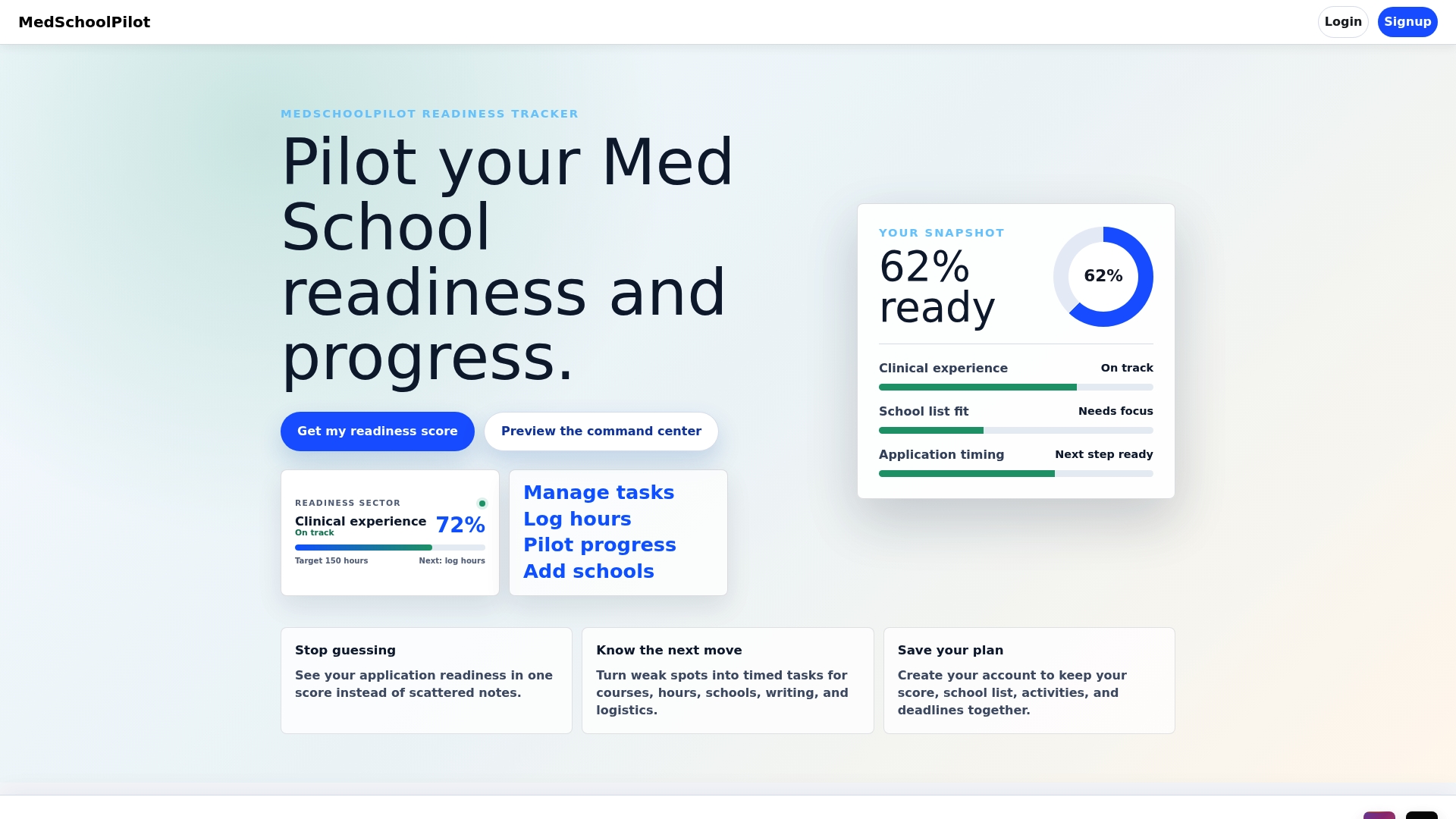
You log your hours as you earn them, set alerts for letter request deadlines and application windows, and watch your readiness score update in real time as you complete milestones. When something goes off track — a grade that needs addressing, an MCAT retake to plan — the platform helps you model the impact and adjust your timeline without losing sight of the full picture. No spreadsheet juggling, no missed deadlines buried in a calendar app.
Ready to put your four-year schedule into a tracker that actually works? Start your readiness tracker on Medschoolpilot and import your course list today.
Useful sources and next reads
The sources below are worth bookmarking. Confirm current-cycle dates (AMCAS, AACOMAS, TMDSAS) and school-specific requirements each year — deadlines shift, and MSAR data updates annually.
For prerequisite and sequencing guidance:
- UT Austin Health Professions — Pre-Med Course Requirements: a clear, representative list of core prerequisites with lab requirements.
- Baylor Pre-Health Curricular Planning Guide: detailed semester-level planning templates and major-integration advice.
- University of Iowa Pre-Medicine Guide: sample semester plans including variations for engineering majors and different starting chemistry levels.
For application timelines and competencies:
- AAMC — Anatomy of an Applicant: the 17 premedical competencies and self-assessment framework.
- AACOM — Prepare for Medical School Timeline: DO-specific application timeline and rolling admissions guidance.
- AAMC — Preparing for Medical School: AP/transfer credit policy guidance and general preparation resources.
- SMU Pre-Health Suggested Plans: example of institutional advising requirements and committee letter eligibility timelines.
For tracking your progress:
- Medschoolpilot: readiness tracker, milestone analytics, and school list management — the practical next step after reading this guide.
This article is general informational guidance, not professional advising. Confirm current prerequisites, application deadlines, and credit policies directly with your target schools’ admissions offices and your campus prehealth advisor.