
AMCAS course classification is determined by a course’s primary content, not the department listed on your transcript or the course code. That single rule, stated plainly in the AAMC Course Classification Guide, is the foundation of every correct entry you will make in the AMCAS Coursework section. Get it right and your application moves through verification cleanly. Get it wrong and you risk a manual review that can push your processing date past rolling-admissions deadlines.
Three things to do before you enter a single course:
- Pull up your official transcript and keep it open alongside the AMCAS coursework screen.
- Open the course description from your college’s catalog or website for every course you plan to enter.
- Confirm you have a record of every attempt, including repeated courses, withdrawals, and courses removed by an institutional forgiveness policy.
Pro Tip: For any course that looks interdisciplinary, copy the exact course description text into a private notes document. If AMCAS questions your classification during verification, that description is your evidence.
Table of Contents
- How does AMCAS group courses into BCPM and all other categories?
- What special course types does AMCAS treat differently?
- How do you decide the correct AMCAS category while filling out coursework?
- What classification mistakes do applicants make most often?
- When should you contact AMCAS or your registrar?
- Key Takeaways
- Why careful classification is worth more attention than most students give it
- Medschoolpilot helps you track coursework entries before you submit
- Authoritative sources for AMCAS classification rules
How does AMCAS group courses into BCPM and all other categories?
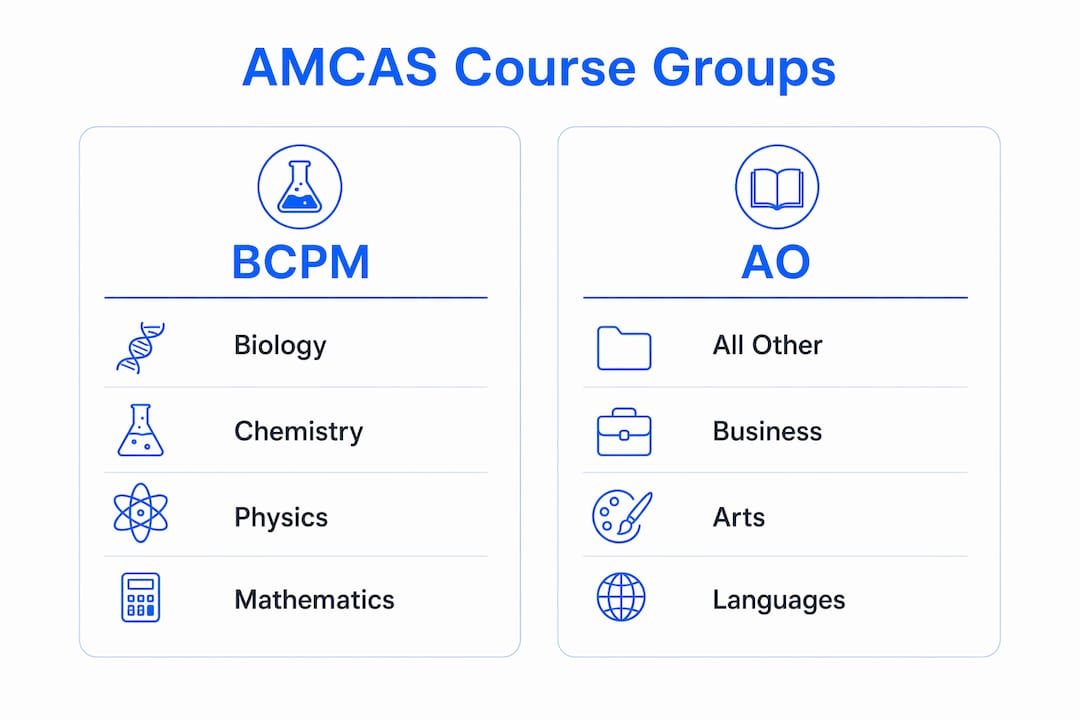
AMCAS splits all coursework into two top-level groups: BCPM (Biology, Chemistry, Physics, Mathematics) and AO (All Other). The distinction matters because BCPM courses feed a separate GPA calculation that medical schools weigh heavily alongside your cumulative GPA. A single misclassified course can shift that number visibly.

What counts as BCPM
BCPM includes four subject areas:
- Biology — cell biology, genetics, microbiology, anatomy, physiology, ecology, and related life-science courses
- Chemistry — general chemistry, organic chemistry, biochemistry, physical chemistry
- Physics — classical mechanics, electromagnetism, optics, modern physics
- Mathematics — calculus, statistics, linear algebra, differential equations
A course earns BCPM status based on what it teaches, not where it lives in the course catalog. An engineering-labeled thermodynamics course built around physics content belongs under Physics, not Engineering. The Course Classification Guide is explicit on this point: departmental labels are administrative and not determinative.
The AO subcategories you will use most
The All Other group contains more than a dozen subcategories. The ones premed students encounter most often:
- Behavioral & Social Sciences (BESS) — psychology, sociology, anthropology, economics
- Computer Science & Technology (COMP) — programming, data structures, software engineering
- Engineering (ENGI) — mechanical, electrical, civil, chemical engineering courses
- English Language and Literature (ENGL) — composition, literature, writing seminars
- Health Sciences (HEAL) — public health, nutrition, clinical skills courses
- Natural & Physical Sciences (NPSC) — environmental science, physical geography, astronomy
A quick note on NPSC: it is a separate classification from BCPM and is not included in the BCPM GPA unless the course’s primary content maps directly to Biology, Chemistry, Physics, or Mathematics. Environmental chemistry, for example, may belong under BCPM Chemistry rather than NPSC depending on the course’s learning objectives.
Other AO subcategories include Business (BUSI), Communications (COMM), Education (EDUC), Fine Arts (ARTS), Foreign Languages (FLAN), Government (GOVT), History (HIST), Philosophy & Religion (PHIL), Special Studies (SSTU), and Other (OTHR) for courses that genuinely fit nowhere else.
Mapping common courses to AMCAS categories:
| Course title | AMCAS classification | Reasoning |
|---|---|---|
| Intro to Cell Biology | Biology (BCPM) | Primary content is cellular life science |
| Engineering Thermodynamics | Physics (BCPM) | Primary content is physics principles |
| Computational Biology | Biology or COMP | Depends on whether coding or biology dominates the syllabus |
| Abnormal Psychology | Behavioral & Social Sciences (AO) | Primary content is psychological science |
| Public Health Epidemiology | Health Sciences (AO) | Population health focus, not basic science |
| Biostatistics | Mathematics (BCPM) | Primary content is mathematical/statistical methods |
What special course types does AMCAS treat differently?
Several course types follow rules that differ from standard letter-graded courses. Entering them incorrectly is one of the fastest ways to trigger a manual review.
| Course type | What to enter | Effect on AMCAS GPA |
|---|---|---|
| Advanced Placement (AP) | Only if your institution granted credit and it appears on your official transcript | Not included in GPA; reported as supplemental hours |
| International Baccalaureate (IB) | Same rule as AP: transcript credit required | Not included in GPA; reported as supplemental hours |
| CLEP | Only if institutional credit appears on transcript | Not included in GPA; reported as supplemental hours |
| Audit (AU) | List it; use the AU course type | No GPA weight |
| Pass/Fail | List it; select Pass/Fail-Pass or Pass/Fail-Fail | Not included in GPA calculations |
| Repeated course | List every attempt separately, exactly as on the transcript | Each attempt is verified; AMCAS records all grades |
| Current/Future (CC) | Enter with CC course type; no grade yet | No GPA weight until grade is posted |
| Deferred/In Progress (DG) | Use DG for multiterm courses with a deferred grade | No GPA weight until complete |
| Military credit | List only if on an official postsecondary transcript | Follows standard rules for that transcript |
| No recorded grade (NR) | Use NR when school error caused no grade to be recorded | No GPA weight |
| Withdrawal (W) | List it; use W course type | No GPA weight |
The rule for AP, IB, and CLEP trips up a lot of applicants. Your AP score alone is not enough. If your college never formally awarded credit, or if that credit does not appear on your official college transcript, do not list it. Listing an AP exam score without institutional credit is an entry error that AMCAS will flag.
A few warning flags worth keeping in mind:
- Pass/Fail courses are reported to medical schools as supplemental hours, not GPA points. Do not enter a P/F course as a letter grade.
- Repeated courses must each appear as a separate line. Institutional grade replacement or forgiveness policies do not change what AMCAS requires; every attempt goes in.
- Current courses should use the CC type with the expected grade left blank. Do not guess or estimate a grade.
How do you decide the correct AMCAS category while filling out coursework?
Follow these steps for every course you enter:
- Open your official transcript. Confirm the exact course title, credit hours, grade, and grading basis (letter vs. pass/fail) as recorded by your institution.
- Open the course description from your college’s current or archived catalog. Read the learning objectives, not just the title.
- Identify the primary content. Ask: if this course were stripped of its department label, what subject would a faculty member say it teaches?
- Match primary content to the AMCAS classification list. Start with BCPM categories. If the content is clearly Biology, Chemistry, Physics, or Mathematics, classify it there. If not, work through the AO subcategories.
- Enter credits, grade, and grading basis exactly as shown on the transcript. Do not round credits or convert a pass/fail to a letter grade.
- Flag interdisciplinary courses. If you are genuinely uncertain between two classifications, note your reasoning in a private document referencing the course description. You may need it if AMCAS reclassifies the course during verification.
Before you hit submit, run through this checklist:
- Every course attempt is listed, including withdrawals and repeats.
- Credit hours match the transcript exactly.
- Grading basis (letter grade vs. pass/fail) matches the transcript.
- AP, IB, and CLEP entries exist only where institutional credit appears on the transcript.
- Special course type codes (AU, CC, DG, W, NR) are applied where applicable.
Pro Tip: Keep a simple spreadsheet with one row per course: course title, AMCAS classification you chose, and a one-line quote from the course description that justifies it. If AMCAS flags a classification change, you can respond to an Academic Change Request with that documentation in minutes rather than scrambling to reconstruct your reasoning.
Use the “Other (OTHR)” classification only as a genuine last resort. Courses like tennis, golf, and aerobics belong there, along with architecture and library science. If a course has any meaningful academic content that maps to a named subcategory, use that subcategory.
What classification mistakes do applicants make most often?
Classifying by department instead of content
This is the single most common error. A physics course cross-listed under Engineering is still Physics for AMCAS purposes. A statistics course offered by a psychology department is still Mathematics if the primary content is statistical methods. The AMCAS Course Classification Guide uses exactly this kind of example to illustrate the rule. Always read the course description before you look at the department name.
Omitting required attempts
Every course attempt must be listed, including courses you withdrew from, courses you failed and retook, and courses your institution later removed from your GPA through a forgiveness policy. AMCAS will see your full transcript during verification. If your entry does not match, the application goes to manual review.
Misreporting credit hours or grading basis
Entering 4.0 credits when the transcript shows 3.5, or entering a letter grade for a course graded pass/fail, are both errors that trigger flags. Copy the numbers and symbols directly from the transcript. Do not rely on memory.
Timing risk from errors
Incorrect or incomplete coursework entries increase the likelihood of manual review, which extends processing time. Medical school admissions operate on a rolling basis, so a delay of even a few weeks can meaningfully reduce your chances at competitive programs.
Run a final review 24–48 hours before submitting. Have your prehealth advisor or a trusted peer look at any unusual classifications, particularly interdisciplinary courses or courses with non-standard grading.
When should you contact AMCAS or your registrar?
Contact your registrar when:
- A transcript has not arrived at AMCAS within the expected window after you requested it.
- A course title on your transcript is ambiguous or abbreviated in a way that makes classification unclear.
- You need an official credit evaluation for transfer credits or foreign coursework.
- A course appears on your transcript without a grade due to a school administrative error.
Contact AMCAS when:
- You discover an entry error after submission that affects your GPA calculation.
- AMCAS flags a classification change during verification and you believe it is incorrect. You will need to submit an Academic Change Request to dispute it. AMCAS will not return the application automatically.
- Your transcript format makes it impossible to clearly map credits or grades to individual courses.
Before reaching out to either party, gather:
- The relevant pages of your official transcript.
- The course description from your college catalog.
- Any prior correspondence about the course or credit.
When you email AMCAS or your registrar, include these items:
- Your full name and AAMC ID (if you have one).
- The course term, course title, and course number.
- A clear, one-sentence description of the discrepancy.
- Attached supporting documents (transcript page, course description, prior correspondence).
Keep your email factual and brief. Registrar offices and AMCAS staff handle high volumes during the application cycle; a clear, well-documented message gets a faster response than a long narrative.
Key Takeaways
Classify every AMCAS course by its primary content, enter every attempt with exact credits and grades from your official transcript, and expect AMCAS verification to standardize your GPA in ways that may differ from your institutional record.
| Point | Details |
|---|---|
| Classify by primary content | Use the course description, not the department name or course code, to assign each classification. |
| BCPM vs. AO distinction | Biology, Chemistry, Physics, and Math courses feed a separate BCPM GPA that medical schools evaluate independently. |
| Enter every attempt | Withdrawals, repeats, and forgiveness-policy removals must all appear exactly as shown on your official transcript. |
| Special types follow strict rules | AP, IB, and CLEP entries belong only when institutional credit appears on your transcript; pass/fail courses are not included in GPA calculations. |
| Medschoolpilot as your tracking tool | Medschoolpilot’s readiness tracker and checklist features help you organize course descriptions, log every attempt, and run a pre-submission review before your AMCAS deadline. |
Why careful classification is worth more attention than most students give it
Most premed students treat the AMCAS Coursework section as a data-entry task. It is not. It is a GPA-defining document that medical schools read alongside your personal statement, and a single misclassified course can shift your BCPM GPA by a tenth of a point or more, depending on the credit weight. At programs where the average accepted BCPM GPA sits above 3.6, that tenth of a point is not a rounding error.
What makes this harder is that AMCAS standardizes GPA conversions to a 4.0 scale, so your AMCAS GPA will often differ from the GPA on your institutional transcript. Students who assume the two numbers will match are frequently surprised during secondary applications, when they have already told programs a number that AMCAS does not confirm. The smarter move is to calculate your AMCAS GPA yourself before you submit, using the classification decisions you have made, so you know what schools will see.
The verification delay risk is real and underappreciated. Rolling admissions means the first complete, verified applications get interview invitations while later ones wait. An application that sits in manual review for two extra weeks in June or July can cost you interviews at programs that filled their early slots. That is not a hypothetical; it is the documented consequence of incomplete or inconsistent coursework entries.
Proactive verification with your prehealth advisor before you submit is the single highest-leverage action most applicants skip. Bring your classification spreadsheet, your transcript, and your course descriptions. An advisor who has reviewed AMCAS applications before will catch the interdisciplinary edge cases you might miss.
Medschoolpilot helps you track coursework entries before you submit
Keeping your transcript, course descriptions, classification notes, and special-type flags organized across dozens of courses is where most applicants lose time and make errors. Medschoolpilot’s readiness tracker gives you a single workspace to log every course attempt, store the course description text you used to justify each classification, and run a pre-submission checklist that mirrors AMCAS requirements.
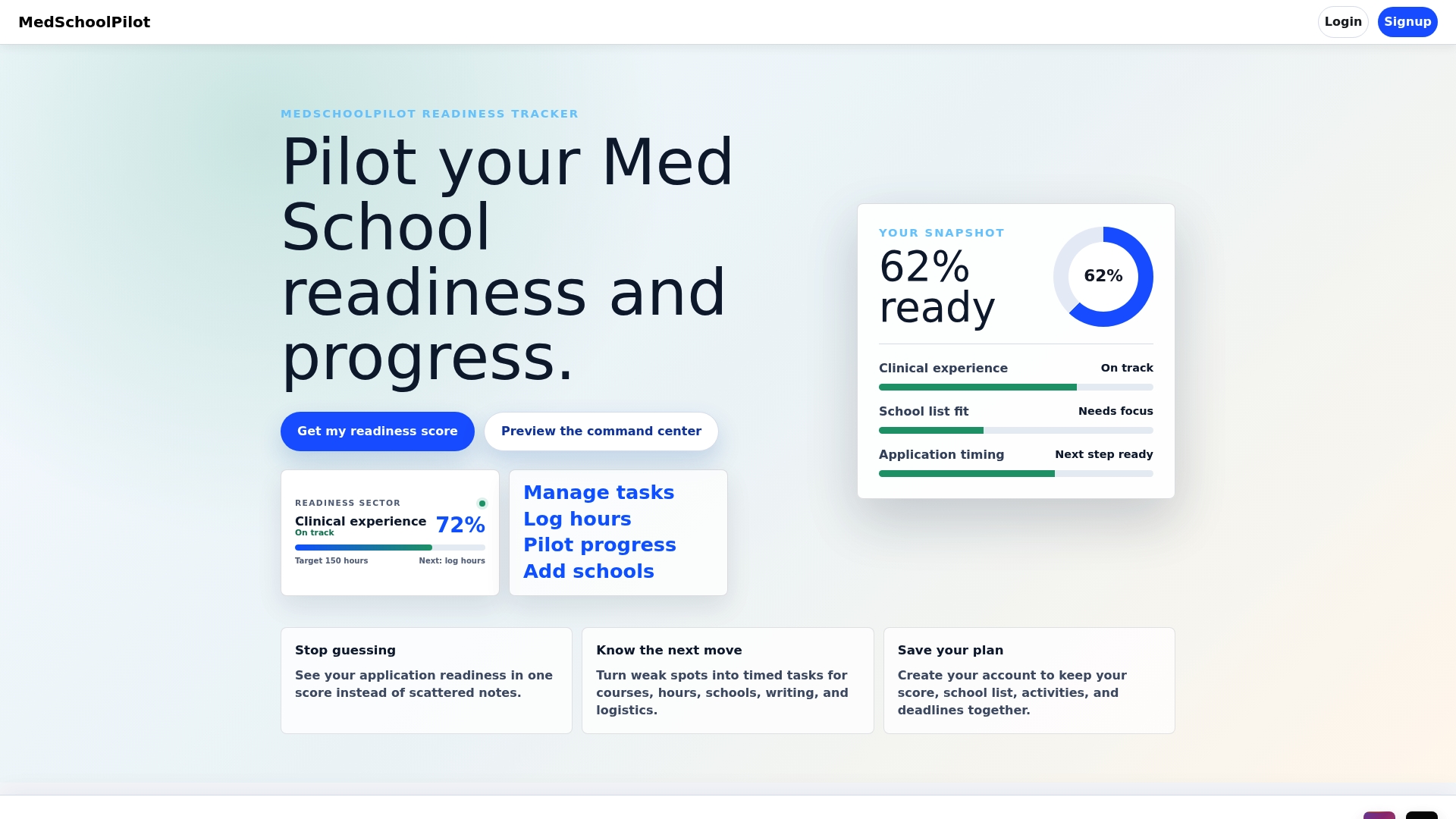
The platform’s milestone tracking is particularly useful for repeat courses and interdisciplinary entries: you can flag each one, attach your rationale, and confirm the entry is complete before the AMCAS deadline hits. Medschoolpilot is a planning and organization tool, not a substitute for AAMC’s official guidance. The AAMC and AMCAS remain the authoritative source for all classification rules, and you should always verify your entries against the official Course Classification Guide.
Ready to organize your coursework entries and track your full application in one place? Start with Medschoolpilot and see how the readiness tracker fits your application timeline.
Authoritative sources for AMCAS classification rules
The AAMC publishes everything you need to classify courses correctly. Bookmark these and keep them open while you work:
- AMCAS Course Classification Guide — the primary reference for matching courses to categories, with subject-area examples. Download the PDF version and keep it open while entering coursework.
- Coursework Details — covers what must be listed, how to handle special course types, and what triggers manual review.
- Verification chapter — explains how AMCAS standardizes GPA and what happens when classifications are changed during verification.
- Grades Included in AMCAS GPAs — lists every course type excluded from GPA calculations, including pass/fail, AP credit, CLEP, audits, and withdrawals.
- AMCAS Applicant Guide — the full application guide covering AP, IB, and other college-level courses taken before postsecondary enrollment.
Save copies of every registrar communication and course description you reference during classification. If AMCAS reclassifies a course and you want to file an Academic Change Request, those documents are your evidence. Printed screenshots of course catalog pages with the term and year visible are particularly useful, since colleges occasionally update descriptions between catalog years.
This article is general informational guidance for premed students. For official rules and your specific situation, always consult the AAMC AMCAS resources directly or speak with a qualified prehealth advisor.