
The AMCAS Work and Activities section gives you up to 15 entries to document the experiences that shaped your path to medicine. Each entry allows 700 characters for your description, and you can designate up to three as Most Meaningful Experiences, which unlock an additional 1,325 characters for deeper reflection. These aren’t just boxes to check. They’re the part of your application where admissions committees actually see who you are beyond your GPA and MCAT score.
Strong AMCAS activities examples do three things well: they use specific, active language to describe what you actually did, they quantify impact wherever possible, and they reflect on what the experience taught you. A vague entry that says “volunteered at a hospital” wastes characters. A strong one names the unit, describes your role, and connects the experience to your understanding of patient care.
Here’s what this guide covers:
- The structure and logistics of the AMCAS Work and Activities section
- All 19 official AMCAS activity categories and how to choose the right one
- How to select which experiences to include when you have more than 15
- How to write descriptions that stand out within tight character limits
- How to choose and write your Most Meaningful Experiences
- 40+ detailed example entries across every major category
- How Medschoolpilot helps you track and organize everything before you apply
The AAMC sets the rules for this section, and understanding them precisely before you start writing saves you from costly revisions later.
Table of Contents
- How the AMCAS Work and Activities section actually works
- What are the 19 AMCAS activity categories?
- How to choose which activities to include
- Writing descriptions that actually get read
- How to choose and write your Most Meaningful Experiences
- 40+ detailed AMCAS activities examples across categories
- How Medschoolpilot helps you track and optimize your AMCAS activities
- Key Takeaways
How the AMCAS Work and Activities section actually works
Every entry in this section requires more than just a description. For each activity, you’ll enter the organization name, your role or position title, the contact name and information for a supervisor, the start and end dates, the total hours completed, and any anticipated hours you expect to log before matriculation. You also select one of the 19 official AMCAS categories and write your narrative description within the character limit.
What the character limits mean in practice
700 characters is roughly 100–130 words. That’s not much. It’s enough for three or four tight sentences if you write efficiently, but it disappears fast if you pad with filler or repeat information already captured in the entry fields. The 1,325 additional characters for Most Meaningful Experiences give you room for a genuine reflection, but that space is earned by choosing the right three experiences, not by writing longer for its own sake.
Completed vs. anticipated hours
AMCAS requires that you separate completed hours from anticipated hours. Anticipated hours cannot extend beyond the year you plan to matriculate. If an activity is brand new and you haven’t logged any hours yet, you must enter zero completed hours and provide valid future start and end dates before the system will accept your anticipated hours input. This trips up a lot of applicants who try to enter anticipated hours on an activity they’ve already started without separating the two figures correctly.
Key fields at a glance
| Field | What to enter | Notes |
|---|---|---|
| Experience type | One of 19 AMCAS categories | Choose the best fit, not the most impressive-sounding |
| Organization name | Full official name | Abbreviations can confuse reviewers |
| Dates | Month and year, start to end | Use “present” only if ongoing at submission |
| Hours completed | Actual logged hours | Do not round up significantly |
| Anticipated hours | Future hours before matriculation | Requires future-dated end date |
| Contact | Supervisor name, title, phone/email | Must be reachable if verified |
| Description | Up to 700 characters | Narrative prose only; no bullet points |
| MME additional space | Up to 1,325 extra characters | For three designated experiences only |
One thing worth knowing: AMCAS strips all formatting from your description fields. Bullet points, bold text, and line breaks you type in may not render the way you expect. Write in narrative prose, and if you want visual separation between ideas, use a simple period and a new sentence rather than relying on formatting.
What are the 19 AMCAS activity categories?
Choosing the right category matters more than most applicants realize. Admissions committees scan these entries quickly, and the category label sets their expectation before they read a single word of your description. Miscategorizing an activity doesn’t disqualify you, but it can create confusion or undersell the experience.
The 19 official categories are:
- Artistic Endeavors: Music, visual art, theater, creative writing, or other sustained artistic pursuits
- Community Service/Volunteer (not medical/clinical): Non-clinical volunteering such as food banks, tutoring programs, or community organizing
- Intercollegiate Athletics: Varsity or competitive collegiate sports
- Leadership (not listed elsewhere): Officer roles, committee leadership, or organizational founding not captured by another category
- Military Service: Active duty, reserves, or ROTC participation
- Other: Experiences that genuinely don’t fit any other category; use sparingly
- Paid Employment (not military): Any job held for compensation, clinical or non-clinical
- Physician Shadowing/Clinical Observation: Time spent observing licensed physicians in clinical settings
- Publications: Peer-reviewed papers, book chapters, or formal published work
- Research/Lab: Wet lab, dry lab, clinical research, public health research, or any formal research role
- Teaching/Tutoring/Teaching Assistant: Formal instruction, tutoring, or TA roles
- Volunteer/Community Service (medical/clinical): Clinical volunteering where you interact with patients, such as hospital volunteering or hospice work
- Extracurricular Activities: Clubs, student organizations, or campus activities not covered elsewhere
- Honors/Awards/Recognitions: Scholarships, dean’s list, competitive awards
- Presentations/Posters: Conference presentations, poster sessions, or public talks
- Conferences Attended: Academic or professional conferences you attended as a participant
- Hobbies: Personal interests pursued outside of academics and formal commitments
Two categories that confuse nearly every applicant: “Volunteer/Community Service (medical/clinical)” versus “Community Service/Volunteer (not medical/clinical).” The dividing line is patient contact. If you were in a clinical environment and interacted directly with patients, even in a non-clinical support role, the medical/clinical category usually fits better. If you were volunteering at a food pantry or building homes, that’s non-clinical regardless of whether the organization has any health mission.
A few practical notes on category selection:
- If you held a paid position in a clinical setting, use “Paid Employment” rather than clinical volunteering, even if the work was patient-facing.
- Research with a faculty mentor goes under “Research/Lab,” not “Extracurricular Activities,” even if it was unpaid.
- A teaching assistantship is “Teaching/Tutoring/Teaching Assistant,” not “Leadership,” even if you had some supervisory responsibility.
- Use “Other” only when nothing else genuinely fits. Overusing it signals poor self-awareness about your own experiences.
How to choose which activities to include
You have 15 slots. Most applicants who’ve been building their application for two or three years have more than 15 experiences worth listing. The question isn’t what to include. It’s what to cut.
Admissions committees consistently prefer fewer, deeper experiences over a long list of shallow ones. An activity you did for three years and grew within tells a more compelling story than five one-time events. When you’re deciding what makes the cut, run each experience through these criteria:
- Clinical exposure: Do you have at least one strong clinical volunteering entry and one shadowing entry? These are near-universal expectations.
- Research: If you’ve done any formal research, it belongs. Even a single semester in a lab is worth including if you can describe your contribution specifically.
- Leadership: Include roles where you held real responsibility, not just membership.
- Community involvement: Non-clinical service shows you care about people beyond the hospital setting.
- Personal growth: Activities that changed how you think about medicine, people, or yourself deserve a slot even if they don’t look impressive on paper.
- Uniqueness: Something that no other applicant in the pool is likely to have done can differentiate you, even if it’s a hobby or an unusual job.
Pro Tip: If you have two closely related experiences at the same organization, consider combining them into one entry. For example, if you volunteered in the ER and also helped with patient transport at the same hospital, one well-written entry covering both roles uses one slot instead of two and still captures the full picture.
When you’re deciding between two similarly strong activities, ask which one you could write about more specifically. The experience you remember in vivid detail will produce a better description than the one you’d have to reconstruct from memory.
For anticipated activities, include them if you have a genuine commitment in place and can provide accurate hours. Don’t pad your list with speculative future plans. If the activity falls through before you matriculate, you can’t update your submitted application.
Writing descriptions that actually get read
The single biggest mistake in AMCAS activity descriptions is writing a job description instead of a personal account. “Assisted nurses with patient care tasks” tells an admissions reader almost nothing. “Provided bedside support to post-surgical patients, coordinating with nursing staff to communicate patient concerns and reduce call-light response times” tells them what you did, how you did it, and hints at your situational awareness.
A structure that works consistently: open with the setting and your role, describe the specific actions you took, quantify the impact where you can, and close with a brief reflection or insight. You won’t always fit all four in 700 characters, but aiming for that arc keeps your writing purposeful.
Writing practices that separate strong entries from forgettable ones:
- Lead with an active verb. “Conducted,” “coordinated,” “designed,” “trained,” “analyzed” all signal agency. “Was responsible for” does not.
- Be specific about numbers. Hours per week, number of patients seen, size of the team you led, number of students tutored. Specificity is credibility.
- Avoid restating the category. If you’ve selected “Research/Lab,” don’t open with “I participated in a research lab.” Use those characters for substance.
- Skip the mission statement. You don’t need to explain what the organization does. Describe what you did within it.
- Reflect briefly. One sentence connecting the experience to your understanding of medicine or your development as a future physician adds dimension without taking much space.
Pro Tip: Draft your descriptions at 900–1,000 characters, then cut to 700. Editing down forces you to keep only what matters, and the result is almost always sharper than writing to the limit from scratch.
AMCAS strips all formatting from description fields, so write in clean narrative prose. If you want to signal a transition between ideas, use a period and a new sentence. Some applicants use a slash or a simple dash to separate distinct responsibilities within one entry, but keep it minimal.

Here’s the contrast in practice:
Weak: “Volunteered at a free clinic helping with patient intake and administrative tasks.”
Strong: “Staffed intake at a student-run free clinic serving uninsured patients, conducting initial screenings for 8–12 patients per shift. Coordinated interpreter services for Spanish-speaking patients and flagged urgent cases for physician review. Learned firsthand how systemic gaps in insurance coverage shape the care patients seek and delay.”
Same experience. The second version uses about 100 more characters but earns every one of them.
How to choose and write your Most Meaningful Experiences
Three of your 15 entries can be designated as Most Meaningful Experiences. This designation unlocks an additional 1,325 characters per entry, giving you space to go deeper than a standard description allows. Most applicants treat this as a chance to write more. The better approach is to write differently.
Your standard description covers what you did. The MME space is for why it mattered and what it changed in you. AMCAS guidance is explicit: focus on lessons learned, how the experience influenced your career goals, and personal growth rather than a longer list of duties.
Choosing the right three
Most applicants default to their most time-intensive activities. That’s not always wrong, but hours alone don’t make an experience meaningful. Choose entries where you can honestly answer: “This changed how I think about medicine, about patients, or about myself.” If you can’t write a genuine answer to that question, the experience probably isn’t your strongest MME candidate, regardless of how many hours you logged.
Aim for variety across your three MMEs:
- One clinical experience that shows you understand what patient care actually involves
- One research or intellectual experience that demonstrates curiosity and analytical thinking
- One personal or community experience that reveals your values and your connection to the people medicine serves
Pro Tip: Write your MME reflection before your standard description, not after. Starting with the deeper reflection clarifies what the experience actually meant to you, which then makes the 700-character description sharper and more intentional.
Effective MME writing focuses on a specific moment or turning point rather than summarizing the entire experience. A single patient interaction, a failed experiment, a conversation with a mentor. Concrete moments carry more weight than general statements about growth.
What to emphasize in your MME reflection:
- A specific challenge you faced and how you responded
- A moment that shifted your perspective on medicine, illness, or patient experience
- A skill or insight you developed that you couldn’t have gained elsewhere
- How this experience connects to the kind of physician you intend to become
What to avoid: restating your standard description in longer form, listing additional duties, or writing generic statements like “this experience confirmed my passion for medicine.” Every applicant in the pool can write that sentence. The ones who stand out write the specific thing that happened and what it actually taught them.
40+ detailed AMCAS activities examples across categories
The examples below are organized by category. Each one demonstrates a different writing approach: some lead with impact, some open with setting, some close with reflection. Read them for structure and language, not as templates to copy word-for-word.
Clinical volunteering examples
Example 1 (Emergency Department Volunteer) “Triaged patient flow in a Level I trauma ED, directing non-emergent patients to appropriate waiting areas and communicating wait time updates to reduce anxiety during high-volume shifts. Assisted nursing staff with supply restocking and patient transport for 6 hours weekly over 18 months. Witnessing the coordination required during a multi-vehicle trauma reshaped my understanding of medicine as a team discipline.”
Example 2 (Hospice Volunteer) “Provided companionship visits to terminally ill patients at a residential hospice, sitting with patients during meals and reading aloud when requested. Supported family members in waiting areas during difficult hours. This role taught me that presence is a clinical skill, and that listening without an agenda is something physicians must practice deliberately.”
Example 3 (Student-Run Free Clinic) “Conducted intake screenings and vital signs for uninsured patients at a weekly student-run clinic. Coordinated Spanish-language interpretation for approximately 30% of patients seen. Observed how delayed care compounds into more complex presentations, reinforcing my commitment to primary care in underserved communities.”
Research examples
Example 4 (Wet Lab Research) “Investigated the role of CRISPR-Cas9 gene editing in correcting a frameshift mutation associated with Duchenne muscular dystrophy under Dr. [Mentor]'s supervision. Performed Western blots, cell culture maintenance, and data analysis over two academic years. Co-authored a poster presented at the university’s annual research symposium.”
Example 5 (Clinical Research Coordinator) “Recruited and consented participants for a Phase II clinical trial examining a novel anticoagulant in atrial fibrillation patients. Maintained IRB compliance documentation and entered data into REDCap for 140+ enrolled subjects. Learned how regulatory frameworks protect patient autonomy and how protocol deviations are managed in real-time.”
Example 6 (Public Health Research) “Analyzed county-level vaccination rate disparities using CDC surveillance data as part of a faculty-mentored public health project. Built regression models in R to identify socioeconomic predictors of vaccine hesitancy. Findings contributed to a grant proposal submitted to the state health department.”
Physician shadowing examples
Example 7 (Internal Medicine) “Shadowed a general internist in an outpatient clinic over 80 hours, observing patient interviews, physical exams, and care plan discussions. Noted how the physician adapted communication style for patients with varying health literacy. These observations directly informed how I approach patient-centered communication in my own volunteer roles.”
Example 8 (Surgery) “Observed 12 laparoscopic cholecystectomy procedures and two open abdominal surgeries over a 6-week surgical rotation. Attended pre-operative briefings and post-operative debriefs. The precision required in the OR and the immediate feedback loop between action and outcome drew me toward procedural medicine.”
Example 9 (Psychiatry) “Shadowed a child and adolescent psychiatrist in both inpatient and outpatient settings, observing diagnostic interviews and medication management discussions with families. Observed how stigma shapes the way families describe symptoms and how the physician reframed conversations to reduce shame.”
Leadership examples
Example 10 (Pre-Med Club President) “Led a 200-member pre-medical society, overseeing a 12-person executive board and managing a $15,000 annual budget. Launched a peer mentorship program pairing 40 first-year students with upperclassmen, reducing reported application anxiety among participants. Coordinated 20+ events per year including physician panels and MCAT prep workshops.”
Example 11 (Community Health Initiative Founder) “Founded a campus initiative providing free blood pressure screenings at local barbershops in partnership with the county health department. Recruited and trained 15 student volunteers, screened 300+ community members over two years, and referred 18% of participants to primary care follow-up. Learned how trust-building precedes health behavior change.”
Teaching and tutoring examples
Example 12 (Organic Chemistry TA) “Facilitated weekly discussion sections for 25 students in Organic Chemistry II, holding additional office hours during exam periods. Developed supplemental problem sets targeting common conceptual errors identified from midterm data. Student evaluations rated my sections 4.7/5.0 on average.”
Example 13 (MCAT Tutor) “Provided one-on-one MCAT tutoring to 8 students over two application cycles, focusing on CARS and Biochemistry sections. Three students improved their scores by 6+ points. Tutoring reinforced my own content mastery while developing my ability to explain complex concepts at varying levels of prior knowledge.”
Paid employment examples
Example 14 (Medical Scribe) “Documented physician-patient encounters in real time across emergency medicine and urgent care settings, producing accurate medical records for 20–30 patients per shift. Developed fluency in medical terminology and clinical reasoning by observing diagnostic workups from intake through disposition. Scribing accelerated my understanding of how physicians think.”
Example 15 (Certified Nursing Assistant) “Provided direct patient care as a CNA in a 120-bed skilled nursing facility, assisting with ADLs, vital signs, and mobility support for 8–10 residents per shift. Navigated end-of-life care conversations with families alongside nursing staff. This role gave me more sustained patient contact than any volunteer position I’ve held.”
Example 16 (Medical Assistant) “Worked as a medical assistant in a family medicine practice, rooming patients, recording chief complaints, administering injections, and processing lab orders. Managed patient flow for a physician seeing 25+ patients daily. Learned the operational realities of primary care that shadowing alone doesn’t reveal.”
Extracurricular and hobby examples
Example 17 (Competitive Debate) “Competed in parliamentary debate for three years, reaching national quarterfinals in my junior year. Debate sharpened my ability to construct evidence-based arguments under time pressure, a skill I apply directly when synthesizing clinical information and communicating with patients.”
Example 18 (Marathon Running) “Trained for and completed three marathons while maintaining a full course load, logging 40–50 miles per week during peak training. Running taught me how to manage physical discomfort, set incremental goals, and recover from setbacks. I draw on that discipline when managing the demands of a pre-medical curriculum.”
Example 19 (Photography) “Documented community events and patient stories for a nonprofit health organization’s annual report and social media presence. Photography trained my eye for detail and composition, and working with patients in vulnerable moments taught me how to create trust quickly in unfamiliar environments.”
Honors and awards examples
Example 20 (Goldwater Scholarship) “Received the Barry Goldwater Scholarship in recognition of research potential in the natural sciences. Selected from a competitive institutional pool based on research accomplishments, faculty recommendations, and a research essay. Award supported continued work in the neuroscience laboratory.”
Example 21 (Dean’s List) “Maintained Dean’s List standing for six consecutive semesters while working 20 hours per week as a medical scribe and serving as pre-med club president. Consistent academic performance alongside significant extracurricular commitments reflects my capacity to manage competing demands.”
MME example entries
MME Example 1 (Hospice Volunteer, extended reflection) Standard description: “Provided weekly companionship visits to terminally ill patients at a residential hospice over 14 months. Supported family members during difficult hours and assisted with meal service.”
MME reflection: “One patient, a retired schoolteacher, spent our last three visits telling me about her classroom. She wasn’t confused. She was choosing what to hold onto. That distinction hit me harder than any lecture on palliative care. I had assumed my role was to comfort her. She was teaching me something about what people need at the end of life: not reassurance, but witness. I carry that into every patient interaction now. I listen for what someone is actually saying, not just what I think they need to hear. This experience is the clearest reason I want to practice medicine with a palliative lens, regardless of specialty.”
MME Example 2 (Research, extended reflection) Standard description: “Investigated CRISPR-Cas9 applications in Duchenne muscular dystrophy correction over two years. Performed Western blots, cell culture, and data analysis. Co-authored a conference poster.”
MME reflection: “Six months into the project, our primary assay stopped working. We spent eight weeks troubleshooting before identifying a contaminated reagent batch. That period was the most valuable of my research training. I learned that science is mostly failure managed systematically, and that the ability to stay methodical when results don’t cooperate is what separates productive researchers from frustrated ones. I also learned to read primary literature differently: not as a record of success, but as a curated version of a much messier process. That skepticism now shapes how I evaluate research critically, which I consider one of the most transferable skills I’ll bring to clinical practice.”
Summary of example entries by category
| Category | Example entries | Typical hours range | Key writing focus |
|---|---|---|---|
| Clinical Volunteering | ED, hospice, free clinic | 100–300+ | Patient interaction, team dynamics |
| Research | Wet lab, clinical trial, public health | 200+ | Methods, contribution, outcomes |
| Physician Shadowing | Internal medicine, surgery, psychiatry | 40+ | Observation, clinical reasoning |
| Leadership | Club president, initiative founder | Varies | Scope, outcomes, team management |
| Teaching/Tutoring | TA, MCAT tutor | 50–200 | Student outcomes, skill development |
| Paid Employment | Scribe, CNA, medical assistant | 500+ | Sustained exposure, clinical skills |
| Extracurriculars/Hobbies | Debate, running, photography | Varies | Transferable skills, character |
| Honors/Awards | Goldwater, Dean’s List | N/A | Context, significance, effort |
How Medschoolpilot helps you track and optimize your AMCAS activities
Most applicants write their AMCAS activity descriptions from memory, often months or years after the experiences happened. The details that make descriptions specific, the patient interaction that shifted your thinking, the exact number of students you tutored, the week you took on additional responsibility, fade faster than you expect. Tracking experiences as they occur and recording reflections in real time produces dramatically better descriptions than reconstructing events at application time.
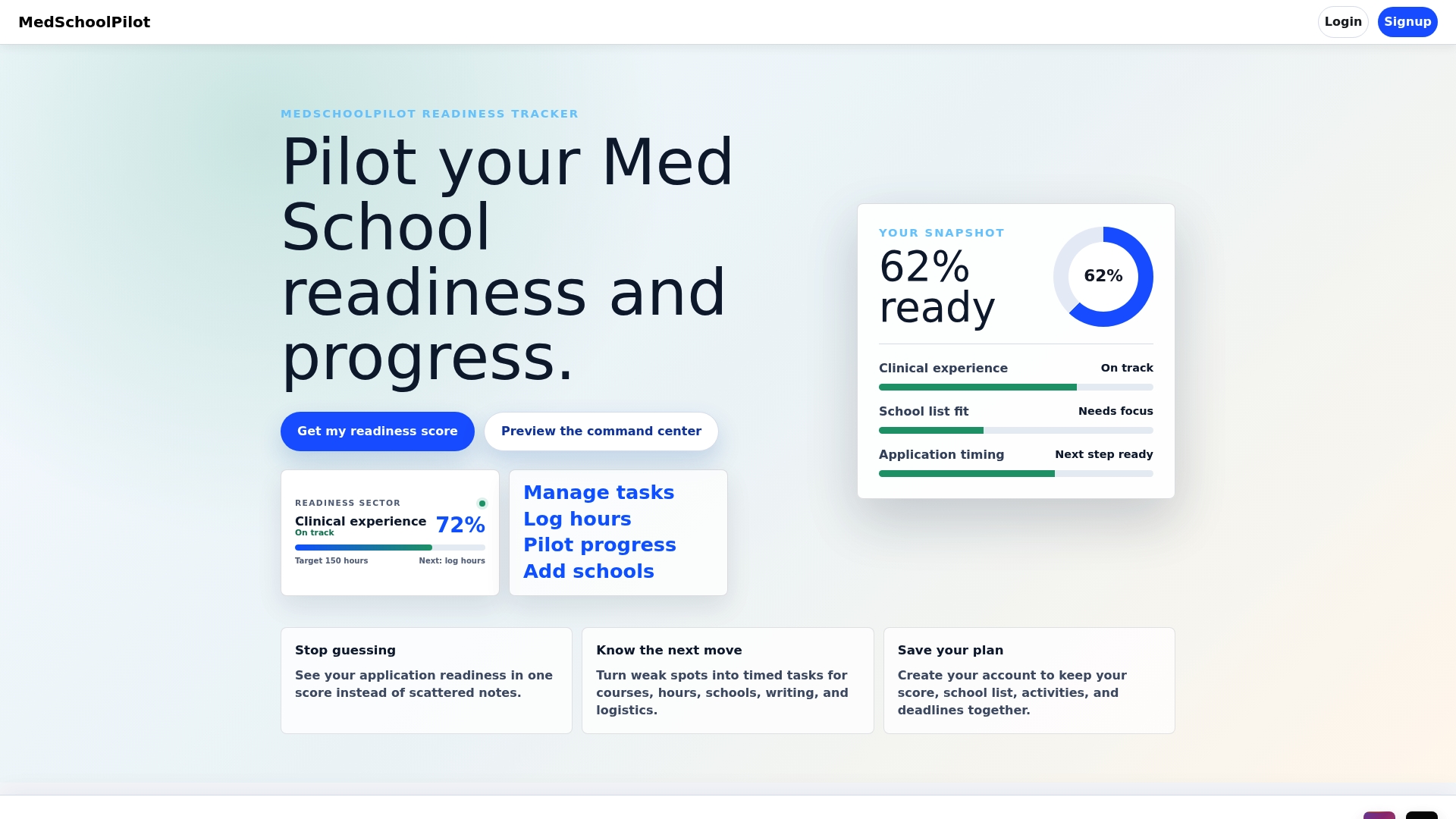
Medschoolpilot is built for exactly this problem. The platform lets you log clinical, research, and volunteering hours as you accumulate them, with fields for dates, organization details, and notes that map directly to what AMCAS will ask for later. When you sit down to write your descriptions, you’re working from a complete record rather than a best guess.
Key advantages of using Medschoolpilot throughout your pre-medical years:
- Hour tracking by category: Log hours under the same categories AMCAS uses, so your totals are already organized when you apply.
- Milestone monitoring: Set targets for clinical hours, research hours, and shadowing, and track your progress toward them in real time.
- Readiness scoring: The platform’s scoring system shows you where your application is strong and where gaps remain, so you can address them before the cycle opens.
- Reflection capture: Add notes after each shift or session while the details are fresh. Those notes become the raw material for your descriptions.
- School list integration: See how your activity profile compares to the expectations of schools on your list, so you can prioritize the right experiences.
Pro Tip: After every significant clinical shift or research session, spend five minutes writing a brief note in Medschoolpilot: what happened, what you observed, what you felt. These micro-reflections are worth more than any amount of brainstorming at application time.
The applicants who write the strongest AMCAS descriptions aren’t necessarily the ones with the most impressive experiences. They’re the ones who paid attention while they were having those experiences and recorded enough detail to write about them specifically. Medschoolpilot gives you the structure to do that consistently, from your first clinical hour through submission day.

Start tracking your application readiness now, before the cycle opens, so your activity log is already complete when you need it.
Key Takeaways
Strong AMCAS activity descriptions combine specific action-oriented language, quantified impact, and brief reflection to show admissions committees who you are beyond your transcript.
| Point | Details |
|---|---|
| Character limits are tight | Each entry allows 700 characters; Most Meaningful Experiences add 1,325 characters for deeper reflection. |
| Depth beats breadth | Admissions committees prefer sustained, meaningful commitments over a long list of short-term activities. |
| Category selection matters | Choosing the wrong AMCAS category can undersell an experience before a reader reaches your description. |
| MMEs require real reflection | Focus MME space on lessons learned and how the experience shaped your path, not on listing more duties. |
| Track experiences in real time | Recording hours and reflections as they happen with a tool like Medschoolpilot produces far stronger descriptions than writing from memory. |